
With Singapore’s humidity hitting 78% this May 19, 2026, your luxury flooring is currently absorbing moisture that can trap microscopic allergens and bacteria. For many homeowners, the urgent question is how to clean silk carpet? without causing the fibers to swell or the delicate dyes to bleed. Silk is a protein-based material that requires a scientific approach to hygiene, as standard cleaning chemicals can strip away the natural sheen that gives these rugs their value.
It’s natural to worry that a simple spill might lead to permanent watermarks or a lingering musty scent in your living room. You deserve a home environment that’s both visually stunning and biologically safe for your family. This guide promises to demystify silk maintenance, offering a clear path to restoring luster and eliminating deep-seated dust. We’ll cover safe DIY spot treatments using pH-balanced solutions and explain when the precision of a specialized professional is necessary to ensure a truly sanitized home environment.
Key Takeaways
- Learn why silk carpets require a low-moisture, pH-neutral restoration process to protect their delicate protein-based fibers from structural damage.
- Discover the precise steps on how to clean silk carpet at home using a brushless suction head to remove particulates without fraying the pile.
- Understand the link between Singapore’s high humidity and “Musty Rug Syndrome,” which creates a breeding ground for hidden fungal growth.
- Identify the risks of using generic alkaline shampoos that cause irreversible “chemical burns” and permanent yellowing on fine silk materials.
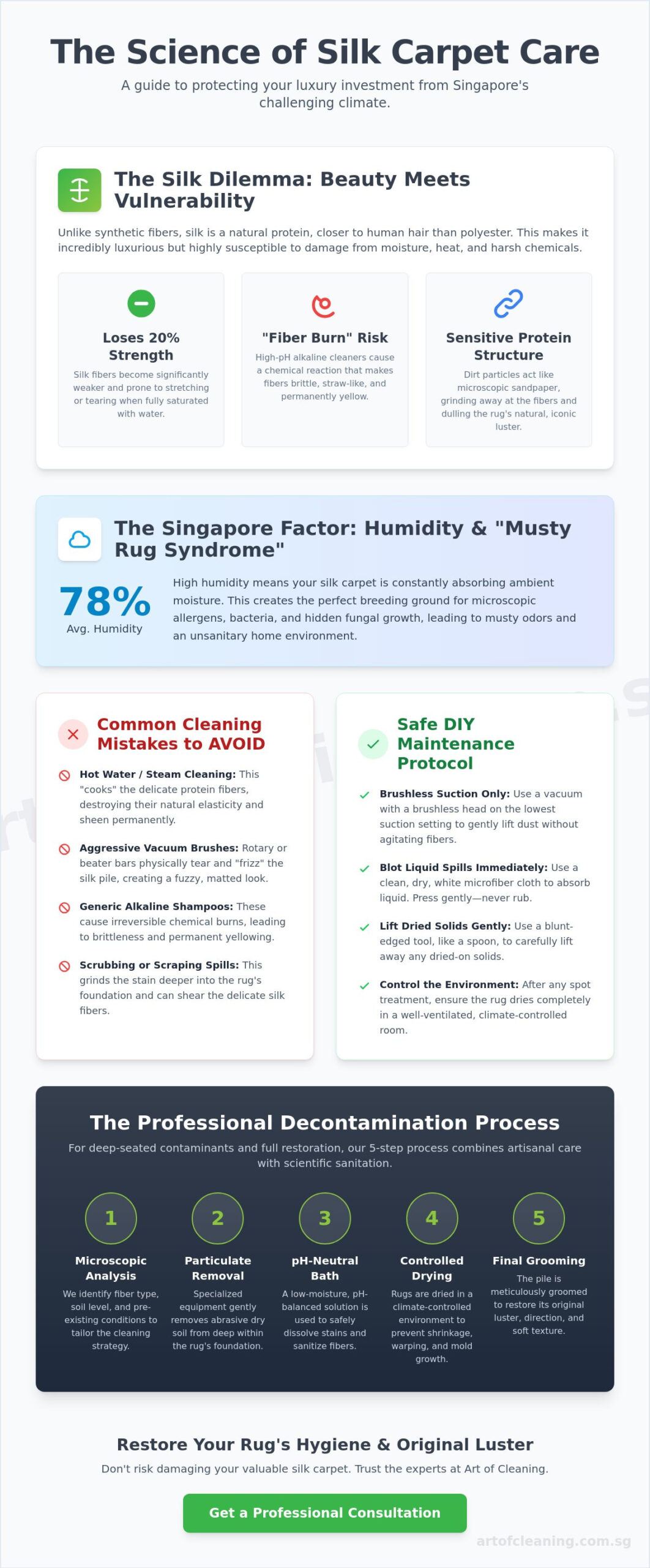
- Explore the specialized 5-step decontamination process that combines artisanal care with scientific sanitation to restore your rug’s hygiene and original luster.
Understanding Silk Fiber Science: Why Silk Carpets Require Specialized Care
Silk rugs represent a significant investment in both home aesthetics and indoor hygiene. Unlike synthetic fibers, silk requires a low-moisture, pH-neutral restoration process to maintain its structural integrity and health-safe properties. When homeowners ask how to clean silk carpet?, they are often surprised to learn that silk is closer in composition to human hair than to plastic-based polyester. It’s a delicate protein-based material consisting primarily of fibroin and sericin. These proteins give the rug its signature feel but also make it susceptible to damage from common household cleaning agents.
Understanding silk fiber science is the first step in effective preservation. The primary protein, fibroin, provides that iconic shimmer, yet it’s highly sensitive to environmental stressors. Dirt particles are more than just an eyesore; they act as microscopic abrasives that saw away at these fine threads every time you step on the rug. This physical degradation eventually kills the “luster factor,” leaving the rug looking dull and lifeless. More dangerously, data from textile experts shows that silk can lose up to 20% of its tensile strength when fully saturated with water. This vulnerability makes traditional “soak and scrub” methods a recipe for permanent structural failure.
The Molecular Vulnerability of Silk
Exposure to high-heat or high-pH alkaline cleaners causes what professionals call “fiber burn.” This is a chemical reaction that permanently alters the protein structure, making the pile feel brittle or straw-like. It’s also vital to distinguish between genuine silk and “art silk” like rayon or viscose. Art silk is essentially processed wood pulp; it lacks the natural resilience of real silk and often collapses or yellows upon contact with moisture. Improper tension during the drying phase also poses a threat. If a wet silk rug isn’t dried under controlled conditions, the fibers shrink unevenly, leading to permanent warping.
Why Standard Carpet Cleaning Methods Fail
Most domestic carpet cleaning machines rely on steam or hot water extraction. While effective for synthetic office carpets, these high temperatures denature silk proteins, essentially “cooking” the fibers and destroying their natural elasticity. Additionally, the rotary brushes found on standard vacuum cleaners are too aggressive. They physically tear the surface of the threads, a phenomenon known as “frizzing,” which creates a fuzzy, matted appearance. Dyes are another concern. Silk dyes are often organic and lack the chemical stabilizers found in synthetics. Without a stabilized approach, colors can bleed and migrate, ruining the intricate patterns of the rug. Knowing how to clean silk carpet? requires moving away from these aggressive mechanical methods toward a more artisanal, scientific approach.
Safe DIY Maintenance: How to Clean Silk Carpets Without Damaging the Pile
Maintaining the sanitary condition of a high-value rug requires a disciplined, “gentle-only” protocol. Because silk fibers are so physically vulnerable when wet, your home maintenance strategy should focus on dry soil removal and immediate, non-aggressive response to spills. When considering how to clean silk carpet? at home, the goal isn’t deep saturation. Instead, it’s about managing surface particulates before they migrate deep into the foundation of the rug. This proactive approach prevents the soil-grinding effect that prematurely ages fine textiles.
A reliable DIY maintenance routine follows four critical steps. First, use a brushless suction head to lift dust without agitating the fibers. Second, if you encounter dried solids, lift them away using a blunt-edged tool like a spoon; never scrape, as this shears the silk proteins. Third, manage liquid spills by blotting with a clean, white microfiber cloth to prevent dye transfer. Finally, ensure the rug dries in a climate-controlled room. For those with significant soil buildup, seeking professional rug cleaning is the safest way to ensure deep-seated contaminants are removed without risking the rug’s structural health.
The Correct Way to Vacuum Silk
Standard vacuum cleaners often cause more harm than good. You must disable the beater bar or power brush entirely; these rotating components pull and “frizz” the delicate silk pile. Use the lowest suction setting available to prevent the vacuum from “grabbing” the rug, which can stretch the hand-knotted foundation. Weekly vacuuming is essential in Singapore’s environment. Removing dust every seven days prevents grit from acting like sandpaper on the fibroin threads, preserving the rug’s signature luster for years longer.
Emergency Spot Cleaning Protocol
The “Blot, Don’t Rub” rule is the most important directive for silk care. Rubbing a stain pushes the liquid deeper into the core and causes permanent pile distortion. For safe spot treatment, use a 50/50 mix of white vinegar and distilled water. This slightly acidic solution respects the rug’s pH balance and helps stabilize dyes. Always test this on a hidden corner first to check for colorfastness. Effective textile conservation care also involves protecting the rug from environmental triggers. Avoid direct UV rays during the drying process, as sunlight can cause rapid fading and weaken the protein bonds. In a humid climate like ours, using a dehumidifier during the drying phase is a scientific necessity to prevent musty odors from developing in the damp fibers.
The Impact of Singapore’s Humidity on Silk Rug Hygiene and Longevity
Singapore’s tropical climate presents a unique set of challenges for luxury textiles. With average humidity levels hovering around 84%, silk rugs act like sponges, absorbing ambient moisture directly into their protein core. This constant saturation creates a high-risk environment for “Musty Rug Syndrome,” where trapped dampness leads to the rapid proliferation of fungal colonies within the foundation. When you research how to clean silk carpet?, you must consider that the goal isn’t just removing visible dirt. It’s about managing the invisible biological load that thrives in our humid air, which was recorded at approximately 78% on May 19, 2026.
High moisture levels combined with the organic proteins in silk provide a perfect nutrient source for mold spores. If you detect a “sour” or earthy scent coming from your rug, it’s often a sign that fungal growth has already taken root. Preventing this requires strict climate control. Running a dehumidifier to maintain indoor levels below 60% is a critical investment in your rug’s longevity. Without these measures, the moisture weakens the fibroin bonds, leading to a permanent loss of structural integrity and a dulling of the rug’s natural sheen.
Humidity and the Risk of Mold and Mildew
Silk’s organic nature makes it a primary food source for mold. Unlike synthetic fibers, silk can be digested by certain fungi if left in damp conditions for too long. Identifying the warning signs early is essential. Look for darkening of the pile or a stiff texture that doesn’t resolve with standard vacuuming. These are indicators that moisture has compromised the rug’s internal hygiene, necessitating a professional intervention to halt the decay before the fibers become brittle and break.
Allergen Management in Fine Fibers
The tight, intricate weave of high-quality silk is remarkably effective at trapping microscopic contaminants. While this keeps dust off your hard floors, it turns the rug into a reservoir for allergens and pathogens. This has a direct impact on your indoor air quality. For families, the concern often centers on dust mite bites and respiratory triggers that hide deep within the fine pile. Standard home cleaning rarely reaches the base of these dense weaves, allowing colonies to grow undisturbed.
This is why understanding how to clean silk carpet? involves more than surface-level care. Professional-grade extraction methods are designed to penetrate the full depth of the pile without damaging the delicate fibers. These specialized processes can remove up to 99% of hidden contaminants, including dust mite excrement, pollen, and bacteria. By prioritizing deep sanitation, you aren’t just cleaning a decorative item; you’re actively protecting the health of your home environment and ensuring your living space remains a sanctuary of hygiene.
Removing Stubborn Stains and Odours: When Home Remedies Risk Damage
When homeowners search for how to clean silk carpet?, they often find generic advice that suggests using standard store-bought shampoos. This is a dangerous misconception. Most commercial detergents are formulated for synthetic fibers like nylon or polyester, which can withstand high alkalinity. Silk, however, is a protein fiber. Applying a high-pH cleaner triggers a “Chemical Burn,” a process where the alkaline solution aggressively breaks down the silk proteins. This results in irreversible yellowing or browning that no amount of subsequent cleaning can fix. Protecting your investment means acknowledging that silk doesn’t react to chemicals the way other textiles do.
Another common frustration in DIY cleaning is the phenomenon of “wicking.” You might successfully blot a surface stain, only to find it reappearing 24 hours later. This happens because liquid travels deep into the rug’s foundation. As the rug dries, the moisture moves back up the fibers through capillary action, bringing the dissolved soil with it. Professional extraction is the only way to remove the source of the stain from the backing. Considering a high-quality silk rug can cost thousands of dollars, the price of professional maintenance is a small fraction of the replacement cost. If your rug has suffered a major spill, booking a professional rug cleaning service is the only way to ensure the stain is removed without compromising the fiber.
The Danger of Store-Bought Detergents
Commercial soaps often contain optical brighteners. These chemicals are designed to reflect light to make a rug look “cleaner,” but they strip away the natural sericin coating of silk. This kills the rug’s organic shimmer. Additionally, DIY methods frequently leave behind a “Residue Trap.” Soap is difficult to rinse out of dense silk weaves without professional equipment. Any leftover soap acts like a magnet for dust and oils, causing the rug to get dirty twice as fast as before. For protein fibers, pH-balanced solutions are non-negotiable for safety.
When to Call a Professional Specialist
Knowing when to stop is a hallmark of a responsible homeowner. Follow the “3-Blot Rule”: if a stain doesn’t show significant transfer to your white cloth after three gentle blots, stop immediately. Continued pressure will only distort the pile. Protein-based stains, such as pet accidents or food spills, are particularly complex because they require enzyme-safe care that won’t “digest” the silk itself. This is why professional carpet cleaning singapore is necessary for odours. Specialists use molecular neutralizers rather than perfumes, ensuring your home remains a healthy, scent-free environment for your family.
Professional Decontamination: The Art of Cleaning Approach to Silk Restoration
When the risks of DIY maintenance outweigh the benefits, a scientific intervention becomes necessary to preserve your textile investment. At Art of Cleaning, we treat every rug as a biological and structural system that requires artisanal precision. Our methodology moves beyond surface aesthetics to achieve deep-tissue sanitation. When clients ask how to clean silk carpet? for the long term, the answer lies in our signature 5-step restoration process. This system is designed to eliminate 99.9% of bacteria and allergens while restoring the natural luster that chemical-heavy home methods often destroy.
The process begins with a forensic inspection to identify fiber density and dye stability. Following this, we perform a mechanical dusting phase to remove the abrasive grit that Section 1 identified as a primary threat to silk proteins. The core of our service is a specialized, pH-neutral wash followed by a controlled rinse and artisanal grooming. By using HEPA-filtration and medical-grade disinfection, we ensure that your rug isn’t just visually bright but is also a foundation for a healthy living space. This level of care provides a definitive answer to the question of how to clean silk carpet? without risking the structural integrity of the hand-knotted base.
Advanced Soil Extraction Technology
Standard machines rely on high-pressure water that can cause the 20% strength loss discussed earlier in this guide. Our approach utilizes specialized air-washing technology to vibrate deep-seated grit out of the pile without the need for aggressive saturation. Once the contaminants are removed, the rug enters a climate-controlled drying chamber. This environment is strictly regulated to prevent the uneven tension and shrinkage that occurs in Singapore’s natural 84% humidity. The result is a residue-free finish that contributes to a healthier home environment for your family, free from the sticky soaps that attract future soil.
The Art of Cleaning Difference
Our commitment to hygiene is backed by high-impact data and a reputation for excellence. We don’t just “freshen” a rug; we decontaminate it. This meticulous attention to detail is why our services have been featured on major national media platforms, confirming our status as Singapore’s trusted specialists in delicate textile care. We understand that your silk rug is a centerpiece of your home’s well-being. Don’t leave its survival to chance or generic detergents that cause permanent fiber burn. Secure your professional silk rug consultation today and experience the intersection of artisanal craft and modern sanitation science.
Secure the Longevity of Your Fine Textiles
Mastering the delicate science of silk care is essential for both the visual beauty of your rug and the biological safety of your home. We’ve explored how the intersection of protein fiber science and Singapore’s high humidity necessitates a meticulous approach to hygiene. While routine maintenance like brushless vacuuming helps, the question of how to clean silk carpet? ultimately requires a solution that addresses deep-seated grit and allergens without triggering permanent fiber burn or structural warping.
As specialized protein fiber care experts, Art of Cleaning provides a level of precision that goes beyond standard services. Our methodology achieves 99.9% bacteria and allergen removal, ensuring your family breathes easier in a sanitized environment. Having been featured on MediaCorp and Channel 8, our reputation for artisanal restoration is verified by the highest local standards. Don’t let moisture and hidden contaminants compromise your investment. Book Your Specialized Silk Rug Deep Cleaning Now and restore the vibrant luster and health of your living space today. Your home deserves the care of a trusted guardian who understands the science of clean.
Frequently Asked Questions
Is it safe to steam clean a silk carpet?
Steam cleaning is fundamentally unsafe for silk fibers. The extreme temperatures denature the fibroin proteins, which leads to permanent structural damage and a brittle, straw-like texture. Since silk loses approximately 20% of its tensile strength when saturated, the combination of high heat and moisture is often catastrophic. We recommend low-moisture, pH-neutral restoration methods to preserve the rug’s integrity.
How often should a silk rug be professionally cleaned in Singapore?
In our tropical environment, you should schedule professional cleaning every 12 to 18 months. Because Singapore’s average humidity is 84%, these rugs act as a reservoir for moisture and microscopic allergens. Regular professional intervention is a scientific necessity to prevent “Musty Rug Syndrome” and remove the abrasive grit that standard vacuums cannot reach. This frequency ensures your home remains a healthy sanctuary.
Can I use baking soda to remove odours from my silk rug?
Baking soda is safe for surface odor removal if you use it sparingly and correctly. Sprinkle it lightly across the pile and let it sit for 30 minutes before removal. It’s critical that you use a brushless suction head to vacuum the powder. Standard vacuum beater bars will frizz the pile, causing physical damage while you attempt to resolve the scent issue. For deep-seated odors, professional molecular neutralizers are more effective.
What should I do if I spill red wine on my silk carpet?
Act immediately by blotting the spill with a clean, white microfiber cloth. Don’t rub the liquid, as this pushes the pigment deeper into the rug’s core and distorts the pile. You can apply a small amount of a 50/50 white vinegar and distilled water solution to help neutralize the stain. If the mark remains after three blots, contact a specialist immediately to prevent permanent dye migration.
Why has my silk carpet lost its shine after I cleaned it at home?
Loss of luster is typically caused by “chemical burn” or soap residue. Many homeowners asking how to clean silk carpet? at home use alkaline shampoos that strip the natural sericin coating. This leaves the fibers looking dull and feeling brittle. Additionally, leftover soap acts like a magnet for dust and oils, creating a film that kills the rug’s organic shimmer. Professional restoration can often remove this residue and revive the luster.
Can professional cleaning remove mold from silk rugs?
Professional decontamination can successfully remove mold and mildew from silk rugs. Specialists use medical-grade disinfection and controlled-temperature drying chambers to kill spores and extract fungal growth. This process is essential in Singapore, where humidity levels often exceed 80%. Treating mold promptly prevents the fungi from digesting the rug’s organic proteins and causing permanent structural rot.
How can I tell the difference between real silk and synthetic silk during cleaning?
Real silk is a protein fiber, while synthetic “art silk” is usually wood pulp or plastic. During a professional assessment, a burn test of a single loose thread reveals the truth; real silk smells like burning hair, while synthetics smell like burnt paper or plastic. Real silk also maintains its strength better than rayon or viscose, which often collapse and feel stiff or “crunchy” when wet.
Is professional silk rug cleaning safe for pets and children?
Our professional rug cleaning process is specifically designed for the safety of families and pets. We prioritize pH-balanced, non-toxic solutions that achieve 99.9% decontamination of bacteria without leaving behind harmful chemical residues. This health-conscious approach ensures your living space is free from the allergens and pathogens that hide in fine fibers, making it safe for children to play on.