
Did you know that 84% of homes in the United States contain detectable levels of dust mite allergens? If you find yourself waking up every morning with heavy congestion or a scratchy throat, you’re likely part of the 25 million people struggling with allergic rhinitis. It’s incredibly frustrating when standard vacuuming feels like it’s doing nothing to alleviate your symptoms. You’ve probably felt that high humidity makes your dust mite allergies treatment at home feel like a losing battle, leaving you skeptical of traditional cleaning methods that only seem to move the dust around.
We understand that your family’s health depends on a home environment that is truly hygienic, not just visually tidy. This guide offers a scientific shift from surface cleaning to microscopic decontamination. You’ll discover actionable, research-backed strategies to reclaim your sleep quality and respiratory health. We’ll walk you through the precise mechanics of humidity management, the necessity of HEPA-filtered extraction, and a specialized routine designed to eliminate hidden contaminants for the long term.
Key Takeaways
- Understand the biological triggers of your symptoms by learning how microscopic digestive enzymes in mite waste impact your respiratory health.
- Implement high-temperature laundry cycles and allergen-proof encasements to establish a protective barrier in your primary sleeping zones.
- Discover how to enhance your dust mite allergies treatment at home by shifting from surface-level vacuuming to professional-grade deep extraction.
- Monitor your environment with the 50% humidity threshold in mind to naturally suppress mite survival and reproduction.
- Recognize the necessity of specialized decontamination for porous surfaces like mattresses and sofas to ensure a truly hygienic living space.
The Science of Dust Mite Allergies: Identifying the Invisible Trigger
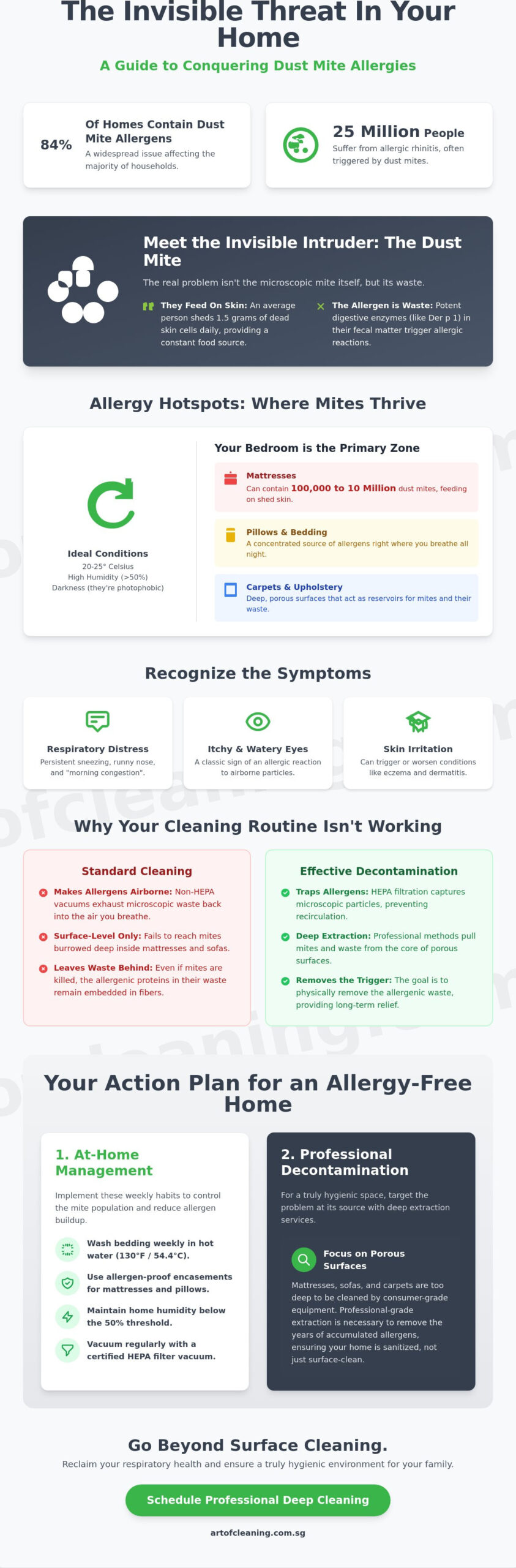
Dust mites are microscopic arachnids, invisible to the naked eye, that live specifically on the organic detritus of our daily lives. They don’t bite or sting. Instead, they consume the roughly 1.5 grams of dead skin cells a human sheds every day. While the mites themselves are harmless, their waste products contain potent digestive enzymes that break down the protein in skin cells. The science of dust mite allergies reveals that these proteins, specifically Der p 1, are the actual triggers for chronic respiratory distress.
In 2026, the species Dermatophagoides pteronyssinus remains the most prevalent household variant, flourishing in dark, humid environments where temperatures stay between 20 to 25 degrees Celsius. Your bedroom is likely the primary hotspot for these organisms. A standard used mattress can contain anywhere from 100,000 to 10 million dust mites. Because we spend a third of our lives in bed, we’re constantly replenishing their food supply and providing the warmth they need to thrive. Establishing a successful protocol for dust mite allergies treatment at home requires acknowledging that these pests are not on the surface, but deep within your bedding and upholstery. This invisible accumulation is why symptoms often persist despite a visually clean house.
Common Symptoms and Health Impact
Dust mite exposure manifests in several ways, often mimicking a common cold that never ends. Common respiratory symptoms include persistent sneezing, a runny nose, and itchy, watery eyes. For those with pre-existing conditions, these allergens are a primary trigger for asthma flare-ups. Many people experience the “morning congestion” phenomenon, where symptoms peak immediately after waking. This happens because you’ve spent hours with your face pressed against a concentrated source of allergens. Beyond respiration, dust mites are a known cause of skin issues like eczema and dermatitis, as the enzymes in their waste can irritate sensitive skin barriers.
Why Standard Cleaning Often Fails
Visual cleanliness doesn’t equate to microscopic hygiene. Most household vacuums lack the filtration needed to capture particles as small as 10 microns. Instead of removing the problem, standard cleaning often stirs up the allergenic waste, making it airborne and easier to inhale. Dust mites are also photophobic, meaning they naturally burrow deep into the core of mattresses and sofa cushions to avoid light. This makes them nearly impossible to reach with surface-level suction. Even if you manage to kill the living mites, the persistent allergenic proteins in their waste remain embedded in the fibers. This persistence means you need more than a quick tidy-up to achieve real health results. Professional services, such as those provided by Art of Cleaning, are often required to extract these deep-seated irritants effectively.
Comprehensive At-Home Protocols for Dust Mite Management
Establishing a successful routine for dust mite allergies treatment at home requires a shift from superficial tidiness to systematic environmental control. It’s about breaking the lifecycle and containing the allergens that have already accumulated. You can’t just move the dust around; you have to eliminate the biological reservoirs where these organisms thrive. Implementing comprehensive at-home protocols ensures that your living space supports your respiratory health rather than undermining it.
The first line of defense is your laundry cycle. Wash all bed linens, including pillowcases and sheets, at least once a week in water heated to at least 130°F (54.4°C). This specific temperature is critical because cooler water may remove the waste, but it won’t kill the living mites. Along with high-heat washing, the use of allergen-proof encasements for mattresses and pillows is non-negotiable. These specialized covers feature a weave so tight that pores are smaller than 10 microns, effectively trapping mites and their waste inside while preventing new ones from colonizing your bed.
Vacuuming must be performed with a certified HEPA (High-Efficiency Particulate Air) filter. Standard vacuums often act as “dust blowers,” capturing large debris while exhausting microscopic allergens back into your breathing zone. Focus your vacuuming schedule on all soft surfaces, including carpets, rugs, and upholstered furniture. To further reduce the allergen load, adopt a minimalist approach to decor. Decluttering your living areas by removing unnecessary “dust collectors” like heavy drapes, stacks of books, or ornate knick-knacks significantly reduces the areas where mites can hide. If your carpets or upholstery feel like they’ve become permanent reservoirs for irritants, professional carpet cleaning can provide the deep-tissue extraction that home units simply cannot match.
Optimizing the Bedroom Sanctuary
Your bedroom should be the cleanest room in the house. Replace wool or feather-filled bedding with synthetic, hypoallergenic alternatives that don’t trap moisture as easily. Utilize the “sunlight method” by exposing pillows and rugs to direct UV light for several hours when possible, as this helps neutralize surface-level mites. For children’s rooms, limit the number of plush toys. If a favorite toy can’t be washed at high temperatures, place it in a sealed bag in the freezer for 24 hours to kill the mites before washing it on a gentle cycle to remove the allergens.
Advanced Dusting Techniques
Stop using dry cloths or feather dusters immediately. The “damp dusting” rule is essential; using a damp cloth ensures that particles are trapped and removed rather than just relocated into the air. Focus your efforts on high-frequency touchpoints such as headboards, the tops of curtains, and the crevices of armchairs. Using specialized microfiber cloths is highly recommended, as their unique wedge-shaped fibers are designed for microscopic particle capture, ensuring a level of hygiene that standard cotton rags can’t achieve.
Comparing Home Remedies vs. Professional Decontamination
While daily habits form the foundation of health, there’s a significant technical gap between standard maintenance and professional decontamination. Achieving effective dust mite allergies treatment at home requires understanding that consumer-grade equipment often lacks the mechanical force needed to address deep-seated allergens. For instance, a high-end household vacuum might offer excellent surface suction, but it lacks the industrial-grade static lift required to pull microscopic particles from the core of a high-density foam mattress or thick carpet pile. Household tools are designed for debris; industrial tools are designed for hygiene.
Professional decontamination focuses on deep-tissue removal rather than mere surface sanitization. This process typically utilizes medical-grade steam and high-intensity UV-C light to neutralize biological triggers without the need for harsh chemicals. According to the Asthma and Allergy Foundation of America, strategic prevention of dust mites involves more than just visual cleaning; it requires addressing the reservoirs where mites colonize and breed. While your DIY routine should be performed weekly, professional interventions are recommended every six to twelve months to ensure that the allergen load doesn’t reach a critical threshold that triggers a physical reaction.
The Limitations of DIY Mattress Care
Many homeowners attempt to use household steam cleaners on their beds, but this often backfires. Consumer steam units frequently operate at lower temperatures and higher moisture levels, which can actually accelerate mite growth by creating the damp environment they love. Even worse, if the mattress doesn’t dry completely within 24 hours, you risk mold growth deep inside the upholstery. Professional extraction is the only reliable way to reach the core of thick rugs and mattresses while ensuring the fibers are left dry and hygienic. It’s a level of precision that standard home appliances simply can’t replicate.
Efficiency and Long-Term Results
Efficiency is a major differentiator. A professional team can achieve in one hour what might take a homeowner several days of labor-intensive scrubbing and vacuuming. More importantly, the success of a professional service isn’t measured by visible dirt alone. Instead, it’s measured by the reduction of microscopic allergens that you can’t see but can certainly feel in your lungs every morning. To see the difference in equipment and methodology, you can view our specialized mattress cleaning process to understand how industrial extraction outperforms standard household tools. This specialized approach ensures that your home isn’t just clean to the eye, but safe for your family’s long-term respiratory health.
Strategic Prevention: Managing Humidity and High-Risk Zones
Controlling the indoor environment is the most effective long-term strategy for dust mite allergies treatment at home. These microscopic organisms don’t consume liquid water. Instead, they survive by absorbing moisture directly from the atmosphere through their shells. Research confirms that dust mites cannot survive when the relative humidity drops below the critical 50% threshold. In tropical regions where ambient humidity frequently exceeds 80%, your home can easily become a breeding ground if moisture levels aren’t actively managed. Using a hygrometer to monitor every room is essential; if a space consistently registers above 60%, it’s a high-alert zone for allergen proliferation.
Your air conditioning system can be your greatest ally or a hidden danger. While it helps lower humidity, dirty filters act as a collection point for skin cells and mite waste. When the unit runs, it recirculates these fine particles throughout your living space. Similarly, carpets in high-humidity areas function as moisture traps, creating a damp micro-climate at the floor level that sustains mite colonies even if the rest of the room feels dry. Regular filter maintenance and specialized extraction are necessary to prevent these zones from becoming permanent allergen reservoirs.
Humidity Control in Tropical Environments
In humid climates, relying solely on open windows for ventilation is often counterproductive because it invites moisture-laden air inside. Dehumidifiers are far more effective in sealed rooms, especially during the monsoon season when external humidity peaks. You must also be wary of micro-climates that form in stagnant areas. Heavy furniture and thick rugs create pockets of trapped air where mites thrive undisturbed. Moving these items regularly and ensuring proper airflow underneath them is a simple yet vital preventive step that disrupts their lifecycle.
Curtain and Upholstery Maintenance
Curtains are frequently overlooked, yet they act as the home’s primary “lung,” trapping outdoor pollutants and indoor dust within their fibers. If you or your family members suffer from severe reactions, switching to roller blinds or easily washable fabrics can significantly reduce the allergen load. For those who prefer heavy drapery, professional curtain steam cleaning for allergen removal is required to extract the microscopic irritants that standard dusting misses. If you’re struggling to maintain a healthy balance in your living space, contact our hygiene specialists for a professional home assessment today.
The Art of Cleaning: Professional Solutions for an Allergy-Free Home
While the daily protocols discussed earlier are vital, they often struggle to overcome years of microscopic buildup within dense upholstery. A professional “reset” serves as the most effective starting point for any successful dust mite allergies treatment at home. Art of Cleaning utilizes a hygienic “deep-dive” methodology that targets the core of your mattress and furniture. This systematic approach ensures that you aren’t just managing the problem, but actively removing it from your environment. By clearing out the deep-seated reservoirs of waste, you create a baseline of hygiene that makes your daily maintenance far more effective.
Our proprietary extraction technology is engineered specifically for mattresses and sofas. Unlike consumer units that merely skim the surface, our systems penetrate deep into the fibers to pull out the biological waste that triggers your symptoms. This level of precision is artisanal in nature, requiring specialized training to ensure every cubic centimeter of fabric is decontaminated. We prioritize family safety by adhering to strictly chemical-free disinfection processes. By using medical-grade steam and specialized light treatments, we neutralize pathogens without leaving behind toxic residues. This approach ensures your home remains a sanctuary for children and pets while achieving a level of hygiene that goes beyond mere visual tidiness.
Our Specialized Upholstery and Carpet Care
Our high-power extraction systems are capable of removing 99.9% of deep-seated dust mite allergens. This isn’t just about removing dirt; it’s about eliminating the microscopic enzymes that cause respiratory distress. We understand that every home is unique, which is why we’ve refined our techniques to treat delicate fabrics like silk or velvet without risking damage. For those looking to revitalize their common areas, our sofa cleaning services for a healthier living room offer a comprehensive solution to hidden contaminants. We focus on the precision of our labor to ensure long-term results that support your well-being.
The Art of Cleaning Difference
Our commitment is rooted in scientific hygiene rather than surface aesthetics. We don’t just want your home to look clean; we want it to be biologically safe. This dedication to precision has led to our expertise being featured on national media platforms, establishing Art of Cleaning as a trusted guardian of the domestic environment. We take pride in the meticulous nature of our labor, ensuring that our clients receive a level of service that reflects our high standards. Ready for a cleaner home? Contact us for a professional hygiene assessment and take the first step toward reclaiming your health. Our team is ready to provide the stability and reliability your family deserves.
Achieving a Truly Hygienic Home Sanctuary
It’s clear that reclaiming your health starts with acknowledging that visual tidiness isn’t the same as microscopic hygiene. You’ve learned that maintaining humidity below the 50% threshold and using high-heat laundry cycles are essential pillars of environmental control. However, even the most diligent daily habits can struggle against the millions of allergens embedded deep within mattresses and sofas. Implementing a consistent routine for dust mite allergies treatment at home is your first line of defense, but a professional deep-tissue extraction provides the necessary reset to truly clear the air.
Art of Cleaning brings a scientific approach to your living space, utilizing 100% chemical-free deep extraction technology that prioritizes your family’s safety. Our expertise in high-humidity allergen management has been featured on major national media platforms, establishing us as a trusted partner for households seeking long-term respiratory relief. We take pride in the meticulous precision of our work, ensuring that every fiber of your home supports your well-being. You don’t have to struggle with morning congestion anymore. Breathe easier today; book your professional home hygiene service with Art of Cleaning. You deserve a home environment that fosters rest and vitality every single morning.
Frequently Asked Questions
Can I ever completely get rid of dust mites at home?
No, complete eradication is impossible because these microscopic organisms are a natural part of the human ecosystem. However, you can reduce their population to levels that do not trigger physical symptoms. Focus on keeping the allergen load below your personal threshold through consistent moisture control and deep cleaning of soft surfaces. Effective management ensures that your home environment supports your health rather than causing irritation.
How often should I have my mattress professionally cleaned for allergies?
We recommend a professional mattress cleaning every six to twelve months for individuals with sensitivities. While your weekly maintenance manages surface accumulation, industrial-grade extraction is necessary to remove deep-seated waste from the core of the mattress. If you live in a high-humidity environment or have pets, increasing the frequency to twice a year ensures that the allergen count remains consistently low for better respiratory health.
Does air conditioning kill dust mites?
Air conditioning does not kill mites directly, but it suppresses their reproduction by lowering indoor humidity levels. Dust mites require moisture from the air to survive; by maintaining a dry environment, you effectively starve them. You must ensure your aircon units are serviced regularly, as clogged filters can become a distribution point for existing allergens rather than a tool for environmental hygiene.
Are there natural sprays that can kill dust mites effectively?
Some essential oil sprays like eucalyptus or tea tree can kill mites on contact, but they do not remove the allergenic waste. Simply killing the mites is only half the battle. To achieve a successful dust mite allergies treatment at home, you must extract the proteins found in their waste and decaying shells. Sprays are a temporary measure and shouldn’t replace physical removal through HEPA vacuuming.
Will a HEPA air purifier help with my dust mite allergy?
A HEPA air purifier is effective for capturing airborne particles but has limited impact on mites living deep in your bedding. Dust mite allergens are relatively heavy and settle quickly on surfaces rather than staying suspended in the air. Use an air purifier as a secondary defense to catch particles stirred up during cleaning, while focusing primary efforts on upholstery and mattress decontamination.
What is the best temperature to wash bedding to kill mites?
You must wash your bedding at a minimum temperature of 130°F (54.4°C) to kill living dust mites. Cooler water may remove some of the waste, but it won’t eliminate the organisms responsible for the buildup. If your fabrics are too delicate for high heat, consider using a high-temperature dryer for at least 15 minutes to achieve the same lethal effect before a standard gentle wash cycle.
Can dust mites live in hard flooring like vinyl or marble?
Dust mites cannot survive inside hard flooring like vinyl or marble, but they can exist in the dust film on top of these surfaces. Unlike carpets, hard floors do not provide the deep fiber reservoirs or moisture traps that mites prefer. This makes hard flooring a superior choice for allergy sufferers, provided you use damp-mopping techniques to remove surface dust without scattering it into the air.
How do I know if my cough is caused by dust mites or something else?
Dust mite related coughs typically peak at night or in the early morning immediately after you wake up. If your symptoms improve when you leave the house or spend time in a different environment, it’s a strong indicator of a domestic allergen trigger. A clinical allergy test is the only definitive way to confirm sensitivity, but a pattern of nocturnal congestion often points toward mattress and upholstery contamination.