
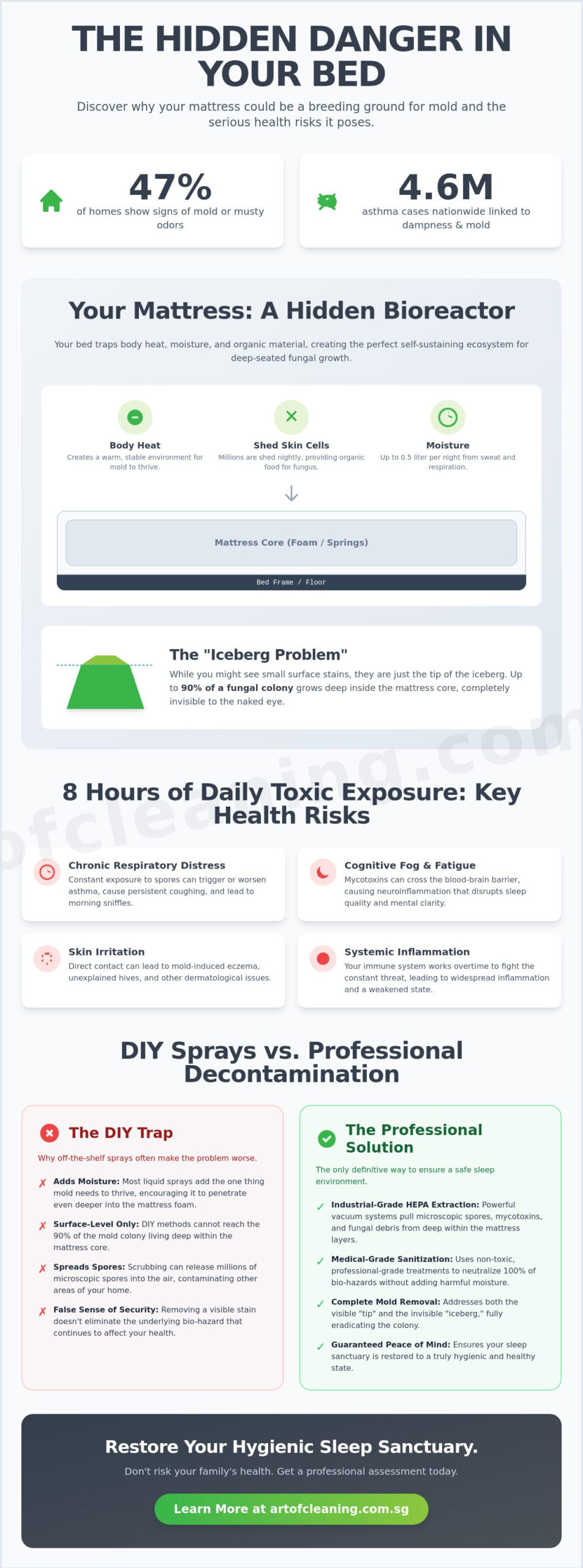
Did you know that approximately 47% of homes currently show signs of visible mold or persistent musty odors? While many people focus on scrubbing bathroom tiles, the most dangerous colony might be growing inches beneath your body while you sleep. Understanding mold on mattress health risks is no longer just about basic cleanliness; it’s a vital matter of respiratory safety. Scientific research indicates that dampness and mold exposure are responsible for roughly 4.6 million asthma cases nationwide, contributing to an annual economic impact of $5.6 billion in health costs. These invisible bio-hazards thrive in the humid layers of your bedding, often going unnoticed until they impact your family’s well-being.
You likely already suspect that those unexplained morning sniffles and that lingering, earthy smell in your bedroom aren’t just seasonal allergies. It’s stressful to feel like your sanctuary has become a health hazard. This guide will help you navigate this silent threat by detailing the critical health implications of mattress mold and showing you how to identify these hazards with precision. We’ll explore the definitive differences between simple dirt stains and active fungal growth. You’ll gain a clear, actionable path toward professional decontamination that ensures your sleep environment remains a place of recovery rather than a source of chronic illness.
Key Takeaways
- Understand how mattresses act as “bioreactors” by trapping body heat, moisture, and organic skin cells to fuel deep-seated fungal growth.
- Identify the specific mold on mattress health risks that go beyond simple sniffles, including systemic inflammation and chronic respiratory distress caused by long-term mycotoxin exposure.
- Learn to distinguish between harmless sweat stains and active fungal colonies by identifying the “musty” volatile organic compounds (VOCs) released by living spores.
- Discover why DIY liquid sprays often worsen the “iceberg problem” by providing the moisture needed for mold to penetrate deeper into the mattress layers.
- Recognize why industrial-grade HEPA extraction and medical-grade sanitization are the only definitive ways to remove 100% of microscopic bio-hazards from your sleep environment.
Understanding Mattress Mold in High-Humidity Environments
Every night, the average human body sheds millions of skin cells and releases nearly half a liter of moisture through sweat and respiration. In the enclosed environment of a bedroom, your mattress absorbs these elements, transforming into a literal bioreactor. Mold spores are microscopic and opportunistic. They drift through the air and settle deep within the porous layers of foam and fabric. Once they find this steady supply of heat, moisture, and organic “food,” they begin to colonize. Unlike surface mildew, which often appears as a powdery gray dusting, toxic black mold (Stachybotrys chartarum) can take root deep in the core, releasing spores that contribute to serious mold on mattress health risks.
In tropical regions, the challenge is amplified by physics. When ambient humidity stays above 80%, the dew point within your bedding is reached much faster. Gaining a scientific Understanding Mattress Mold is the first step in realizing that this isn’t a matter of poor housekeeping; it’s a consequence of environmental biology. The porous nature of sleep surfaces means that once a colony establishes itself, it creates a self-sustaining micro-ecosystem that traditional cleaning cannot reach.
The Anatomy of a Contaminated Mattress
Traditional spring mattresses allow for some internal airflow, but modern memory foam is designed for density and support, which unfortunately restricts ventilation. Moisture becomes trapped in the microscopic cells of the foam. This leads to the “Deep Seating” effect, where 90% of the fungal colony remains invisible to the naked eye. Mold typically grows from the bottom up and the inside out. Boxed mattresses, which are compressed and vacuum-sealed for delivery, can also trap minute amounts of manufacturing moisture that expand once the seal is broken in a humid home.
Humidity Factors and Modern Living
Modern high-rise living often compromises natural cross-ventilation. Many residents rely on air-conditioning cycles that create significant temperature fluctuations. When you switch off the AC, the cool mattress core meets the warm, humid air, causing internal condensation. This moisture has nowhere to go, especially if you use a floor mattress setup. Placing a mattress directly on the floor eliminates the essential air gap underneath, guaranteeing that trapped sweat will trigger mold growth within weeks. This lack of airflow is a primary driver behind the mold on mattress health risks that many families face without realizing it. Without a proper bed frame to facilitate evaporation, your mattress remains in a state of permanent dampness, providing the perfect foundation for bio-hazards.
The Invisible Danger: Primary Health Risks of Sleeping on Mold
While you rest, your body should be in a state of cellular repair. However, if your bed is contaminated, you are instead subjecting your immune system to an eight-hour marathon of toxic exposure. The health problems caused by mold range from immediate allergic reactions to chronic systemic issues. Because you spend approximately one-third of your life in direct contact with your mattress, the cumulative dose of spores and fungal byproducts is significantly higher than in any other part of your home. This intense proximity is the primary driver of mold on mattress health risks, especially in unventilated bedrooms where air turnover is low.
Beyond the lungs, mold exposure often manifests as persistent cognitive fatigue and “brain fog.” Mycotoxins can cross the blood-brain barrier, triggering neuroinflammation that disrupts sleep quality and mental clarity. On the surface, your skin acts as a sponge. Mold-induced eczema and unexplained hives are common indicators that a mattress has reached a critical level of contamination. Vulnerable groups, including children and the elderly, face the highest risks. For these individuals, what starts as a simple runny nose can quickly escalate into severe respiratory distress or secondary infections.
The national economic impact of mold-related infections is estimated to be $5.6 billion annually, highlighting the severity of this issue. An estimated 21% of current asthma cases in the U.S., which is approximately 4.6 million cases, are directly attributable to dampness and mold exposure in the home. These mold on mattress health risks are particularly dangerous because the exposure is localized and constant. While you sleep, your face is often inches away from the source of the spores.
Allergic Rhinitis and Asthma Triggers
When you inhale fungal spores, your immune system may produce Immunoglobulin E (IgE) antibodies. This IgE-mediated response triggers the release of histamine, leading to the morning congestion and watery eyes many mistake for seasonal allergies. Case studies show that air purifiers are often ineffective if the source of the spores is the very surface you are lying on. If you wake up every morning feeling more congested than when you went to sleep, it’s a clear signal that your sleep hygiene is compromised. Seeking a professional mattress cleaning service can help identify if your bedding has become a biological trigger.
Toxic Load and Mycotoxicosis
Mold doesn’t just release spores; it also produces mycotoxins. These secondary metabolites are chemical irritants that can be absorbed through the skin or inhaled as volatile organic compounds. This toxic load builds up over time, leading to systemic inflammation that affects your entire body’s health. Mycotoxicosis is a medical condition resulting from the chronic inhalation, ingestion, or dermal absorption of toxic fungal byproducts. Unlike a simple allergy, this condition represents a systemic poisoning that requires the total removal of the fungal source to resolve.
Signs Your Mattress is Harboring Toxic Growth
Identifying a contaminated mattress often requires looking beyond the surface. One of the most significant challenges for homeowners is the “Scent Lag,” where residents experience chronic respiratory issues long before a single spot appears. Statistics indicate that roughly 47% of homes have either visible mold or a persistent mold odor. If you’ve been managing unexplained morning allergies, it’s time to investigate. The primary mold on mattress health risks aren’t always visible; they’re often carried by microbial volatile organic compounds (mVOCs) that permeate the air you breathe while sleeping.
The Scent of Decay: Detecting Microbial VOCs
Mold produces a distinct, earthy, or “wet dog” smell as it digests the organic matter within your mattress. This isn’t just an unpleasant odor; it’s a chemical signature of active growth. To verify this, try the “Scent Test.” Seal your bedroom door and windows for at least four hours with the air conditioning off. Upon re-entering, a sharp, musty scent indicates a high concentration of mVOCs. Don’t use fabric fresheners or scented sprays to hide this smell. These products only mask the warning signs while adding moisture, which effectively fuels the fungal colony.
Visual Identification Guide
Distinguishing between a spilled morning coffee and a toxic colony is essential for your safety. Spills typically have defined, jagged edges and a flat texture. In contrast, active mold growth often presents as fuzzy, circular patches that seem to “bloom” across the fabric. Consult a CDC guide on mold health risks to understand the specific pathogens that thrive in domestic environments.
- Aspergillus: Often appears as white, gray, or green dusty patches; it’s frequently mistaken for simple dust or lint accumulation.
- Stachybotrys: Known as toxic black mold, it usually looks slimy and dark, taking root in the deep seams where moisture accumulates.
Don’t forget to inspect the hidden contact points. Flip your mattress to check the underside and examine the areas where the mattress touches the bed frame. These stagnant air pockets are prime real estate for fungal expansion. If you find yourself feeling significantly better after spending a weekend away from your home, your “Health Log” is likely pointing toward a localized environmental issue. Addressing these mold on mattress health risks requires a meticulous inspection of every seam and fold where spores might hide. Using a UV light can also help reveal biological traces that aren’t yet visible to the naked eye.
Why DIY Mold Removal Often Backfires
The impulse to scrub away a visible stain is natural. With fungal growth, however, this action often causes more harm than good. DIY methods frequently address only the “tip of the iceberg,” leaving 90% of the colony to thrive internally. While surface stains might disappear temporarily, the underlying mold on mattress health risks remain until the core is sanitized. In fact, most home-cleaning attempts actually accelerate the growth of bio-hazards by providing the two things mold needs most: moisture and a way to spread.
The Consumer Product Safety Commission (CPSC) has recognized the increasing complexity of mattress safety, recently updating mandatory standards for crib mattresses (ASTM F2933-25) and toddler beds (ASTM F1821-26) as of 2026. These updates emphasize the need for structural integrity and hygiene. When you attempt a DIY fix, you risk compromising these modern safety standards. Improper cleaning techniques can trap moisture within the hybrid spring systems and foam layers that are popular in 2026, creating a permanent breeding ground for bacteria and spores.
The Myth of Vinegar and Bleach
Using acidic vinegar or alkaline bleach may seem like a powerful solution, but these chemicals rarely penetrate the dense memory foam or latex layers where the real danger resides. Bleach, in particular, is highly corrosive and can degrade the organic fibers and adhesives within your mattress, leading to “chemical off-gassing” that further irritates your respiratory system. Adding any liquid to a mattress without industrial extraction is counter-productive. Without the ability to pull that liquid back out, you’re simply feeding the “iceberg” and allowing the mold to rot the mattress from the inside out.
The Danger of Spore Cross-Contamination
Scrubbing a moldy patch is a recipe for disaster. This physical agitation releases millions of microscopic spores into the air, where they settle on your pillows, curtains, and carpets. This cross-contamination turns a localized mattress problem into a room-wide health hazard. Professional remediation requires HEPA filtration to capture these airborne particles, a step that home vacuums simply can’t replicate. Additionally, relying on “sun-drying” is ineffective in high-humidity environments where ambient moisture levels prevent the mattress core from ever reaching total dryness.
Don’t risk your family’s respiratory health with ineffective home remedies. To ensure your sleep environment is truly safe, you should book a professional mattress cleaning service that utilizes industrial-grade extraction and sanitization. This is the only definitive way to eliminate mold on mattress health risks and restore your home’s hygiene.
Professional Decontamination: Restoring a Hygienic Sleep Sanctuary
Professional intervention is the only definitive way to neutralize the bio-hazards lurking within your bedding. While a quality queen mattress in 2026 typically costs between $1,000 and $2,000, investing in specialized decontamination is a cost-effective alternative that protects both your health and your financial investment. Unlike surface scrubbing, professional systems utilize a scientific framework to eliminate mold on mattress health risks at the source. This process involves a multi-stage approach that combines deep extraction with medical-grade disinfection to ensure every layer of the mattress is treated.
The national economic impact of mold-related infections is estimated to be $5.6 billion annually, highlighting the importance of professional sanitization in the home. Our methodology focuses on neutralizing mycotoxins and removing the microscopic spores that trigger chronic inflammation. By utilizing industrial steam and specialized antimicrobial agents, we can effectively reset your sleep environment to a factory-fresh state of hygiene. This level of precision is essential for families, especially those with members who are immunocompromised or suffer from pre-existing respiratory conditions.
Industrial-Grade Extraction Technology
Standard household equipment lacks the suction power to reach the inner core of modern, high-density hybrid mattresses. Our specialized systems utilize high-pressure, low-moisture extraction that reaches deep into foam layers without leaving them saturated. This precision ensures that we remove the 90% of the colony that remains invisible to the eye. By opting for Art of Cleaning’s mattress cleaning service, you’re choosing a methodology that prioritizes environmental safety and long-term hygiene. We use HEPA-integrated vacuuming to capture microscopic spores that would otherwise be redistributed into your bedroom air during a standard cleaning session.
Creating a Mold-Resistant Bedroom
Maintaining a hygienic sanctuary requires ongoing vigilance after the initial decontamination. To prevent a recurrence, you must control the ambient environment. Aim for the “Goldilocks” humidity zone between 40% and 60% by using a dedicated dehumidifier. This range is high enough for comfort but too low for fungal spores to germinate. Pair this with a breathable, waterproof mattress protector to block moisture from sweat while allowing air to circulate. Since spores often settle on floor surfaces before migrating to bedding, regular carpet cleaning services are essential to ensure your entire room remains a spore-free zone. These combined efforts significantly reduce mold on mattress health risks, allowing you to sleep with the confidence that your home is truly a safe haven for your family.
Secure Your Sleep Environment for a Healthier Future
Your mattress is more than just a piece of furniture; it’s a critical component of your family’s respiratory health. As we’ve explored, the invisible nature of fungal colonies means that surface cleanliness doesn’t equate to safety. Addressing mold on mattress health risks requires moving beyond basic housekeeping and adopting a scientific approach to hygiene. By understanding the triggers of mycotoxin exposure and the limitations of DIY methods, you can take decisive action to eliminate deep-seated bio-hazards.
As specialized upholstery and carpet deep cleaning experts, Art of Cleaning provides the meticulous care your home deserves. We’ve been featured on major national media platforms for our commitment to hygiene excellence, utilizing medical-grade HEPA extraction and disinfection processes. Don’t let invisible contaminants compromise your well-being any longer. Protect your family’s health with professional mattress decontamination from Art of Cleaning today. You deserve the peace of mind that comes with a truly sanitized and healthy sleep sanctuary.
Frequently Asked Questions
Can mold on a mattress make you sick even if you can’t see it?
Yes, mold can definitely make you sick even if it’s invisible to the naked eye. Fungal colonies often start deep within the porous foam layers, releasing microscopic spores and volatile organic compounds (mVOCs) into your breathing zone. These particles trigger immune responses while you sleep, leading to the primary mold on mattress health risks discussed earlier. Relying only on visual inspection is risky because significant biological growth often precedes visible staining.
Is it safe to sleep on a mattress with a small amount of mold?
It’s not safe to sleep on a mattress with any amount of mold, regardless of the size of the patch. Even a small visible colony indicates that environmental conditions are right for fungal growth; thousands of spores are already being released into your bedding. Continued exposure can lead to sensitization, where your body becomes increasingly reactive to the fungi. This eventually causes more severe respiratory or dermatological issues that compromise your long-term well-being.
How can I tell the difference between a sweat stain and mold?
You can tell the difference by looking at the texture and edges of the mark. Sweat stains are typically yellowish, flat, and have jagged, irregular borders. In contrast, mold colonies often appear fuzzy or velvety and tend to grow in circular “blooming” patterns. If the spot is accompanied by a persistent, earthy odor that doesn’t disappear with standard airing, it’s almost certainly an active fungal growth rather than a simple salt or moisture stain.
Will a mattress protector prevent mold from growing?
A high-quality, breathable, and waterproof mattress protector is a powerful preventative tool, but it’s not a complete guarantee. While it blocks external liquids and sweat from entering the core, mold can still develop if humidity is trapped between the protector and the mattress. For maximum safety, you should pair a protector with a bed frame that allows airflow underneath. Maintain bedroom humidity levels between 40% and 60% to stop spores from germinating.
How long does it take for mold to grow on a damp mattress?
Mold can begin to colonize a damp mattress in as little as 24 to 48 hours. In high-humidity environments, the combination of trapped body heat and moisture creates a perfect breeding ground that accelerates this timeline. Once spores germinate, they quickly extend hyphae into the porous foam layers. This rapid expansion is why immediate industrial extraction is necessary after any significant liquid spill or flooding event to prevent deep-seated contamination.
Can professional cleaning remove all mold spores from deep inside the foam?
Professional cleaning is highly effective at removing spores from deep inside the foam when using industrial-grade extraction and HEPA filtration. These specialized systems generate the necessary suction to pull contaminants from the inner layers, while medical-grade disinfection neutralizes remaining mycotoxins. This scientific approach addresses the “iceberg problem” by treating the hidden 90% of the colony. This is something standard home vacuums or surface sprays simply cannot achieve.
Should I throw away a moldy mattress or try to clean it?
Whether you should throw away or clean a mattress depends on the extent of the growth and the mattress’s value. If the mold has compromised the structural integrity or covers a large percentage of the surface, replacement is often the safest route. However, for high-value hybrid or memory foam mattresses with localized growth, professional decontamination can restore hygiene. It’s often worth consulting a specialist to determine if the mold on mattress health risks can be professionally eliminated.
What are the first symptoms of mold sickness from a bed?
The first symptoms of mold sickness from a bed usually include persistent morning congestion, watery eyes, and frequent sneezing that improves once you leave the room. You might also notice unexplained skin rashes or a general feeling of “brain fog” and fatigue due to disrupted sleep quality. Because these symptoms mimic seasonal allergies, many people overlook them until the fungal colony has significantly expanded and the toxic load on the immune system increases.