
Your marble floors were once the crown jewel of your home. Now they look dull, pitted, and no amount of mopping seems to bring back that deep, mirror-like shine. If you’ve been quietly wondering whether expensive replacement is your only option, the answer is almost certainly no.
That frustration is completely valid. Marble is a porous, living stone that etches, scratches, and absorbs contaminants over time, and standard cleaning products can actually accelerate the damage. What looks like a surface problem is often something more serious: microscopic grooves harbouring bacteria and allergens that routine mopping simply can’t reach.
This is precisely why professional marble polishing in Singapore has evolved into a scientific restoration process, not just a cosmetic one. Skilled technicians don’t just buff away dullness; they systematically grind, hone, and seal the stone to eliminate microbial traps while recovering the natural brilliance locked beneath years of wear.
In this 2026 guide, you’ll discover how the restoration process works step by step, what separates a genuine specialist from a general cleaner, and how the right professional approach can extend the lifespan of your stone investment while creating a surface that’s genuinely hygienic and easy to maintain.
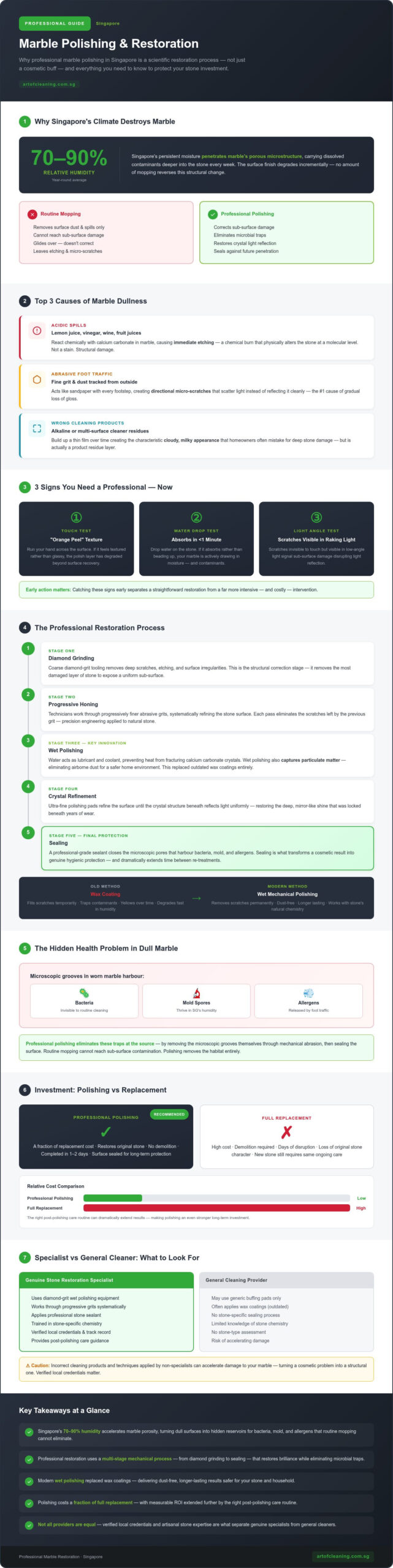
Key Takeaways
- Singapore’s high humidity accelerates marble porosity, turning dull surfaces into hidden reservoirs for bacteria, mold, and allergens that routine mopping cannot eliminate.
- Professional marble polishing Singapore specialists use a multi-stage mechanical process — from diamond grinding to sealing — that restores brilliance while closing the microscopic gaps where contaminants thrive.
- Modern wet polishing techniques have replaced outdated wax coatings, delivering a dust-free, longer-lasting result that is safer for both your stone and your household.
- Investing in professional restoration delivers measurable ROI: the cost of polishing is a fraction of full marble replacement, and the right post-polishing care routine can dramatically extend your results.
- Not all stone care providers are equal — discover what separates a genuine artisanal specialist from a general cleaner, and why verified local credentials matter when choosing a restoration partner.
Why Marble Polishing is Essential in Singapore’s 2026 Climate
Marble polishing is, at its core, a mechanical restoration process. Technicians work through progressively finer abrasive grits, systematically refining the stone surface until microscopic irregularities are removed and the crystal structure beneath can reflect light uniformly. It’s precision engineering applied to natural stone, not a simple buff-and-shine operation.
Singapore’s climate makes this process not just desirable but genuinely necessary. Average relative humidity sits between 70% and 90% year-round, and that persistent moisture doesn’t simply sit on your marble floor. It penetrates. Marble is a metamorphic rock with a naturally porous microstructure, and in Singapore’s conditions, those pores continuously absorb atmospheric moisture, carrying dissolved contaminants deeper into the stone with every passing week. What competitors often overlook is that the surface finish itself is sacrificial: it degrades incrementally under these conditions, and no amount of mopping reverses that structural change.
Daily mopping addresses what’s visible. It removes surface dust and spills. But it cannot reach the sub-surface layer where etching, micro-scratching, and contamination have already taken hold. A mop glides over a damaged surface; it doesn’t correct one.
Common Causes of Marble Dullness in Singapore Homes
Understanding why your marble loses its finish is the first step toward protecting it. The most common culprits include:
- Acidic spills: Lemon juice, vinegar, wine, and even some fruit juices react chemically with calcium carbonate in marble, causing immediate etching. This isn’t a stain. It’s a chemical burn that physically alters the stone’s surface at a molecular level.
- Abrasive foot traffic: Fine grit and dust tracked in from outside act like sandpaper with every footstep, creating directional micro-scratches that scatter light instead of reflecting it cleanly.
- Incorrect cleaning product residues: Alkaline or multi-surface cleaners leave a thin film that builds up over time, creating the characteristic cloudy, milky appearance that homeowners often mistake for deep stone damage.
When to Call a Professional Restoration Specialist
Three reliable indicators tell you that routine care is no longer sufficient. First, run your hand across the surface: if it feels slightly textured rather than glassy, that “orange peel” effect confirms the polish layer has degraded beyond surface-level recovery. Second, perform a simple water drop test by placing a few drops on the stone; if they absorb within a minute rather than beading up, your marble is actively drawing in moisture and the contaminants it carries. Third, look for scratches that are invisible to the touch but visible when light rakes across the surface at a low angle. These sub-surface scratches disrupt light reflection and signal that professional marble polishing in Singapore is the appropriate next step, not another round of cleaning products.
Each of these signs points to damage that has moved beyond the surface. Catching them early is what separates a straightforward restoration from a far more intensive intervention.
The Professional Restoration Process: From Grinding to Shining
For decades, marble maintenance meant applying wax coatings and hoping for the best. Wax fills surface scratches temporarily, but it doesn’t remove them. It traps contaminants beneath a film that yellows over time, and in Singapore’s humidity, it degrades rapidly, leaving floors looking worse than before treatment. Modern professional marble polishing in Singapore has moved decisively away from this approach. What replaced it is a systematic, mechanical process that works with the stone’s natural chemistry rather than masking its condition.
The shift to wet polishing is one of the most significant technical advances in stone restoration. Water acts simultaneously as a lubricant and a coolant during abrasive work, preventing heat from fracturing the calcium carbonate crystals within the marble. Critically for home environments, wet polishing captures particulate matter at the source. Dry grinding generates fine silica dust that becomes airborne and can settle throughout a property for days. Wet methods eliminate that risk entirely, making professional restoration genuinely compatible with occupied Singapore homes.
Step 1: Lippage Removal and Diamond Grinding
Diamond grinding is the structural foundation of stone leveling, using industrial diamond-impregnated resin pads to plane the marble surface down to a consistent, unified plane before any refinement begins. This step addresses lippage, the height variation between adjacent tiles that causes edges to catch light unevenly and collect grime in the gaps. Coarse-grit pads remove deep scratches, embedded stains, and surface deterioration that has accumulated over years of foot traffic. It’s aggressive, precise work. Done incorrectly, it removes too much material; done correctly, it creates a blank canvas with no memory of prior damage.
Step 2: Honing and Refining the Stone
Once the coarse scratches from grinding are present across the entire surface, technicians progress through a sequence of progressively finer abrasive pads. Each stage removes the scratch pattern left by the previous one, working down to a level where the stone’s pore structure begins to close. This honing phase is where patience separates skilled specialists from rushed operators. Skipping grit stages to save time leaves sub-surface scratches that the final polish cannot conceal. The calcium carbonate matrix must be uniformly smooth before it can react correctly with polishing compounds.
Step 3: Polishing, Buffing, and Sealing
The final phase triggers a controlled chemical reaction. Polishing powders, typically oxalic acid-based compounds, react with the calcium carbonate in marble to produce a crystalline surface layer that reflects light with genuine depth. This isn’t a coating applied on top of the stone; it’s a transformation of the stone itself. The result is that characteristic mirror finish that no wax product can replicate.
Sealing follows immediately. A high-quality impregnating sealant penetrates below the surface and bonds within the pore structure, creating an invisible barrier against moisture, oils, and acidic spills without altering the stone’s appearance. The final buff removes any residue and verifies the finish is streak-free across the entire surface, the kind of meticulous detail work that defines an artisanal standard of restoration.
If you’d like to understand how this process applies to your specific stone type and floor condition, reviewing the marble polishing service details is a practical starting point before booking any assessment.
The Health Perspective: How Polishing Eliminates Microbial Traps
Most homeowners assess their marble floors visually. What they can’t see is the more pressing problem. Worn, etched marble develops a microscopic landscape of pits, fissures, and channels that function as permanent reservoirs for biological matter. In Singapore’s persistently humid climate, those reservoirs stay warm and moist year-round, creating near-ideal conditions for bacterial colonisation, mold spore germination, and allergen accumulation. This isn’t a theoretical concern. It’s a structural consequence of surface degradation that routine cleaning physically cannot address.
The science is straightforward. Calcium carbonate, the primary mineral in marble, becomes increasingly porous as the surface degrades. Each etch mark and micro-scratch effectively increases the stone’s total surface area, giving microorganisms more anchoring points and more shelter from mop heads and cleaning solutions. A polished, sealed surface presents a near-impermeable plane; a worn one presents a labyrinth. The difference in sanitisation effectiveness between the two states is dramatic, and it compounds over time as damage accumulates.
Removing Invisible Contaminants
Deep-seated organic matter trapped within stone pores contributes directly to indoor odors that persist despite regular cleaning. Bacteria metabolising trapped food particles, skin cells, and moisture produce volatile compounds that circulate through your living space continuously. Dust mites, which thrive in humid Singapore conditions, exploit the same micro-gaps, and their waste particles are among the most common household allergen triggers for respiratory sensitivity.
Professional marble polishing in Singapore addresses this at a structural level. The grinding and honing stages physically remove the compromised surface layer where contaminants have embedded, eliminating the problem rather than cleaning around it. For households managing allergies, asthma, or young children spending time on the floor, this distinction is clinically meaningful, not merely cosmetic. For a broader approach to reducing indoor biological load, professional deep cleaning services in Singapore can complement stone restoration as part of a complete home hygiene strategy.
The Hygiene Benefits of a Sealed Surface
Impregnating sealants applied after polishing don’t just protect the stone’s appearance. They bond within the pore structure and create a barrier that actively resists organic growth by denying moisture and nutrients the entry points microorganisms require. A sealed surface is also significantly easier to sanitise with mild, pH-neutral products, which matters for households trying to reduce exposure to harsh chemical cleaners that can irritate airways and skin.
This is the Art of Cleaning standard: beauty backed by scientific sanitation. Restoring your marble floor through professional marble polishing Singapore specialists isn’t a luxury decision. It’s a measurable investment in the biological quality of your home environment, delivered by a team that has been trusted by Singapore homeowners since 2018 and recognised by major national media networks for exactly this level of rigour.
Maintaining Your Investment: Post-Polishing Care and ROI
Marble replacement in Singapore is a significant capital expenditure. Between material costs, hacking fees, disposal, and reinstallation, full floor replacement routinely runs into tens of thousands of dollars for a standard HDB or condominium unit. Professional restoration through marble polishing Singapore specialists costs a fraction of that figure and, with the right maintenance framework in place, can extend the life of your restored surface by years. The financial case isn’t close.
What undermines that investment faster than anything else is the wrong cleaning chemistry. Vinegar, lemon juice, and citrus-based multipurpose sprays are among the most common culprits. These products have a pH of roughly 2 to 3, and that acidity reacts immediately with the calcium carbonate in marble, dissolving the crystalline surface layer that the polishing process worked to create. A single application won’t destroy your floor, but repeated use etches the surface progressively, undoing professional restoration in a matter of months. The same applies to bathroom tile cleaners and any product marketed as a “natural” descaler. Natural, in this context, means acidic.
The correct standard for Singapore households in 2026 is a pH-neutral stone cleaner, formulated specifically for polished natural stone. These products clean effectively without disrupting the mineral surface or compromising the impregnating sealant applied after restoration. Diluted correctly, they’re also gentler on indoor air quality, which matters in Singapore’s tightly sealed, air-conditioned interiors.
Daily and Weekly Maintenance Framework
Dust mopping is the single most protective habit you can build. Singapore’s urban environment deposits fine particulate grit continuously, and every footstep grinds that grit against your polished surface like a low-grade abrasive. A dry microfibre flat mop used daily removes that threat before it can cause micro-scratching. For spills, technique matters as much as speed: blot the liquid with a clean cloth rather than wiping it across the surface. Wiping spreads an acidic spill over a wider area; blotting contains it. For high-traffic areas like entranceways and open-plan living rooms, a weekly damp mop with a pH-neutral solution is sufficient. Lower-traffic areas can follow a fortnightly schedule. Review the Art of Cleaning pricelist to explore maintenance package options that align with your floor’s specific traffic load and stone type.
Professional vs. DIY: The Risks of Consumer Polishing Kits
Consumer polishing kits are widely available, and they carry real risks that their packaging doesn’t adequately communicate. Angle grinders and handheld polishers operated without professional training generate uneven pressure and heat. That heat is the critical problem: calcium carbonate crystals fracture under thermal stress, creating a phenomenon called “burning” where the stone surface develops a hazy, uneven discolouration that professional equipment must then correct. Consumer-grade sealants compound the issue. Most are surface-applied topical coatings rather than true impregnating sealants, meaning they sit on top of the stone rather than bonding within its pore structure. In Singapore’s humidity, they peel, yellow, and trap moisture beneath the film.
A Singapore-registered professional brings calibrated wet polishing equipment, verified stone chemistry knowledge, and accountability that a kit simply cannot replicate. The cost of correcting a DIY attempt frequently exceeds what the original professional service would have cost. Contact Art of Cleaning to arrange an assessment before attempting any home restoration approach on your marble floors.
Art of Cleaning: Singapore’s Specialists in Artisanal Stone Restoration
There’s a meaningful difference between a company that cleans floors and one that genuinely understands stone. Art of Cleaning was founded in 2018 with a specific commitment to the latter: treating marble restoration as a craft that demands technical precision, material knowledge, and an uncompromising standard of finish. That philosophy is embedded in the name itself. The “art” isn’t marketing language. It’s a working standard that every technician is held to on every job.
Being featured on major national media networks, including CNA and SPH publications, isn’t something Art of Cleaning treats as a footnote. For Singapore homeowners evaluating who to trust with a significant stone investment, verified media recognition from credible local institutions is a meaningful signal. It confirms accountability, not just capability. Any provider can claim expertise; fewer are willing to stand behind their work in front of a national audience.
The integrated service approach also sets Art of Cleaning apart in practical terms. Marble restoration rarely happens in isolation. Renovation projects leave behind fine particulate contamination that settles into stone pores before polishing even begins. Combining marble polishing Singapore services with post renovation cleaning into a coordinated sequence ensures the stone is properly decontaminated before restoration work starts, which directly affects the quality and longevity of the final finish. That kind of joined-up thinking is what a health-first methodology looks like in practice.
Our Specialized Equipment and Training
Art of Cleaning uses industrial-grade planetary grinding machines that distribute pressure evenly across the entire pad surface. This matters because uneven pressure is the primary cause of “high spots” and waviness in DIY or under-equipped restoration attempts. Planetary systems maintain consistent contact geometry regardless of operator movement, which is what produces a genuinely flat, mirror-quality result rather than a visually acceptable approximation. All work is conducted using wet methods, keeping the working environment dust-controlled and safe for occupied residential and commercial spaces throughout the process.
Get Your Custom Marble Restoration Quote
Every floor assessment begins with a site visit. Stone condition varies considerably between a residential living room with moderate foot traffic and a commercial lobby absorbing hundreds of daily contacts, and the restoration approach must reflect that difference. Grit sequencing, polishing compound selection, and sealant specification are all calibrated to the specific stone type and wear profile identified on-site, not applied from a generic template.
Transparent pricing is part of the Art of Cleaning standard. You can review indicative service tiers on the Art of Cleaning pricelist before committing to anything. When you’re ready to discuss your specific floor’s condition and restoration requirements, contact Art of Cleaning to arrange your assessment. The result you’re looking for, a surface that reflects light with genuine depth and resists biological contamination at a structural level, starts with that first conversation.
Your Marble Deserves More Than a Mop
Singapore’s humidity doesn’t forgive neglected stone. What starts as surface dullness quietly becomes a structural hygiene problem, one that routine cleaning products aren’t designed to solve. The good news is that professional marble polishing Singapore specialists can reverse years of damage through a systematic, science-backed restoration process that delivers results no DIY kit can replicate.
Art of Cleaning has been trusted by Singapore homeowners since 2018, recognised by major national media networks, and built its reputation on a single standard: beauty backed by scientific sanitation. That’s not a tagline. It’s a measurable outcome delivered on every job.
Restore your floor’s natural brilliance with Art of Cleaning’s professional marble polishing services. Your stone has more life in it than you think.
Frequently Asked Questions About Marble Polishing in Singapore
How often should I have my marble floors polished in Singapore?
For most Singapore homes, a full professional restoration every two to three years is a reasonable baseline. High-traffic areas like entranceways and open-plan living rooms may need attention sooner, while bedrooms and low-use spaces can go longer between sessions. The most reliable indicator isn’t a fixed schedule; it’s the condition of your floor. If the water drop test shows absorption within a minute, don’t wait for your next scheduled service.
Can professional polishing remove deep stains or oil marks from marble?
Many deep stains and oil marks can be significantly reduced or eliminated, depending on how long they’ve been present and how deeply they’ve penetrated. The diamond grinding stage physically removes the compromised surface layer where staining has taken hold, which is why professional restoration achieves results that topical stain removers cannot. Oil-based contamination that has migrated deep into the stone may require a poultice treatment applied before polishing begins. An on-site assessment will give you an honest picture of what’s recoverable.
Is the marble polishing process messy or dusty for my home?
Professional marble polishing Singapore services conducted with wet polishing equipment generate virtually no airborne dust. Water captures particulate matter at the source throughout the grinding and honing stages, which means fine silica particles don’t circulate through your home or settle on furniture. The working area will be damp during the process, and some minor floor preparation is required around the perimeter, but the overall disruption to an occupied home is minimal compared to dry methods.
What is the difference between marble honing and marble polishing?
Honing produces a smooth, flat, low-sheen finish with no reflective glare. It’s achieved by stopping the abrasive sequence at a mid-range grit before the final polishing compound is applied. Polishing takes the process further, using a reactive compound that creates a crystalline surface layer capable of producing a high-gloss, mirror-like reflection. Honing is often preferred for busy households or commercial spaces where slip resistance matters; polishing delivers the deep reflective finish most homeowners associate with premium marble.
Why has my marble floor become dull even though I mop it daily?
Daily mopping cleans the surface but doesn’t correct it. Dullness is a structural condition caused by micro-scratching from foot traffic grit, chemical etching from acidic spills, and the gradual degradation of the stone’s crystal surface under Singapore’s humid conditions. A mop glides over these microscopic irregularities without removing them. Once the polish layer has degraded to this point, no cleaning product restores it; only mechanical refinement through professional restoration recovers the reflective surface beneath.
Can I walk on the marble floors immediately after the polishing service?
Light foot traffic is generally possible within a few hours of the service completing, once the surface is fully dry and the sealant has had adequate time to cure. Your technician will give you a specific timeframe based on the sealant product used and the ambient conditions on the day. It’s worth avoiding wet footwear or dragging furniture across the floor for at least 24 hours to allow the impregnating sealant to fully bond within the stone’s pore structure.
Does marble polishing remove the ‘lippage’ or unevenness between tiles?
Yes, lippage correction is addressed during the diamond grinding stage, which is specifically designed to plane adjacent tiles down to a consistent, unified level. The degree of correction possible depends on the severity of the height variation and the thickness of the marble tiles involved. Minor to moderate lippage is routinely resolved as part of a full restoration. Significant structural unevenness caused by substrate movement beneath the tiles is a separate issue that a site assessment will identify before work begins.
Is it possible to change the finish from high-gloss to a matte (honed) look?
Yes, transitioning from a high-gloss to a honed matte finish is a straightforward outcome of the restoration process. Technicians simply complete the abrasive sequence at the appropriate grit level without applying the final polishing compound. The reverse, moving from a honed finish to a high-gloss one, is equally achievable. Both directions require the same professional equipment and expertise, so if you’ve been considering a different aesthetic for your stone, a restoration service is the practical opportunity to make that change.