
Did you know that a typical household carpet can harbor up to 200,000 bacteria per square inch, making it significantly more contaminated than most high-touch surfaces in your home? In Singapore’s relentless 80% humidity, these fibers act as a magnet for dust mites, mold spores, and invisible allergens that regular vacuuming simply cannot reach. You likely take pride in a tidy living space, yet you might still notice persistent musty odors or unexplained respiratory triggers. It’s a common concern for health-conscious families who want more than just surface-level cleanliness.
This 2026 guide provides a scientific framework for how often to professionally clean carpets to maintain a truly sterile environment. You’ll discover the precise frequency required to neutralize biological threats and prolong the life of your textiles. We’ll explore the data behind professional deep extraction, compare it to standard DIY attempts, and provide a clear, actionable schedule tailored to the unique environmental demands of our region. By the end of this article, you’ll have a comprehensive hygiene strategy to ensure your home remains a safe sanctuary for your loved ones.
Key Takeaways
- Understand why Singapore’s high humidity turns carpets into active filters for pollutants, requiring a scientific approach to household hygiene.
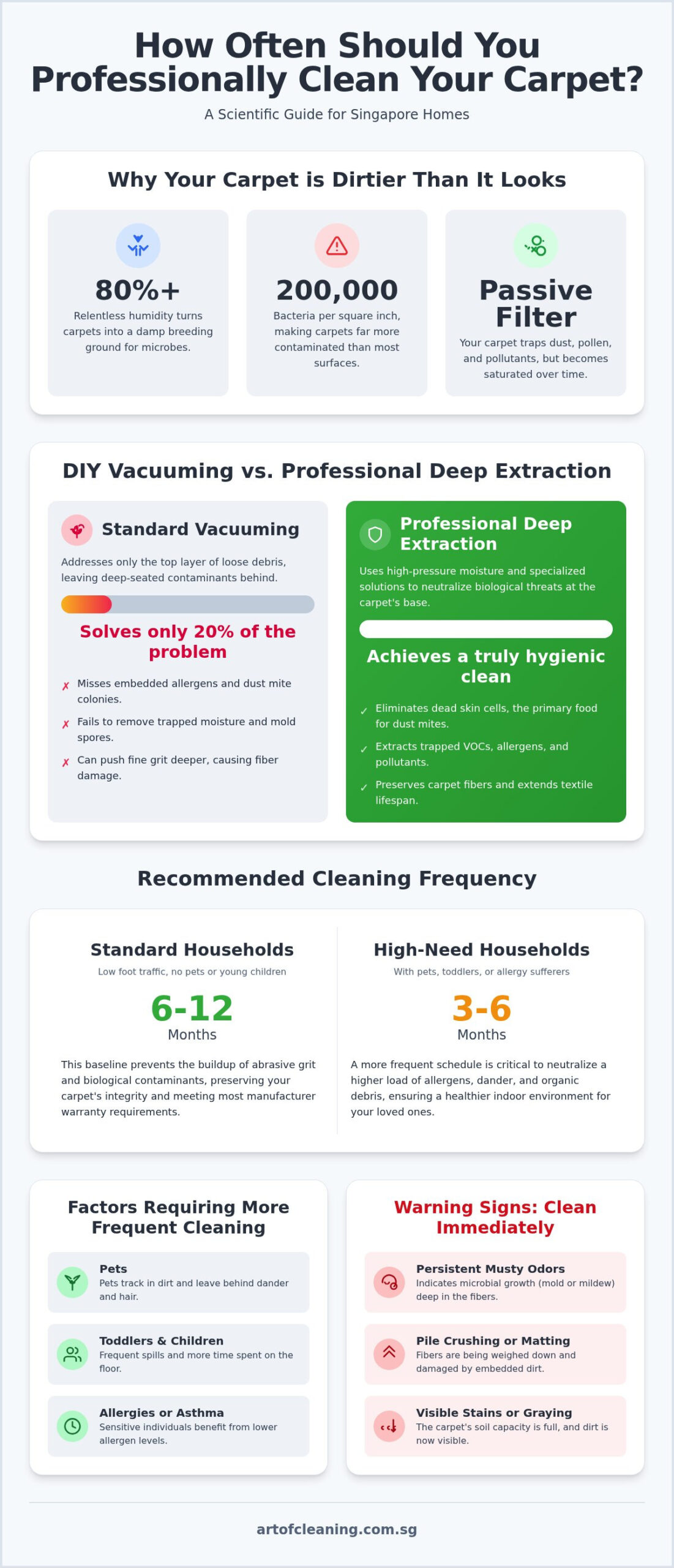
- Learn exactly how often to professionally clean carpets by establishing a 6–12 month baseline tailored to your specific household traffic and environmental needs.
- Identify the specific factors, such as the presence of pets or toddlers, that necessitate a more frequent 3–6 month deep cleaning schedule to neutralize allergens.
- Recognize the critical warning signs—like persistent musty odors and pile crushing—that indicate your carpet requires immediate professional intervention.
- Discover how specialized deep extraction techniques remove invisible microbial threats and prolong the lifespan of your home’s textiles.
Beyond the Surface: Why Carpet Appearance is Deceptive in High-Humidity Climates
In Singapore, your carpet isn’t just a decorative floor covering; it’s a massive, passive air filter. It works 24 hours a day to pull dust, pollen, and airborne pollutants out of the breathing zone. While this helps indoor air quality initially, these fibers eventually reach a saturation point. In our local climate, where humidity frequently exceeds 80%, this “filter” becomes a damp breeding ground. Moisture trapped deep within the pile promotes rapid microbial growth that remains invisible to the naked eye. This is why the question of how often to professionally clean carpets is a matter of environmental health rather than just aesthetics.
The Science of Indoor Air Quality
The air inside your home circulates through these fibers constantly. When a carpet is neglected, it stops trapping particles and starts releasing them back into your living space every time you step on it. This creates a cycle of respiratory triggers, particularly for those sensitive to dust mites or mold spores. Professional intervention focuses on reducing the total contaminant load. Bio-burden is the total microbial load in a textile. By managing this load through scientific sanitation, you directly improve the breathability of your home, transforming a potential health hazard back into a functional filter for your family.
Why Vacuuming Only Solves 20% of the Problem
Many homeowners believe that a high-end vacuum with a HEPA filter is sufficient for maintenance. However, standard suction only addresses the top layer of loose debris. It fails to reach the carpet backing where the heaviest contaminants settle. In fact, the mechanical action of a vacuum brush can sometimes push fine grit and skin cells deeper into the pile, where they act like sandpaper on the fibers, causing premature wear. To achieve a truly hygienic result, you must move beyond surface care.
Various carpet cleaning methods, such as professional-grade deep extraction, use high-pressure moisture and specialized solutions to break the bond between dirt and fiber. This meticulous process removes several hidden threats:
- Dead skin cells: These serve as the primary food source for dust mite populations.
- Volatile Organic Compounds (VOCs): Chemical traces from household products and outdoor smog trapped in the weave.
- Embedded allergens: Microscopic particles that standard consumer filters often miss.
Understanding these hidden threats helps determine how often to professionally clean carpets to ensure your indoor environment remains a safe sanctuary. While your carpet might look clean today, the invisible bio-burden beneath the surface tells a different story about your home’s hygiene.
Standard Frequency: How Often Should You Clean Your Carpets?
Establishing a consistent hygiene schedule is the most effective way to protect your investment and your health. While global Carpet and Rug Institute recommendations often suggest a window of 12 to 18 months, the reality of living in a tropical, high-density environment requires a more proactive approach. For most local households, the baseline for how often to professionally clean carpets should be every 6 to 12 months to prevent the accumulation of deep-seated biological contaminants.
A “pre-emptive strike” strategy is essential here. You shouldn’t wait for visible graying or stains to appear before booking a service. By the time dirt becomes visible to the eye, abrasive grit has already migrated to the base of the fibers, where it acts like sandpaper, cutting into the yarn with every footstep. Regular professional extraction removes these microscopic shards, preserving the carpet’s structural integrity and ensuring you meet the strict maintenance requirements often found in manufacturer warranties.
Residential Frequency Guidelines
Your specific household dynamics dictate your ideal schedule. A single professional living in a high-floor apartment with a strict indoor-only footwear policy may only require an annual deep clean. However, larger families with active children generate a significantly higher volume of skin cells and organic debris, necessitating a 6-month interval to maintain air quality. For low-usage areas like guest rooms, an 18-month cycle is generally acceptable, provided the space is kept ventilated to prevent musty odors from settling in the fibers.
Commercial and Office Carpet Schedules
Workplace environments face a much higher “bio-burden” due to constant foot traffic from outdoor areas. Lobbies, corridors, and communal zones act as magnets for street pollutants and fine particulates. To maintain a professional appearance and a healthy workforce, these high-traffic zones require quarterly deep cleaning. Implementing a specialized office cleaning services singapore strategy allows businesses to manage these invisible threats systematically. If you aren’t sure where your space falls on this spectrum, you can consult with a hygiene specialist to develop a customized maintenance plan.
Personalizing Your Schedule: 4 Key Factors That Increase Cleaning Frequency
While general Carpet and Rug Institute guidelines provide a foundational baseline, your home’s unique “bio-load” dictates a more tailored approach. Determining how often to professionally clean carpets requires an honest assessment of your daily lifestyle and environmental exposure. For many households, the standard 12-month interval is insufficient to manage the specific contaminants introduced by pets, children, or local urban development.
The Pet Owner’s Maintenance Arc
Living with furry companions introduces a steady stream of biological waste that remains invisible to the naked eye. Beyond the obvious mud or occasional accident, pets shed significant amounts of dander and skin cells that settle deep into the carpet backing. These organic materials serve as a primary food source for dust mites and can harbor flea larvae, even in well-maintained homes. To neutralize these threats and prevent persistent odors from becoming permanent, pet owners should schedule a professional deep extraction every 4 to 6 months. This frequency ensures that antimicrobial treatments can effectively manage the microbial load before it impacts your home’s air quality.
Allergies and Respiratory Health
If any family member suffers from asthma, eczema, or chronic allergies, your carpet serves as a critical reservoir for triggers. In 2026, the standard for healthy living involves aggressive dust mite eradication and the removal of fine particulate matter that standard vacuums leave behind. Toddlers and young children are particularly vulnerable, as they spend the majority of their time playing directly on the floor where these allergens are most concentrated. For a truly sterile environment, we recommend aligning your carpet care with other hygiene services like mattress cleaning singapore to ensure total room sanitation every 3 to 6 months.
External environmental factors also play a significant role in your cleaning cycle. If you live near an active construction site or prefer keeping your windows open to the tropical breeze, your carpets will accumulate soil at an accelerated rate. Fine silica dust and outdoor pollutants act like microscopic blades, shredding carpet fibers from the inside out. In these scenarios, increasing the frequency of professional care is an artisanal investment in your home’s longevity. By removing these abrasive elements before they settle, you prevent the “graying” effect and keep your indoor environment fresh and reliable.
- Pet Dander: Requires extraction every 4–6 months to prevent odor saturation.
- Toddler Safety: High-frequency cleaning (every 3–6 months) protects developing respiratory systems.
- Allergy Protocols: Quarterly deep cleaning removes deep-seated pollen and dust mite waste.
- Construction Dust: Immediate professional care is needed following nearby renovation or heavy outdoor work.
Warning Signs Your Carpet Needs Immediate Professional Care
Many homeowners rely on a purely reactive approach, waiting for a major spill before considering how often to professionally clean carpets. However, your carpet often sends subtle distress signals long before a visible stain appears. If you ignore these indicators, you risk permanent damage to the textile’s structural integrity and a significant decline in your home’s air quality. Recognizing these markers early is a key part of a proactive hygiene strategy.
The Olfactory Test: Beyond Air Fresheners
A faint, persistent “musty whiff” is a clear indicator of deep microbial activity within the fibers. In Singapore’s high humidity, moisture trapped in the carpet backing allows bacteria and mold spores to thrive, producing volatile organic compounds that smell like damp socks. Surface-level sprays or air fresheners only mask the issue temporarily. Professional deodorization neutralizes at the molecular level. This scientific approach removes the source of the scent rather than just hiding it, ensuring your living space is truly fresh rather than just perfumed.
Visual Degradation and Fiber Health
Grit is the silent killer of fine textiles. When fine sand and soil migrate to the base of the pile, they act like microscopic blades. Every time someone walks across the room, these particles saw away at the yarn. This results in “pile crushing,” where the fibers lose their ability to stand upright and feel stiff or matted. You may also observe the “shadow effect,” which is a distinct darkening in high-traffic walkways. This isn’t just surface dirt; it’s often a combination of deep-seated grease and physical fiber abrasion. If you notice “filtration soiling,” those dark gray lines appearing at the room’s perimeter, your carpet’s “filter” is completely full. Neglecting these signs leads to a point of no return where the damage becomes permanent.
Your body might also be sending its own warning signs. Are you or your children sneezing more often when you’re at home? Unexplained skin irritation or a sudden spike in respiratory triggers often points toward a saturated carpet. When the textile can no longer hold onto dust mites and pollutants, they become airborne with every footstep. If you notice any of these health-based red flags or visual changes, it’s time to book a professional deep extraction to restore your environment’s safety.
- The Musty Whiff: Signals active microbial growth in the backing.
- Pile Crushing: Indicates abrasive grit is destroying fiber structure.
- The Shadow Effect: Shows deep-seated grease in high-traffic zones.
- Filtration Soiling: Dark lines at the edges mean the carpet can no longer filter air.
- Health Triggers: Increased sneezing or skin issues suggest a saturated bio-burden.
The Art of Cleaning Difference: Meticulous Deep Extraction
Understanding how often to professionally clean carpets is the first step toward a healthier home, but the methodology used during that window is what truly defines your indoor air quality. Art of Cleaning approaches every project with an artisanal mindset, treating textile care as a precision craft rather than a commoditized service. We prioritize scientific hygiene over mere surface aesthetics, ensuring that the invisible threats discussed in previous sections are systematically removed from your living space.
Our commitment to excellence is backed by professional-grade extraction equipment and a team trained to meet the highest industry standards. We don’t just wash the surface. We perform a deep-seated restoration that targets the very base of the carpet pile. This meticulous focus on detail is why our brand has become a trusted name for families who view cleanliness as a fundamental component of their well-being.
Our Specialized Hygiene Process
Every service begins with a thorough assessment of your carpet’s condition. We identify high-traffic zones and stubborn stains that require specialized pre-treatment to break down organic bonds. Following this, we utilize deep steam extraction to reach the carpet backing, flushing out the grit and bio-burden that standard equipment leaves behind. This process is detailed further in our guide to professional carpet cleaning singapore, which outlines our health-first philosophy. Our goal is to leave your home refreshed, sanitized, and structurally sound.
Why National Clients Trust Art of Cleaning
As an NEA-licensed specialist, we maintain a level of transparency and reliability that sets us apart in the regional market. Our expertise has been featured on major national media platforms, serving as a hallmark of our verified identity and prestige. We believe in providing expert consultations and clear, upfront pricing so you can make informed decisions about your home’s maintenance. Our process is designed to be seamless, from the initial booking to the final post-cleaning inspection, ensuring a low-friction experience for every client.
The health of your home shouldn’t be left to chance. By aligning your maintenance schedule with our professional intervention, you protect both your investment and your family’s respiratory health. Don’t wait for visible dirt to dictate your hygiene strategy. Book your professional hygiene assessment today and experience the Art of Cleaning signature of quality.
- Precision Craft: We treat every carpet with an artisanal level of care.
- Scientific Hygiene: Our focus is on removing 99% of invisible contaminants.
- Verified Prestige: Recognized by major national media for our service standards.
- Total Transparency: No hidden fees, just expert results and reliable service.
Investing in a Healthier Home Environment for 2026
Your carpet’s role as a passive air filter is vital for maintaining high indoor air quality. In Singapore’s 80% humidity, proactive maintenance is the only way to prevent your home’s foundation from becoming a reservoir for allergens. Understanding how often to professionally clean carpets allows you to move beyond reactive cleaning and adopt a scientific hygiene strategy. By targeting the bio-burden hidden deep within the fibers, you ensure your living space remains a safe sanctuary for your family.
As an NEA Licensed Specialist featured on MediaCorp and Channel 8, Art of Cleaning delivers a level of precision that goes beyond standard service. Our deep extraction methodology is backed by over 1,500 5-star reviews, reflecting our commitment to meticulous care and transparent results. We take pride in being the guardians of your home environment, using professional-grade equipment to neutralize invisible threats. It’s time to prioritize the well-being of your household with a schedule that reflects your specific needs.
Secure Your Home’s Health with Art of Cleaning’s Specialist Carpet Care
Take the final step toward a truly refreshed and allergen-free home today.
Frequently Asked Questions
Is professional carpet cleaning worth it if I vacuum every day?
Daily vacuuming only addresses about 20% of the soil within your home. It cannot reach the heavy grit or biological contaminants that settle at the base of the fibers over time. Professional intervention is essential to remove the deep-seated bio-burden and neutralize bacteria that thrive in high humidity. This process restores the carpet’s function as an effective air filter, ensuring your indoor environment remains safe for your family.
How long does it take for a professionally cleaned carpet to dry?
Most carpets will be touch-dry within 4 to 8 hours after a deep extraction service. In our local climate, drying times are influenced by airflow and ambient humidity levels. We recommend keeping your air conditioning or ceiling fans running to accelerate moisture evaporation. Using professional-grade equipment ensures that the majority of the water is extracted during the cleaning process, preventing any risk of mold growth in the backing.
Can professional cleaning remove old, set-in pet stains and odors?
Professional deep extraction is highly effective at neutralizing organic stains and persistent biological odors. Unlike surface-level cleaners, our specialized solutions break down the molecular bonds of pet waste and dander deep within the pile. While the success rate depends on the age of the stain and the carpet’s fiber type, we can significantly improve both the appearance and the hygiene of affected areas by flushing out trapped contaminants.
What is the difference between steam cleaning and dry carpet cleaning?
Steam cleaning uses pressurized hot water to flush out dirt from the carpet backing, while dry cleaning typically relies on surface-level chemicals and minimal moisture. For a true deep clean, steam cleaning is the superior choice for sanitization and allergen removal. It reaches the base of the pile to extract the invisible soil and bacteria that dry methods often leave behind in the textile fibers.
Will professional cleaning shrink or damage my delicate rugs?
Meticulous care prevents any risk of shrinkage or damage to delicate textiles. Our artisanal approach involves a pre-inspection to determine the fiber composition and dye stability of your rugs before we begin. By adjusting the water temperature and pressure settings specifically for wool or silk, we ensure a safe restoration. This specialized attention to detail preserves the structural integrity of your high-value floor coverings while achieving a deep hygienic clean.
How often should carpets be cleaned in a commercial office setting?
High-traffic office environments generally require professional care every 3 to 6 months to manage the heavy accumulation of street pollutants. Determining how often to professionally clean carpets in a commercial setting depends on footfall patterns and the layout of communal zones. Regular maintenance prevents the “shadow effect” in corridors and ensures a healthier workspace for employees by reducing airborne particulates and dust mite waste in the air.
Are the cleaning chemicals used safe for infants and pets?
The solutions we utilize are formulated to be safe for both infants and pets once the extraction process is complete. Our methodology ensures that no harmful chemical residues remain in the fibers. We prioritize environmental health by using professional-grade products that effectively sanitize the pile without compromising the safety of those who spend their time playing or resting directly on the floor surfaces in your home. For readers seeking similar non-toxic cleaning standards in the Central Florida area, you can check out Aurofresh Cleaning for professional residential and commercial care.
Waiting too long results in irreversible fiber abrasion and a dangerous spike in the local microbial load. Accumulated grit acts as a physical blade, shredding the yarn from the inside out with every footstep you take. Additionally, the carpet’s ability to trap allergens eventually fails, which can trigger respiratory issues for occupants. Deciding how often to professionally clean carpets proactively is the only way to avoid premature replacement and health-related complications.