
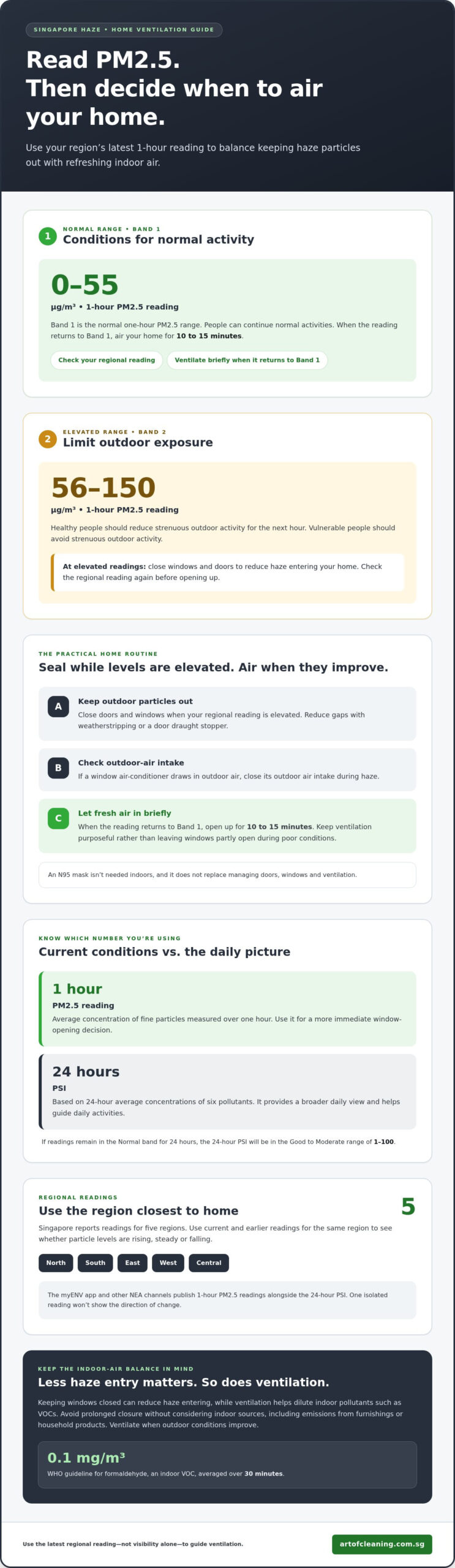
Haze is airborne pollution that can reduce visibility and contain fine particles; PM2.5 refers to particles 2.5 micrometres or smaller. To protect indoor air quality in Singapore during haze, use your region’s 1-hour PM2.5 reading as a guide: close doors and windows when levels are elevated, then air your home for 10 to 15 minutes when the reading returns to Band I.
It’s easy to rely on how hazy the sky looks, but the latest reading gives a more useful signal for deciding whether to keep windows closed or let fresh air in. This guide explains what haze is, how to interpret Singapore’s PM2.5 bands, and what practical steps can reduce particles entering your home. You’ll also learn how the 1-hour reading differs from the 24-hour PSI, so you can make a more informed choice as conditions change.
Key Takeaways
- Use your region’s 1-hour PM2.5 reading to guide when to keep windows closed and when to air your home.
- Balance limiting outdoor haze particles with maintaining indoor air quality when windows stay shut.
- Adjust outdoor activity based on the PM2.5 band, especially for children, older adults and people with existing health conditions.
- Reduce particles entering your home by closing doors and windows during haze and using suitable indoor air filtration.
- Understand how the 24-hour PSI differs from the more immediate PM2.5 reading before deciding what to do.
Window-closing and airing guidance based on 1-hour PM2.5 readings
Use Singapore’s 1-hour PM2.5 reading to judge current conditions, then decide whether to close windows or air your home. The reading reflects one hour, while the 24-hour PSI provides a broader daily view.
One-Hour PM2.5 and 24-Hour PSI
A 1-hour PM2.5 reading is the average concentration of fine particles measured over one hour; the 24-hour PSI is based on 24-hour average concentrations of six pollutants. The shorter measure can better reflect current conditions when deciding whether to open windows, while PSI helps guide daily activities.
In Singapore, Band 1 is the normal one-hour PM2.5 range of 0-55 µg/m³, and people can continue normal activities, according to the National Environment Agency Singapore. If readings remain in the Normal band for 24 hours, the 24-hour PSI will be in the Good to Moderate range of 1-100. Check the 1-hour reading when making an immediate ventilation decision, rather than relying only on the daily index.
Current and Historical Regional Readings
Singapore reports air-quality readings for five regions: North, South, East, West and Central. The myENV app and other NEA channels publish 1-hour PM2.5 readings alongside the 24-hour PSI, so use the region closest to your home when assessing current conditions.
Pollutant concentrations can differ across regions and shift over time. Compare the current figure with earlier readings for the same region to see whether particle levels are rising, steady or falling; one isolated reading won’t show that direction. Historical readings help you judge whether to keep windows shut for longer or prepare to air the home when levels return to Band 1.
Sealing Windows While Maintaining Ventilation
To keep haze out, close windows and doors when the regional reading is elevated, and reduce gaps with weatherstripping or a door draught stopper. Keep ventilation purposeful rather than leaving windows partly open during poor conditions; when the reading returns to Band 1, air the home for 10 to 15 minutes.
This answers the practical balance: seal gaps while outdoor particles are elevated, then use a short airing period when conditions improve. If a window air-conditioner draws outdoor air, close its outdoor air intake during haze. An N95 mask isn’t needed indoors, and it doesn’t replace managing doors, windows and ventilation. Check the regional reading again before opening up, because conditions can change between hourly updates.
Haze in Singapore: Is Your Indoor Air Safe?
Singapore’s haze guidance uses outdoor PM2.5 readings and PSI to inform exposure precautions; indoors, reduce particle entry and manage ventilation. The public-health advice focuses on exposure, while building operators can use current readings to guide outdoor-air intake and ventilation decisions.
Balancing Haze Particles and Indoor VOCs
Keeping windows closed can reduce the amount of haze entering, but ventilation also helps dilute indoor pollutants such as volatile organic compounds (VOCs). The practical balance is to limit outdoor air when readings are elevated, then ventilate when conditions improve.
Formaldehyde is one indoor VOC: the World Health Organization guideline is 0.1 mg/m³ averaged over 30 minutes. A field study of nine new homes tracked 39 VOCs and found most indoor concentrations were inversely proportional to air exchange rates. Avoid prolonged closure without considering indoor sources, such as emissions from furnishings or household products.
Indoor Air Quality Guidance During Haze
Singapore’s haze advice helps households manage exposure using outdoor PM2.5 readings and PSI; it does not make an outdoor reading an indoor measurement. For buildings, use current conditions to manage outdoor-air intake and ventilation, rather than assuming the same setting suits every haze level.
For example, if a window air-conditioner draws in outdoor air, close its outdoor intake during haze. When outdoor readings improve, ventilation can help dilute indoor VOCs. The goal is to balance limiting particle entry with reducing indoor pollutant build-up, an approach often emphasized by HVAC providers like Comfort Boys Air and Heating when managing residential airflow and ventilation.
Outdoor precautions depend on both the reading and the activity. When one-hour PM2.5 is 56-150 µg/m³, Band 2, Elevated, healthy people should reduce strenuous outdoor activity for the next hour, while vulnerable people should avoid it, according to the National Environment Agency Singapore. At PSI above 100, children should minimise prolonged or strenuous outdoor physical exertion.
Plan outdoor activities around the latest readings, not visibility or weather alone. At PSI values from 101-200, the National Environment Agency Singapore classifies conditions as Unhealthy. Reduce prolonged or strenuous exertion, especially for people with existing respiratory or heart conditions, older adults, children, and pregnant people.
Mask guidance depends on exposure duration and particle levels. Singapore’s Ministry of Health advises people who must be outdoors for several hours to wear an N95 or equivalent mask if PM2.5 is above 250 µg/m³. N95 masks are generally recommended when PSI exceeds 300 and prolonged outdoor exposure is unavoidable. Women in the second and third trimesters of pregnancy should not use an N95 or equivalent mask for a long duration.
A short trip and prolonged outdoor exertion involve different levels of exposure. Check current regional readings before planning outdoor activities, and choose an indoor setting when conditions call for reduced exposure. During haze, the right ventilation approach can change as outdoor particle levels rise or fall.
Health advice for healthy and vulnerable people
Singapore’s haze advice uses one-hour PM2.5 readings to guide activity over the next hour. PSI provides a broader daily health category, while symptoms and personal health also matter.
Health Advisories Across PSI and AQI Categories
PM2.5 bands and PSI categories indicate when outdoor exposure should be reduced or avoided. The National Environment Agency Singapore advises that when one-hour PM2.5 is 56-150 µg/m³ (Band 2, Elevated), healthy people should reduce strenuous outdoor activities for the next hour, while vulnerable people should avoid them.
At 151-250 µg/m³ (Band 3, High), healthy people should avoid strenuous outdoor activities for the next hour, and vulnerable people should avoid all outdoor activities for the next hour, according to the National Environment Agency Singapore. Band 4 (Very High) begins at 251 µg/m³; healthy people should minimise all outdoor activities for the next hour, while vulnerable people should avoid all outdoor activities for the next hour, according to the National Environment Agency Singapore.
Haze Symptoms and Health Effects
Haze can irritate the eyes, nose and throat, even when short-term exposure doesn’t cause major health issues for healthy people. Singapore’s PSI descriptor is Unhealthy for values from 101-200, according to the National Environment Agency Singapore. AQI is a separate index: values from 151-200 are classified as Unhealthy, while 201-300 are associated with advice to avoid outdoor exertion for people with respiratory disease.
Seek medical care if symptoms are severe, persist or worsen, particularly if you have asthma or another chronic respiratory condition. As of 12 October 2026, Singapore had activated the Public Health Preparedness Clinic Scheme and Haze Subsidy Scheme for haze-related medical needs.
Precautions for People Most at Risk
Children, older adults, pregnant people and those with asthma, heart disease or chronic lung conditions may need extra care during haze. At PSI above 100, children should minimise prolonged or strenuous outdoor physical exertion. For everyone, compare the latest reading with the activity planned, since strenuous exercise increases exposure compared with resting indoors.
Singapore’s Ministry of Health advises people who must be outdoors for several hours to wear an N95 or equivalent mask if PM2.5 is above 250 µg/m³. N95 masks aren’t needed indoors or for brief exposure, such as walking from a bus stop to a shopping centre. Women in the second and third trimesters of pregnancy should not use an N95 or equivalent mask for a long duration.
When readings rise, vulnerable people should avoid outdoor activities for the next hour and follow relevant health advice. If you have asthma, follow your existing care plan and reduce exertion when advisories recommend it. These precautions help limit exposure without treating every haze reading as equally risky.
Household steps to reduce exposure to haze particles
During haze, reduce the particles entering your home, then remove those that settle indoors. Monitor regional PM2.5 readings and adjust ventilation, filtration and cleaning as conditions change.
Cleaning Settled Haze Particles
Haze particles can settle on floors, furniture and fabrics after entering your home. Wipe hard surfaces with a damp cloth and mop floors. Dry dusting and sweeping can stir settled dust back into the air.
Wash exposed clothing and indoor fabrics when needed, and avoid drying laundry outdoors during haze, as particles can settle on it. Give particular attention to frequently touched surfaces and areas near windows or entrances. These steps remove settled particles, but do not prevent new ones from entering.
Vacuuming can stir up dust if the machine releases particles back into the room. Where available, use a vacuum with effective filtration and follow its care instructions. If outdoor readings remain elevated after cleaning, keep doors and windows closed.
Choosing a Home Air Purifier
A portable air purifier with a HEPA filter can capture PM2.5 and help reduce indoor particle levels. For a Singapore home, choose a model whose stated room coverage matches the bedroom or living area where it will operate; a unit suited to one room may not clean the whole home.
Check the purifier’s clean-air delivery information and filter replacement guidance, then place it where air can circulate freely. A purifier is most useful in occupied rooms, such as a bedroom overnight or a living area during the day. Keep the intake and outlet clear, and maintain the filters as directed.
Avoid air cleaners that intentionally produce ozone, which the US Environmental Protection Agency advises against. Ozone-producing devices are not a safe substitute for particle filtration. A purifier only treats air in its operating space, so continue to manage doors, windows and outdoor-air intakes.
For a window air-conditioner that draws air from outside, close its outdoor-air intake during haze. Check and replace air-conditioning filters more frequently during haze season, since they can accumulate particles faster; professional HVAC providers like BulletProof Air can assist with cooling system maintenance and filter servicing. Keep an eye on the one-hour PM2.5 reading: when it is elevated, limit outdoor-air entry; when it returns to normal conditions, ventilate the home as appropriate.
For strenuous outdoor activity, follow current readings and health advice rather than relying on an indoor purifier. A HEPA unit can help improve air in a room, but it does not protect someone outdoors or remove the need to reduce exposure. Combine filtration, careful ventilation and regular surface cleaning to manage particles throughout the home.
24-Hour Pollutant Standards Index (PSI) descriptors
Singapore’s 24-hour PSI combines pollutant data into a daily indicator for understanding air pollution and planning activities. Its descriptor helps put haze conditions into context, but it isn’t a substitute for the shorter-term PM2.5 reading when considering immediate exposure.
The PSI is derived from 24-hour average concentrations of six pollutants. Singapore uses the 24-hour PSI to guide daily activities, while the one-hour PM2.5 reading can better reflect current conditions for immediate outdoor-exposure decisions. That distinction matters during haze: a daily index gives a broader picture, while a changing particle reading can signal whether conditions are worsening or easing now.
Singapore’s PSI descriptors are:
- Good: 0-50 PSI.
- Moderate: 51-100 PSI.
- Unhealthy: 101-200 PSI, according to the National Environment Agency Singapore.
- Very Unhealthy: 201-300 PSI.
- Hazardous: above 300 PSI.
At 101-200 PSI, the Unhealthy descriptor signals that daily activity choices deserve attention. For example, reduce prolonged or strenuous outdoor activity rather than treating an indoor reading as equivalent to outdoor conditions. At 201-300 PSI, the descriptor becomes Very Unhealthy; above 300 PSI, it is Hazardous. These categories communicate increasing pollution levels, so use the relevant health advice alongside the index.
A PSI category describes outdoor air over a 24-hour period, not the air in a specific room. Indoor exposure also depends on whether haze particles enter through open windows, doors or an outdoor-air intake. A home can therefore need careful ventilation management even while the daily PSI remains below an Unhealthy descriptor. The index is a guide to ambient conditions, not a measurement of every indoor environment.
During Singapore’s haze season, episodes are more common between May and October. Use the PSI to understand the broader daily trend, then consider the current regional PM2.5 reading before deciding on strenuous outdoor plans or airing your home. If the 24-hour index remains steady but the shorter reading changes, the two measures are showing different time windows, not conflicting information.
Reading both measures gives a clearer picture: PSI supports daily planning, while one-hour PM2.5 helps assess immediate conditions. For indoor air quality during Singapore haze, use the PSI descriptor as context, not as the only decision point. Pair it with current particle readings and the relevant health guidance to choose sensible exposure precautions.
Art of Cleaning: Carpet Cleaning
Art of Cleaning’s Carpet Cleaning service helps remove accumulated dust and debris from carpets after haze particles enter the home. Professional cleaning can be useful when particles have settled into carpet fibres and routine vacuuming has not cleared the build-up. It complements, but does not replace, limiting outdoor air during elevated readings, suitable air filtration and careful ventilation.
For other fabric surfaces, Art of Cleaning also provides Rug Cleaning, Sofa Cleaning and Mattress Cleaning. These services address different areas of the home, from a rug near an entrance to upholstered furniture used every day. Choose the service that matches the items needing attention.
To discuss cleaning for your home, contact Art of Cleaning.
Make your home’s next step a cleaner one
Protecting indoor air quality in Singapore during haze season also means considering what settles on soft furnishings after particles enter your home. Regular cleaning supports your household routine alongside sensible ventilation and filtration. If carpets, rugs or sofas need attention, Art of Cleaning provides dedicated cleaning services for these fabric surfaces.
Start with the item that needs care most, whether it is a carpet near the entrance or a sofa used every day. Focused cleaning can complement regular home upkeep, while decisions about air quality should follow changing outdoor conditions.
Contact Art of Cleaning to discuss cleaning for your home. With practical habits and attentive care, you can keep building a more comfortable indoor environment through haze season.
Frequently Asked Questions
What is Haze?
Haze is air containing suspended particles and pollutants that can make the sky look smoky or reduce visibility. In Singapore, haze episodes are more common between May and October, and conditions can shift with regional weather. Smoke can travel beyond its source before reaching Singapore, so a hazy-looking day does not reveal the particle concentration near your home. Use air-quality readings to assess conditions rather than relying on sight alone.
Is smell or visibility a good indicator of air quality?
No. Smell and visibility can alert you to changing conditions, but neither measures PM2.5 concentration. Singapore’s NEA says burning smells are usually stronger at night because weaker winds and cooler temperatures slow pollutant dispersion. That stronger smell doesn’t necessarily mean the reading has increased by the same amount. For decisions such as outdoor plans or ventilation, compare your region’s air-quality readings rather than judging only by odour or the view outside.
What happens when air quality goes into the unhealthy range?
At a 24-hour PSI of 101-200, Singapore’s National Environment Agency describes the air quality as Unhealthy. People should reduce prolonged or strenuous outdoor activity, especially those more sensitive to haze. Short-term exposure over a few days generally causes healthy people irritation of the eyes, nose or throat rather than major health issues. If symptoms are severe, persistent or worsening, seek medical attention, particularly with asthma or another chronic respiratory condition.
What is PM2.5?
PM2.5 means fine particulate matter measuring 2.5 micrometres or smaller. These particles are small enough to remain suspended in air and enter the respiratory system when inhaled. A PM2.5 reading expresses particle concentration, while PSI combines data from six pollutants into an index. For example, Singapore’s one-hour PM2.5 reading can help you judge current conditions, while the 24-hour PSI offers a wider view of daily air quality.
When is it safe to open the windows?
Use the one-hour PM2.5 reading for your region and open windows when it returns to Band 1. Air the home for 10 to 15 minutes, then close up again if readings rise. For example, if the reading is elevated during the afternoon but back in Band 1 later, wait for that improvement rather than opening windows simply because the sky looks clearer. Keep ventilation decisions responsive to changing conditions.
AskST: How worrying is Singapore’s haze outlook, and how can you protect yourself?
Haze risk depends on conditions that can change, so treat forecasts as planning guidance and follow current readings. Singapore faced a high risk of severe haze for the rest of 2026, with conditions expected to peak from August to September; a positive Indian Ocean Dipole could prolong the dry season into October. Reduce exposure by limiting strenuous outdoor activity when advised, keeping outdoor particles out, and using suitable indoor filtration.
How does haze affect indoor air quality in Singapore homes and workplaces?
Outdoor haze particles can enter through open windows, doors and air intakes, then settle on floors, furniture and fabrics. At home or work, keeping outdoor air out for long periods can also limit the dilution of indoor pollutants, including VOCs. The balance is to manage outdoor-air entry when haze is elevated, then ventilate as conditions improve. Cleaning settled dust and maintaining air-conditioning filters can also support indoor air management.
How can I check real-time haze and air quality readings in Singapore?
Check the myENV app or other National Environment Agency channels for Singapore’s air-quality data. The channels publish one-hour PM2.5 readings alongside the 24-hour PSI for five regions: North, South, East, West and Central. Choose the region closest to your location, then note both the current reading and its recent direction. The shorter PM2.5 measure helps assess immediate conditions; PSI provides context for daily activities.