
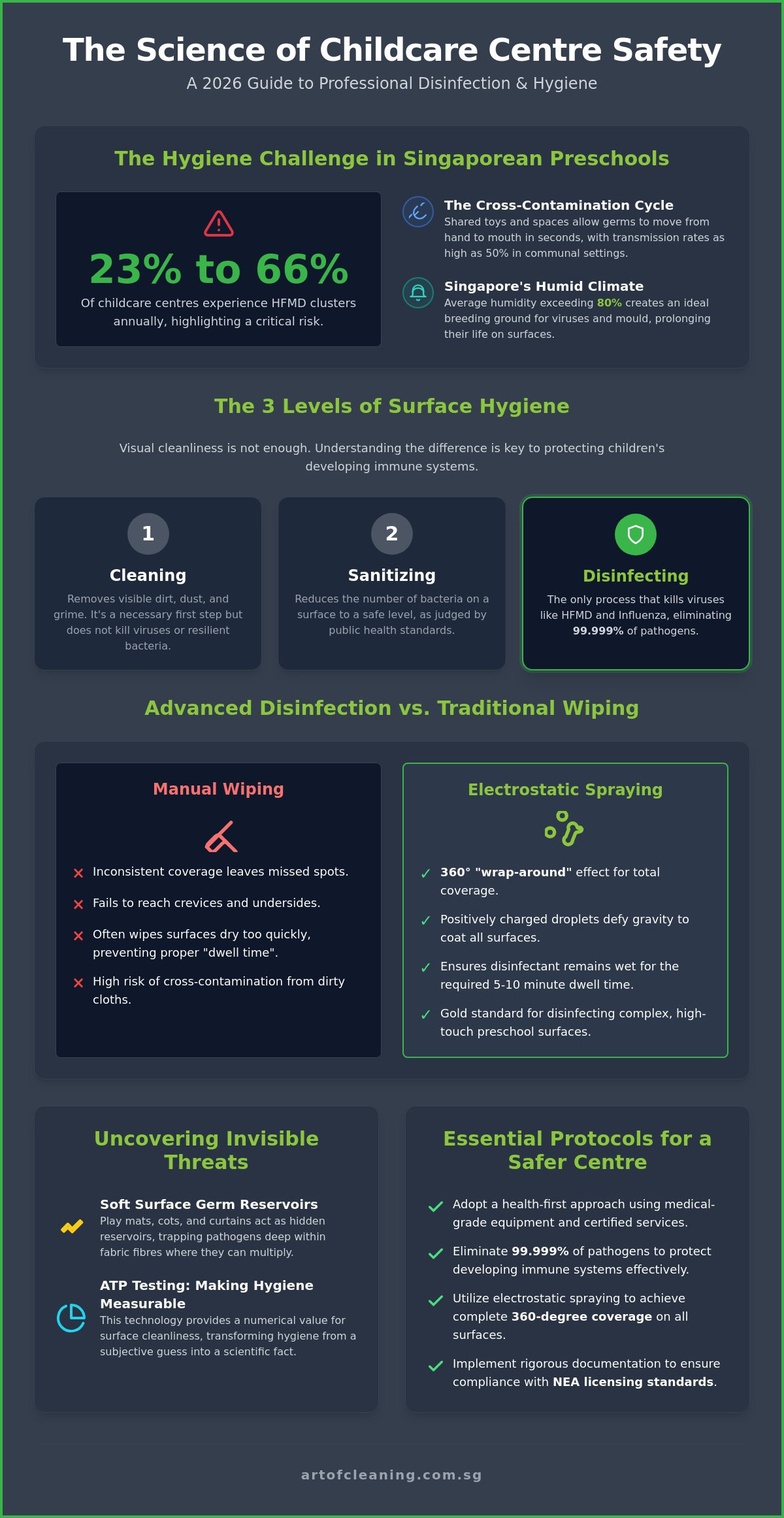
Did you know that between 23% and 66% of childcare centres in Singapore experience HFMD clusters every single year? This data underscores a persistent reality for preschool operators: surface-level cleaning is no longer enough to protect the children in your care. When daily cases of Hand, Foot, and Mouth Disease spike, the pressure to maintain a certified germ-free environment becomes a matter of both health and regulatory survival. Investing in specialized childcare centre disinfection services is the most effective way to address these hidden contaminants before they lead to widespread student absenteeism.
You likely agree that your primary mission is providing a safe space for growth, yet the constant worry over meeting stringent NEA licensing requirements and the safety of cleaning chemicals can be overwhelming. We’ve developed this 2026 guide to help you navigate these challenges with scientific precision and quiet confidence. You’ll discover how professional-grade disinfection protocols protect vulnerable immune systems while ensuring your facility exceeds national hygiene standards. We will also examine the latest advancements in non-toxic misting technology and explain how a meticulous sanitization strategy builds the deep parental trust your centre needs to thrive.
Key Takeaways
- Understand why professional-grade disinfection must eliminate 99.999% of pathogens to effectively protect the developing immune systems of children in high-density environments.
- Discover why electrostatic spraying has replaced manual wiping as the gold standard for achieving 360-degree coverage on complex preschool surfaces.
- Identify how soft surfaces like play mats, cots, and curtains act as germ reservoirs and learn the specialized methods required to sanitize these fabric fibres.
- Ensure your facility remains compliant with NEA licensing standards by implementing rigorous documentation and utilizing certified childcare centre disinfection services.
- Learn how a health-first approach using medical-grade equipment provides a superior level of safety that goes beyond mere surface-level tidiness.
The Science of Safety: Why Childcare Disinfection is Non-Negotiable in 2026
Professional disinfection isn’t a vague term; it’s a scientific benchmark. It refers to a “5-log reduction,” which is the elimination of 99.999% of harmful pathogens on a treated surface. In a high-density preschool, this precision is vital because children’s immune systems are still learning to recognize and fight off threats. Singapore’s unique environment adds another layer of complexity. Our average humidity often exceeds 80%, creating an ideal breeding ground for mould and prolonging the life of viruses on surfaces. When children share toys or dining areas, they participate in a “Cross-Contamination Cycle” that moves germs from hand to mouth in seconds. Following established school hygiene principles ensures that your facility contributes to Singapore’s national health resilience rather than becoming a hotspot for transmission.
The Impact of Viral Outbreaks on Childcare Operations
An HFMD outbreak is an operational nightmare that no principal wants to face. Data from 2018 to 2022 shows that as many as 1,073 childcare centres in Singapore experienced HFMD clusters in a single year. These outbreaks lead to mandatory closures, which disrupt learning and cause significant financial strain. Implementing scheduled childcare centre disinfection services is a proactive investment that directly reduces student and staff absenteeism. By maintaining a documented disinfection log, you also satisfy NEA requirements and provide parents with tangible proof of your commitment to safety. Common childhood illnesses often have transmission rates as high as 50% in communal settings, making rapid sanitization the only viable defense.
Addressing the “Invisible Threats” in Play Zones
Visual cleanliness is often deceptive. You can’t see the viral particles on door handles, cubbies, or shared learning materials. Standard detergent cleaning is effective for removing visible dirt, but it lacks the chemical strength to deactivate resilient viruses. It often leaves behind a microscopic biofilm where bacteria can continue to multiply. We solve this by using ATP (Adenosine Triphosphate) testing to quantify surface cleanliness levels. This technology provides a numerical value representing the biological matter left on a surface. It transforms hygiene from a subjective opinion into a measurable fact. High-quality childcare centre disinfection services use this data to target “hot zones,” ensuring that play areas are scientifically safe for every child.
Advanced Disinfection Technologies: Going Beyond Manual Wiping
Many preschools rely on traditional manual wiping. While this removes visible grime, it often fails to reach the undersides of chairs or the intricate crevices of toys. Effective childcare centre disinfection services move beyond surface aesthetics to achieve true microbial control. It’s vital to distinguish between three levels of hygiene. Cleaning removes physical soil; sanitising reduces bacteria to a safe level; but disinfection is the only process that kills viruses like HFMD and Influenza. Without 360-degree coverage, a single missed patch can restart the contamination cycle. Modern technology ensures every shadow and hidden edge receives the necessary “dwell time.” This is the specific duration, often between 5 to 10 minutes, that a disinfectant must remain wet on a surface to successfully deactivate pathogens. Wiping a surface dry too quickly often leaves the virus alive and active.
Electrostatic Spraying vs. Ultra-Low Volume (ULV) Fogging
Electrostatic spraying is the current gold standard for high-touch environments. By applying a positive charge to the disinfectant droplets, they actively seek out grounded surfaces. This creates a “wrap-around” effect. The solution literally defies gravity to coat the back of a door handle or the underside of a desk automatically. ULV fogging remains essential for large communal halls and classrooms with high ceilings. It disperses a fine mist, typically between 5 and 50 microns in size, that hangs in the air before settling on every horizontal and vertical surface. Together, these methods ensure no corner remains untreated. They provide a level of safety that manual labor simply can’t achieve in a busy preschool setting.
Selecting Child-Safe, Food-Grade Disinfectants
Safety is as important as efficacy when treating spaces for infants and toddlers. We prioritize hospital-grade solutions that are non-corrosive and pH neutral. This ensures they don’t damage expensive learning equipment or irritate sensitive skin. Using NEA-approved active ingredients is mandatory to meet state sanitation regulations for childcare, which emphasize the use of registered, non-toxic disinfectants. We also focus on eliminating volatile organic compounds (VOCs). This protects the air quality within the centre, preventing the harsh “chemical smell” often associated with industrial cleaning. Selecting NSF-certified, food-grade products is a critical step for dining areas where children’s hands frequently touch tables and then their mouths. For centres looking to upgrade their hygiene protocols, exploring specialized disinfection cleaning services ensures these technical standards are met with precision and care.
The Upholstery Germ Reservoir: Sanitizing Play Mats, Cots, and Curtains
Soft surfaces are often the most overlooked areas in preschool hygiene protocols. While hard surfaces like tables and doorknobs receive frequent attention, the porous nature of fabric fibres allows them to act as silent reservoirs for pathogens. Play mats, nap cots, and shared rugs don’t just hold dust; they trap allergens, skin cells, and viral particles deep within their structure. Standard surface wipes are ineffective here because they cannot penetrate the material’s pile. To achieve a truly clinical level of safety, your strategy must include specialized upholstery cleaning services that integrate deep-care extraction with chemical disinfection. This ensures that the high-density areas where children spend most of their time, particularly during nap and floor-play sessions, are scientifically verified as safe.
Deep Carpet and Rug Sanitisation
Vacuuming alone fails to remove pathogens from play rugs because it only addresses surface-level debris. In fact, standard vacuuming can sometimes aerosolize smaller particles, pushing them back into the breathing zone. We utilize hot water extraction to kill bacteria and viruses residing deep in the carpet piles. This process involves injecting pressurized heated water and medical-grade solutions into the fibres, then immediately extracting the liquid along with the loosened contaminants. For a more technical breakdown of this process, you can refer to our professional carpet cleaning guide. This method is the only way to ensure that the “Invisible Threats” discussed earlier are completely removed from the floor level.
Curtain and Soft Toy Decontamination
Curtains act as secondary air filters for your classrooms, trapping airborne contaminants and mould spores that thrive in Singapore’s high humidity. Over time, these fabrics become a significant source of indoor air pollution. We recommend steam cleaning as a chemical-free way to sanitise these large surface areas and shared soft toys. The high-temperature steam naturally deactivates germs without leaving behind any residue that might irritate a child’s skin. This focus on allergen removal provides immediate health benefits, especially for children with asthma or sensitive respiratory systems. Integrating these soft-surface protocols into your childcare centre disinfection services creates a comprehensive shield that protects every inch of the learning environment. It’s a meticulous level of craft that prioritizes the long-term well-being of your students over simple, surface-level tidiness.
Regulatory Compliance and Best Practices for Preschool Sanitization
Regulatory compliance in Singapore is rigorous for a reason. The National Environment Agency (NEA) maintains an Environmental Hygiene Checklist, last updated in July 2023, specifically for premises housing vulnerable individuals. It’s no longer enough to claim your centre is clean; you must provide a documented disinfection log that details the frequency and types of NEA-approved products used. This paper trail is often the first thing licensing inspectors examine. Engaging professional childcare centre disinfection services ensures that your records are always audit-ready and meet every technical requirement. We also recommend incorporating antimicrobial coatings on high-touch surfaces. These coatings provide a microscopic shield that continues to deactivate pathogens long after the initial application, offering an extra layer of security between scheduled deep cleans.
NEA Standards and Licensing for Childcare Centres
The Environmental Sanitation (ES) Regime is a mandatory framework for preschools. Inspectors look for evidence of professional cleaning contracts that address specific biological risks. An accredited cleaning partner doesn’t just wipe surfaces; they understand the nuances of pathogen deactivation. In Singapore’s tropical climate, humidity-driven mould is a significant regulatory concern. If an inspector finds mould on curtains or ceiling corners, it indicates a failure in environmental hygiene. Professional sanitization targets these moisture-prone zones to prevent spores from becoming a health hazard. It’s a level of precision that protects your license and your reputation.
Developing a Robust Hygiene Schedule
Consistency is the cornerstone of effective hygiene. You must differentiate between daily housekeeping and periodic professional intervention. While your internal staff handles daily spills, we recommend a quarterly deep-cleaning cycle for all soft furnishings, including rugs and nap cots. This frequency prevents the germ reservoirs mentioned earlier from reaching dangerous levels. For broader insights into maintaining commercial spaces, you can adapt our office cleaning strategy to fit your preschool’s unique operational flow. Establishing this cadence ensures your centre remains a safe haven for learning. If you’re ready to secure your facility’s health standards, contact Art of Cleaning to discuss a tailored compliance plan.
Art of Cleaning: Professional Hygiene Solutions for Singapore Childcare Centres
At Art of Cleaning, we view ourselves as the guardians of your educational space. Our specialized health-first approach to childcare centre disinfection services prioritizes the elimination of 99.999% of pathogens using medical-grade equipment and child-safe protocols. We don’t settle for mere surface-level tidiness; we prioritize the long-term well-being of every infant and toddler in your care. By combining our industry-leading upholstery expertise with advanced surface sanitization, we ensure that every rug, cot, and play mat is scientifically safe. For principals and centre managers seeking clarity, we invite you to review our pricelist for transparent service options that reflect our artisanal level of craft and commitment to health-based trust.
Why National Childcare Providers Trust Our Expertise
Our specialists undergo rigorous, specialized training designed specifically for sensitive environments. They understand the nuances of viral deactivation and the critical need for non-toxic, pH-neutral solutions that won’t irritate a child’s skin. This meticulous attention to detail is why our brand has been featured on major local broadcasting networks, serving as a powerful regional endorsement of our verified identity. We also recognize that your operational hours are sacred. Our teams provide flexible, after-hours service scheduling to ensure your facility is fully decontaminated without disrupting daily learning. This balance of efficiency and quiet confidence makes us a stable partner for Singapore’s leading preschools.
Customised Disinfection Plans for Your Facility
Every childcare facility has a unique architectural footprint and different high-traffic zones. We don’t believe in one-size-fits-all solutions. Our process begins with a detailed site assessment to identify specific hygiene challenges, from humidity-prone corners to high-density play zones. Our “Total Hygiene” package provides a systematic solution that covers hard surfaces, carpets, and aircon units to address both contact and airborne threats. By treating the aircon system, we help eliminate the mould spores and bacteria that circulate through the air, which is particularly vital in Singapore’s humid climate. This holistic method ensures that every potential transmission path is blocked. This comprehensive shield ensures that your centre exceeds NEA standards while fostering high parental trust. We invite you to contact our team for a professional consultation to secure your facility’s health and safety for the year ahead.
Securing the Future of Singapore’s Learning Environments
Maintaining a safe preschool requires a shift from surface-level tidiness to scientific pathogen control. We’ve explored how 360-degree disinfection technologies and deep upholstery sanitization address the invisible threats found in play zones and nap areas. By implementing these advanced protocols, you don’t just meet NEA requirements; you actively break the cross-contamination cycle that leads to viral outbreaks. Choosing specialized childcare centre disinfection services is a proactive investment in your facility’s operational stability and the health of your students.
Ensuring a safe and scientifically sound environment sets the stage for a child’s future academic success; as they advance to more complex levels of study, you can visit Learning Voyage Education Centre to see how they support students in subjects like chemistry.
Art of Cleaning brings a meticulous level of craft to every project. Our work has been featured on MediaCorp and Channel 8, reflecting our status as a trusted regional specialist. We use medical-grade, child-safe solutions that effectively deactivate viruses without compromising the safety of young children. Whether you need deep carpet extraction or total surface misting, our specialists provide the precision your centre deserves. Secure Your Centre’s Health with Art of Cleaning today. Together, we can create a resilient and thriving space where every child can grow with confidence.
Frequently Asked Questions
Is the disinfectant used safe for children and infants?
Yes, we use hospital-grade, non-toxic, and pH-neutral solutions that are specifically selected for their safety in infant environments. These products are NEA-approved and free from volatile organic compounds (VOCs). This ensures that surfaces are safe for immediate contact once dry, protecting children who frequently touch their mouths and faces. Our health-first approach prioritizes the safety of developing immune systems over simple surface-level tidiness.
How long after the disinfection service can children return to the classroom?
Children can typically return to the classroom within 30 to 60 minutes after the service is completed. Our electrostatic spraying and ULV fogging technologies create a fine mist that dries rapidly. This minimal downtime allows centres to maintain their operational schedules while ensuring a scientifically verified germ-free environment. We focus on efficiency so your curriculum continues without significant disruption to the children’s routine.
Does professional disinfection help prevent the spread of HFMD?
Professional disinfection is a critical tool for preventing HFMD clusters by achieving a 99.999% reduction in viral pathogens on surfaces. While it doesn’t stop person-to-person transmission, it effectively breaks the “Cross-Contamination Cycle” found in shared play and dining areas. This proactive approach is essential given that up to 66% of centres in Singapore have faced HFMD clusters in recent years. It’s a necessary shield for any high-density preschool.
What is the difference between standard cleaning and professional disinfection?
Standard cleaning removes physical debris, while professional childcare centre disinfection services target microscopic viruses and bacteria. Standard detergents lack the chemical potency to deactivate resilient pathogens like HFMD or Influenza. Our specialists use electrostatic technology to ensure 360-degree coverage, followed by ATP testing to verify that biological contaminants have been eliminated at a microscopic level. We provide a level of craft that goes beyond visual cleanliness.
How often should a childcare centre undergo professional deep disinfection?
We recommend a quarterly cycle for deep professional disinfection of all soft furnishings and high-touch zones. However, centres should increase this frequency during peak HFMD seasons or if a cluster is identified within the community. Maintaining this cadence ensures that germ reservoirs in carpets and curtains don’t reach levels that compromise student health. Consistent scheduling is the cornerstone of long-term environmental hygiene and regulatory compliance.
Will the disinfection process leave any sticky residue or unpleasant odours?
No, our specialized disinfection process leaves zero sticky residue and no harsh chemical odours. We prioritize medical-grade solutions that are designed to evaporate cleanly and safely. This maintains the air quality of your classrooms, ensuring a fresh and healthy environment for both students and staff immediately after treatment. You won’t have to worry about the “chemical smell” often associated with lower-quality industrial cleaning products.
Do you provide a certificate of disinfection for NEA licensing purposes?
Yes, we provide a comprehensive service report and a certificate of disinfection that assists with your NEA licensing and Environmental Sanitation (ES) Regime compliance. This document acts as a verified record of the professional-grade protocols applied to your facility. It gives parents and regulatory inspectors confidence that your centre meets the stringent hygiene standards updated by the NEA in July 2023. Our reports are detailed and audit-ready.
Can you perform the disinfection service after school hours or on weekends?
We offer flexible scheduling for childcare centre disinfection services, including after-school hours and weekends, to avoid disrupting your curriculum. Our specialists work around your operational needs to ensure the centre is fully sanitized before the children arrive the next morning. This non-disruptive approach allows you to prioritize health without sacrificing learning time. We take pride in being a dependable and stable partner for busy preschool operators.