
Recent data from Singapore Management University shows that public satisfaction with eatery hygiene has fallen to 82.7%, a worrying trend for any business owner. With the Singapore Food Agency’s SAFE framework now in full effect as of January 19, 2026, your establishment’s long-term track record is under the microscope. Achieving a Grade A rating requires meticulous attention to detail, starting with specialized commercial upholstery cleaning for restaurants to ensure every surface is scientifically decontaminated.
We understand that visible stains and trapped food odors are more than just an eyesore; they’re a threat to your brand’s prestige and guest trust. You shouldn’t have to choose between high replacement costs and a subpar dining environment. This guide promises to show you how professional deep cleaning protects your hygiene standards, extends the lifespan of your expensive furniture, and creates a truly premium experience for every guest who walks through your doors.
You’ll discover the latest 2026 trends in green cleaning technology and how to manage hygiene audits without disrupting your daily operations. We’ll also detail why treating your fabric as a bio-filter is the key to improving indoor air quality and maintaining a pristine, healthy space for years to come.
Key Takeaways
- Understand why surface-level tidiness isn’t enough and how hidden contaminants like skin cells and food particles affect your dining atmosphere.
- Learn the science behind hot water extraction and why it’s the gold standard for commercial upholstery cleaning for restaurants compared to traditional wiping.
- Identify the specific maintenance needs for different seating styles, from high-traffic dining chairs to the deep crevices of built-in banquettes.
- Discover how a data-driven cleaning schedule can significantly improve your ROI by extending furniture lifespan and avoiding premature replacement costs.
- Explore the benefits of partnering with specialists who use professional-grade, NEA-compliant solutions for a deep, artisanal level of hygiene.
The Critical Link Between Upholstery Hygiene and Restaurant Reputation
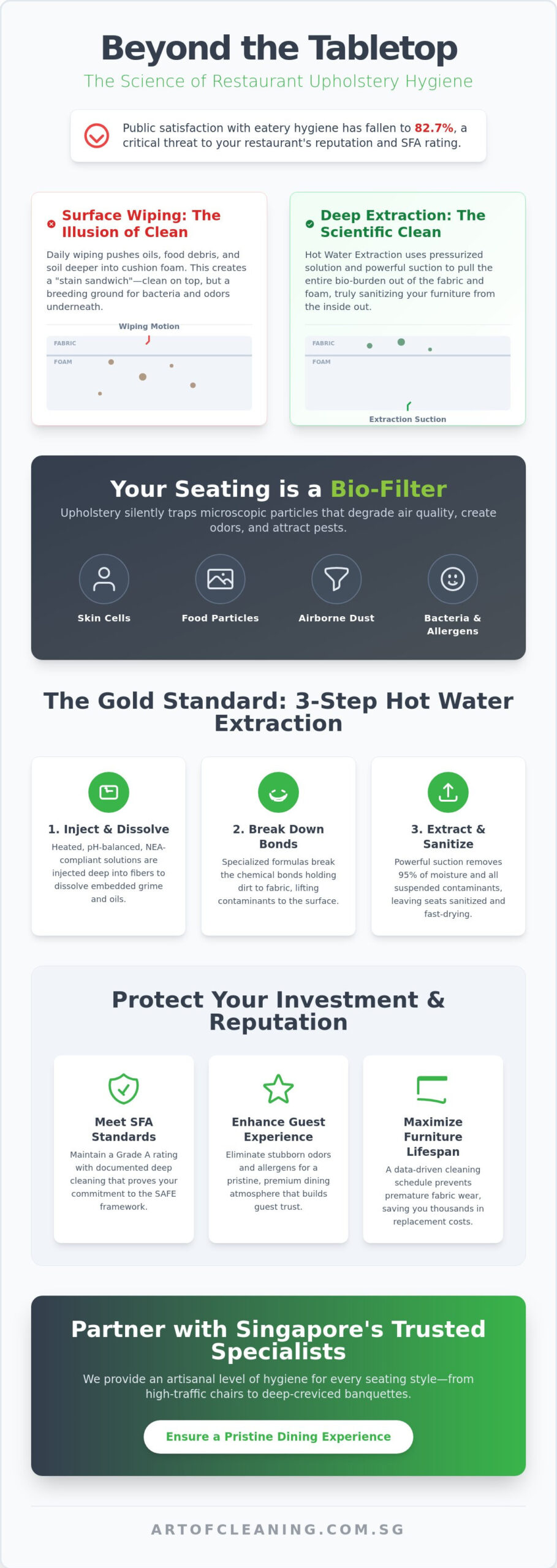
Commercial upholstery cleaning for restaurants is far more than a cosmetic touch-up; it’s a specialized decontamination protocol designed to eliminate the bio-burden that standard daily wiping misses. In a high-traffic F&B environment, seating acts as a massive bio-filter. Every day, your chairs and booths absorb a complex cocktail of microscopic skin cells, airborne dust, and fine food particles. While your staff might clear the table, these hidden contaminants settle deep into the fabric fibers, creating a reservoir of organic soil that affects the very air your guests breathe.
When upholstery becomes saturated with these particles, it directly impacts your indoor air quality (IAQ). Every time a guest sits down, the physical compression forces a plume of invisible dust and allergens back into the dining area. Maintaining high commercial cleaning standards ensures that these seating surfaces remain healthy rather than becoming a source of respiratory irritation. Guests might not see the bacteria, but they certainly feel the difference in a space that prioritizes deep hygiene over surface-level tidiness.
Beyond Aesthetics: The Sensory Dining Experience
A guest’s perception of your brand is shaped by sensory cues long before the food arrives. Whether it is the artistic flair of your hand-drawn menu boards from PoscART or the pristine condition of your seating, every element contributes to your reputation. Trapped organic matter within fabric undergoes a process of anaerobic decomposition, which is the primary cause of that lingering “old restaurant” odor that no amount of ambient scenting can mask. Tactile experience is equally vital. If a guest touches a chair and feels a sticky or oily residue, their trust in your kitchen’s sanitation vanishes instantly. This sensory failure often leads to negative online reviews that focus on “grimy” environments rather than your culinary skill. The silent brand killer is the invisible bacterial buildup in seating that signals a lack of care to your most observant customers.
Meeting NEA Standards and Hygiene Audits
Under the Singapore Food Agency’s SAFE framework, which became fully operational in early 2026, maintaining a Grade A rating requires a proven track record of consistent hygiene. Professional sofa and chair cleaning records serve as critical documentation during hygiene audits, proving your commitment to a Food Safety Management System (FSMS). Deep cleaning is also your first line of defense against pest infestations. Cockroaches and ants are naturally drawn to the microscopic food residue trapped in chair crevices and seams. By removing these food sources through deep extraction, you create an environment that is fundamentally hostile to pests, ensuring your restaurant remains compliant and your reputation stays pristine.
Deep Extraction vs. Surface Wiping: The Science of F&B Sanitation
Daily wiping is a standard practice in every dining room, but it’s often counterproductive for long-term hygiene. When staff use a damp cloth to scrub a spill, the mechanical pressure actually drives liquefied oils and food debris deeper into the porous cushion foam. This creates a “stain sandwich” where the surface looks clean, but the core remains a breeding ground for bacteria. Professional commercial upholstery cleaning for restaurants moves beyond the surface by utilizing Hot Water Extraction (HWE). This process involves a high-pressure injection of heated, pH-balanced solutions that break the bond between organic soil and fabric fibers.
The science of F&B sanitation requires a delicate balance of temperature and chemistry. Using water that’s too hot can set certain stains, while water that’s too cool fails to sanitize. Our specialized solutions are formulated to meet international FDA Food Code regulations, ensuring that no toxic residues are left behind in areas where guests eat. High-powered suction is the final, critical step. By recovering 95% of the injected moisture, we remove the suspended contaminants and drastically reduce drying times, which is essential for the fast-paced turnover of Singapore’s restaurant industry.
Tackling the “Big Three” Restaurant Stains
Oils and grease are the most frequent offenders in F&B environments. Standard detergents often fail to emulsify these kitchen-borne fats, leaving a sticky residue that attracts more dirt. Protein-based stains from dairy, eggs, or meat residues require a different scientific approach; they need specific enzymatic agents to break down their complex organic structures. Tannins and dyes found in wine, coffee, and turmeric-based sauces are equally challenging. These substances act like natural dyes on fabric. Our artisanal approach involves identifying the specific stain profile before selecting the correct pH-balanced agent to lift the pigment without damaging the material.
The Problem with Residual Moisture in High Humidity
Singapore’s persistent high humidity presents a unique environmental challenge for fabric care. If upholstery remains damp for too long, it becomes an ideal incubator for mould and mildew growth. This doesn’t just damage the furniture; it compromises the health of your guests. Industrial-grade moisture extraction is non-negotiable to achieve the necessary 4-6 hour dry times. You can learn more about our professional sofa cleaning techniques and how we manage these regional climate factors. For those managing busy dining rooms, ensuring a fast, safe return to service is vital. Partnering with a specialist ensures your seating is deep-cleaned and ready for the next shift without the risk of lingering dampness.
Tailoring Care for Different Restaurant Seating Styles
Every restaurant design presents unique sanitation challenges. A casual bistro with vinyl booths requires a different scientific approach than a Michelin-starred establishment featuring delicate velvet dining chairs. Effective commercial upholstery cleaning for restaurants must be tailored to the specific material and construction of each asset to avoid damage while ensuring deep hygiene. Treating all furniture with a one-size-fits-all method can lead to fiber degradation or ineffective soil removal.
Banquettes and Fixed Booth Seating
Banquettes are notorious for the “crumb zone,” the deep crevice where the seat cushion meets the backrest. This area acts as a collection point for food particles, dust, and even lost cutlery. Over time, these organic materials decompose, attracting pests and creating localized odors. Specialized “crevice” cleaning tools are essential to extract these hidden dangers. We also pay close attention to vertical surfaces. These often catch splashes from spilled drinks that staff might miss during a quick table reset. Sanitizing the baseboards and under-seat areas is equally critical, as these often become overlooked odor traps in enclosed dining spaces.
High-Traffic Dining and Bar Chairs
Dining and bar chairs experience intense physical contact throughout the day. The top rail is a primary germ-transfer point, touched by dozens of hands during every shift. Scientific decontamination of these touch-points is vital for guest safety. Meanwhile, seat pads absorb body oils and sweat, which can lead to unsightly darkening of the fabric. According to a study on customer perceptions of cleanliness, guests often equate the hygiene of public seating with the overall safety of the food served. You can view our specialized dining chair cleaning services to see how we address these high-traffic areas with precision.
Luxury materials like velvet or silk-blend fabrics require a meticulous, low-moisture approach. Using excessive heat or aggressive chemicals on these fibers can lead to “bruising” or permanent texture loss. For leather and faux-leather booths, the focus shifts to preservation. Without regular conditioning, these materials lose their natural oils, leading to unsightly cracking and peeling. Our artisanal process involves cleaning and then applying a professional-grade conditioner to maintain the material’s integrity, ensuring your investment lasts for years. This level of craft ensures your furniture remains as comfortable and visually appealing as the day it was installed.
Building a Maintenance Schedule: Frequency and ROI
Maintaining a restaurant’s interior is a balancing act between operational costs and guest satisfaction. While daily cleaning is non-negotiable, the financial return on professional commercial upholstery cleaning for restaurants becomes clear when you analyze the long-term lifespan of your assets. High-quality dining chairs and custom-built banquettes represent a significant capital expenditure. Without deep hygiene care, these items often require full replacement every three years due to deep-set stains and fabric degradation. By implementing a consistent professional schedule, you can often double that lifespan, shifting your budget from emergency replacements to sustainable maintenance.
The “First Impression” factor plays a direct role in your revenue. Guests who feel comfortable and safe in a pristine environment are statistically more likely to stay longer and order more, which naturally increases your average check size. To minimize operational friction, we recommend scheduling these deep cleaning sessions during off-peak hours or scheduled closures. This ensures your dining room is fully dry and sanitized before the next peak shift begins. You can check our commercial cleaning price list to begin planning your annual maintenance budget with precision.
Recommended Cleaning Frequencies for F&B
Determining the right frequency depends on your guest volume and the nature of your cuisine. High-volume casual dining locations with high turnover and families should aim for quarterly deep cleaning. This frequency prevents the heavy accumulation of food particles and organic soil in high-traffic zones. Fine dining establishments and lounges with lower turnover but delicate fabrics should schedule biannual care. This focuses on maintaining the fabric’s lustre and removing microscopic dust. We also suggest training floor staff on immediate spill response; taking quick action on a wine or sauce spill prevents the pigment from bonding with the fibers before professional help arrives.
Protecting Your Investment with Fabric Shielding
After a deep decontamination, applying a post-cleaning fabric protector is a smart strategic move for any F&B business. These solutions create an invisible barrier that repels liquids, giving your staff more time to blot up spills before they become permanent stains. Additionally, anti-microbial treatments provide an extra layer of guest safety by inhibiting the growth of bacteria and fungi within the cushion foam. This dual approach ensures your seating remains hygienic and visually impressive for much longer. If you’re ready to protect your brand’s reputation, consult with our expert team to design a custom maintenance plan that fits your specific needs.
Why Art of Cleaning is the Trusted Partner for Singapore Restaurants
Art of Cleaning approaches every project with a “health-first” philosophy that goes beyond surface-level tidiness. We recognize that in Singapore’s competitive F&B sector, your reputation rests on the safety and comfort of your guests. Our team utilizes professional-grade, NEA-compliant cleaning solutions specifically designed for food-grade environments. This ensures that no harsh chemical residues remain to interfere with the dining experience. We’ve built a proven track record by partnering with leading F&B groups and independent eateries across the island, providing a level of stability and reliability that high-volume businesses depend on.
Our commitment to hygiene is rooted in scientific precision. Art of Cleaning provides specialized commercial upholstery cleaning for restaurants that balances aesthetic excellence with rigorous health standards. By positioning ourselves as the guardians of your dining environment, we ensure that your seating remains a safe, welcoming space for families and food enthusiasts alike. This quiet confidence in our expertise allows us to deliver results that are both visually stunning and microscopically clean.
The Art of Cleaning Difference: Meticulous and Caring
Our methodology is rooted in scientific precision. We commit to 99.9% contaminant removal by utilizing specialized extraction technology that reaches deep into the foam core of your furniture. This thoroughness is why our services have been featured on major national media platforms, establishing our brand as a hallmark of verified quality and prestige in the region. We take pride in the craft of our labor, ensuring an artisanal attention to detail in every upholstery fibre we treat. It’s not just about a clean seat; it’s about restoring the health and safety of your dining space so you can focus on your culinary craft.
Ready to Refresh Your Dining Space?
Managing a restaurant involves complex logistics and tight windows of availability. We understand that disruption to your service isn’t an option. That’s why we offer flexible scheduling designed to accommodate your specific opening hours, whether that means early morning sessions or late-night deep cleans. Our experts are ready to conduct a comprehensive site assessment to help you determine the most effective frequency for your commercial upholstery cleaning for restaurants. This tailored hygiene plan ensures your establishment remains pristine and compliant year-round.
Protecting your brand’s reputation starts with a commitment to deep hygiene. Don’t let hidden contaminants compromise your guest experience or your SFA grading. Contact Art of Cleaning for a bespoke restaurant upholstery quote and discover the peace of mind that comes with professional, artisanal fabric care.
Securing Your Restaurant’s Future Through Deep Hygiene
The landscape of Singapore’s dining industry in 2026 demands more than just great food; it requires a visible and verifiable commitment to health. We’ve explored how deep extraction technology outclasses surface wiping by removing 99.9% of bacteria and allergens that compromise your indoor air quality. By implementing a tailored maintenance schedule, you don’t just protect your furniture’s lifespan; you safeguard your brand’s reputation against the scrutiny of modern hygiene audits.
Professional commercial upholstery cleaning for restaurants is an investment in guest trust and operational longevity. As a specialist featured on major national media networks and trusted by Singapore’s leading hospitality brands, Art of Cleaning brings an artisanal level of care to every dining chair and banquette. We’re dedicated to helping you maintain the high standards your patrons expect and deserve. This meticulous approach ensures your seating remains a source of comfort rather than a reservoir for contaminants.
Take the first step toward a healthier, more premium dining environment today. Request a Professional Restaurant Upholstery Assessment to see the difference our specialized decontamination can make for your establishment. We look forward to helping your business thrive in a cleaner, safer future.
Frequently Asked Questions
How long does it take for restaurant upholstery to dry after professional cleaning?
Restaurant upholstery typically requires 4 to 6 hours to dry completely after a professional treatment. Our industrial-grade extraction systems recover approximately 95% of the moisture used during the process. This rapid turnaround is essential for F&B establishments to resume service without the risk of lingering dampness or mould growth. Proper ventilation and air conditioning can further accelerate this timeline to ensure your dining room is ready for the next shift.
Will professional upholstery cleaning remove old food and grease smells?
Yes, deep extraction is the only effective way to eliminate persistent food and grease odors. Unlike surface sprays that merely mask scents, our methodology targets the decomposed organic matter trapped within the cushion foam. By removing the biological source of the smell, we restore a fresh and neutral dining atmosphere. This scientific approach is vital for maintaining the sensory experience your guests expect from a premium establishment.
Is the cleaning process safe for fine fabrics like velvet or silk in high-end restaurants?
Our artisanal approach ensures that fine fabrics like velvet and silk-blends are treated with specialized low-moisture techniques. We adjust water temperature and pressure to suit the specific delicate nature of luxury fibers, preventing common issues like texture loss or shrinkage. Fine dining establishments trust our expert technicians to identify material profiles correctly before beginning any decontamination. This level of precision preserves the visual integrity and tactile softness of your high-end seating.
Can you clean built-in banquettes and booths that cannot be moved?
We specialize in cleaning built-in banquettes and fixed booths using compact, high-pressure crevice tools. These attachments allow us to reach deep into the “crumb zone” where seat cushions meet backrests, extracting debris that standard equipment misses. We also treat the vertical surfaces and baseboards that frequently catch spills. This comprehensive reach ensures that your fixed furniture assets are as hygienic as your moveable dining chairs.
Do you use food-safe and non-toxic chemicals for restaurant cleaning?
We exclusively use professional-grade, NEA-compliant solutions that are non-toxic and safe for F&B environments. These specialized chemicals are formulated to break down tough kitchen-borne oils without leaving behind harmful residues or aggressive chemical scents. Our “health-first” philosophy prioritizes the safety of your diners and staff. You can rest assured that your seating surfaces are scientifically decontaminated using agents that meet the highest international safety standards.
How often should a high-traffic restaurant have its upholstery professionally cleaned?
High-traffic restaurants should invest in commercial upholstery cleaning for restaurants at least once every quarter. This frequency is the industry standard for preventing the heavy accumulation of food particles and body oils in busy dining zones. Consistent maintenance protects your furniture’s lifespan and ensures your establishment remains in peak condition for every guest. Establishments with lower guest volume may find that biannual deep cleaning is sufficient to maintain their hygiene standards.
Can professional cleaning help my restaurant pass NEA hygiene inspections?
Professional commercial upholstery cleaning for restaurants is a critical component of a successful Food Safety Management System (FSMS). SFA and NEA auditors look for a sustained track record of cleanliness, and our detailed service records provide the proof of maintenance you need. Deep cleaning also eliminates the microscopic food sources that attract pests like cockroaches and ants. Maintaining clean seating is a proactive step toward achieving and keeping a Grade A hygiene rating.
What is the difference between a general cleaner and a specialized upholstery cleaner?
General cleaners typically focus on surface-level tidiness, whereas specialized upholstery cleaners perform deep-tissue decontamination. Specialized technicians understand the chemistry required to emulsify fats and proteins without damaging fabric fibers. We use industrial-grade hot water extraction equipment that is far more powerful than standard portable vacuums. This scientific focus on bio-contaminant removal and fabric preservation is what distinguishes an artisanal specialist from a general maintenance service.