
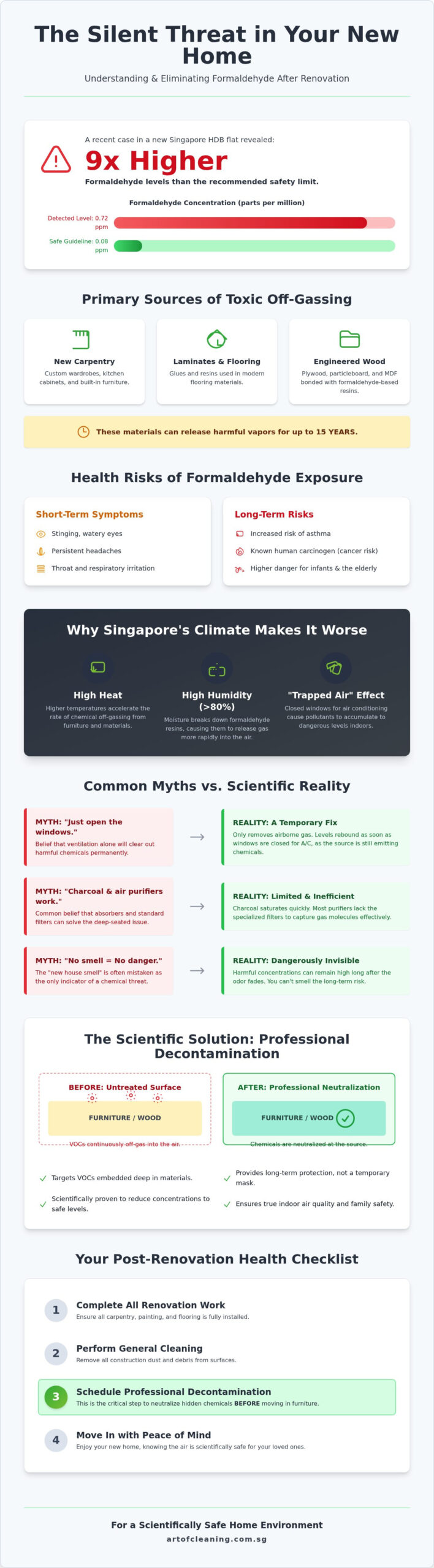
In July 2024, a new five-room HDB flat was found to have formaldehyde levels nine times higher than the recommended safety guideline of 0.08 parts per million. You’ve likely walked into your newly renovated home and noticed that sharp, stinging “new house smell” while wondering if it’s truly safe for your children or elderly parents. It’s common to feel overwhelmed by conflicting advice on whether to just open the windows or hire a specialist for formaldehyde removal singapore.
We understand that your priority isn’t just a clean-looking home, but a scientifically safe environment for your family. This guide will debunk the myths surrounding DIY fixes and reveal the scientific truth about how materials off-gas over several years. You’ll learn exactly why professional neutralization is essential in our tropical climate, where heat and humidity accelerate the release of these harmful vapors. We’ll preview the specialized decontamination processes that ensure your indoor air quality meets health standards, giving you the peace of mind to move your furniture and family in without hesitation.
Key Takeaways
- Understand why new carpentry and laminates are the primary sources of toxic off-gassing in modern homes.
- Learn why passive methods like open windows or charcoal aren’t enough to stop chemical emissions from porous surfaces.
- Discover the scientific difference between surface cleaning and professional formaldehyde removal singapore treatments that neutralize VOCs at the source.
- Identify the ideal timeline for decontamination to ensure your space is safe before you move in your furniture and loved ones.
- Find out how technical precision and specialized equipment can protect your family from respiratory issues caused by renovation chemicals.
Formaldehyde: Why is it a Silent Threat in Singapore?
Formaldehyde is more than just a strong scent; it’s a colorless, pungent-smelling gas that acts as a Silent Threat in Singapore homes. It belongs to a class of chemicals known as Volatile Organic Compounds (VOCs). These are frequently found in the industrial resins and glues used to manufacture plywood, particleboard, and laminates. While the National Environment Agency (NEA) will prohibit the sale of interior paints containing formaldehyde starting January 1, 2026, the primary danger in most modern homes remains the extensive custom carpentry installed during renovations. These built-in wardrobes and kitchen cabinets can continue to release toxins into your living space for up to 15 years.
The health implications of this exposure are serious and documented. In the short term, residents often experience stinging eyes, persistent headaches, and throat irritation. For vulnerable groups like infants and the elderly, the risks are even higher. Chronic inhalation is linked to an increased risk of asthma and certain cancers. Because these chemicals are invisible, many families remain unaware that their indoor air quality is compromised until physical symptoms begin to manifest.
The “New House Smell” vs. Chemical Concentration
Many homeowners mistakenly believe that once the sharp odor of a new renovation dissipates, the danger has passed. This is a dangerous misconception. VOCs are organic chemicals with a boiling point ranging from 50°C to 250°C, which allows them to vaporize easily into the air at room temperature. Chemical concentrations can remain dangerously high even when they’re below the human olfactory threshold. You can’t always smell the danger, but your body still reacts to it. Distinguishing between a temporary odor and a long-term off-gassing cycle is the first step toward true home safety. Without professional formaldehyde removal singapore, these chemicals remain embedded in your furniture, slowly leaching out over a decade or more.
Singapore’s Tropical Climate Factor
Our local environment significantly worsens the problem. Relative humidity levels in Singapore often exceed 80%, providing the perfect conditions for urea-formaldehyde resins to break down and release gas more rapidly. Heat also plays a major role; as temperatures rise, the rate of chemical release increases. In high-density HDB flats and condominiums, we frequently keep windows closed to run air conditioning. This creates a “trapped air” effect where pollutants accumulate to levels much higher than the World Health Organization’s recommended limit of 0.1 mg/m³. Standard ventilation is rarely enough to counteract these factors, making specialized formaldehyde removal singapore a necessary step for any health-conscious homeowner moving into a newly renovated space.
Myth vs. Reality: Does Ventilation and Charcoal Actually Work?
When you receive the keys to your new home, the most common advice from friends and contractors is to “air it out.” While ventilation is a basic component of air quality, it’s often mistaken as a complete solution for formaldehyde removal singapore. The reality is that formaldehyde isn’t just floating in the air; it’s chemically bonded within your cabinetry. Opening windows only addresses the gas that has already escaped into the room. As soon as you close your windows to turn on the air conditioning, the concentration levels quickly rebound. Freshly renovated apartments in Singapore often show formaldehyde levels 3 to 8 times higher than the World Health Organization’s recommended limit, proving that passive air flow isn’t a substitute for active decontamination.
Relying on DIY methods creates a dangerous false sense of security. While these toxins remain invisible, the long-term exposure risks are significant. The Science of Professional Formaldehyde Removal highlights that this substance is a known human carcinogen. Masking the smell or hoping a small bag of charcoal will fix the problem doesn’t protect your family’s respiratory health. Air purifiers also offer limited help; most standard units use HEPA filters designed for dust, not gas molecules. To capture formaldehyde, you need specialized, heavy-duty carbon filters that require frequent replacement as they saturate.
The Limitations of Passive Ventilation
Passive ventilation depends on a high air exchange rate. In Singapore’s urban environment, achieving the necessary flow is difficult due to building density and stagnant tropical air. When you fill a room with new wardrobes and kitchen sets, the source of the gas is massive compared to the volume of air being moved. Professional intervention reaches the core of the carpentry, ensuring toxins are neutralized before they enter your lungs.
The Truth About Household “Remedies”
Many homeowners turn to activated charcoal or even sliced onions. For charcoal to effectively lower VOC levels in a standard home, you’d need hundreds of kilograms of the material spread across every surface. Small decorative bags simply don’t have the capacity to absorb a constant stream of off-gassing molecules. Instead of passive absorption, Art of Cleaning utilizes professional-grade equipment and active chemical neutralization to break down these compounds at a molecular level.
The Science of Professional Formaldehyde Removal vs. Surface Cleaning
A visually spotless home doesn’t guarantee a healthy one. While post-renovation cleaning removes sawdust and debris, it often leaves the invisible chemical load untouched. Professional formaldehyde removal singapore is a technical decontamination process that targets the volatile organic compounds (VOCs) trapped within porous building materials. Unlike standard surface cleaning, which only removes external contaminants, chemical neutralization involves applying specialized agents that penetrate the wood substrate. These agents react with the urea-formaldehyde resins found in your carpentry, converting them into harmless by-products at a molecular level. This is essential because standard cleaning agents don’t have the chemical properties to break down these resilient bonds.
Our approach relies on precision and technical expertise. We use professional-grade equipment to measure air quality against the World Health Organization’s recommended limit of 0.08 parts per million (ppm). This data-driven methodology ensures that we aren’t just guessing about the safety of your air. By establishing a scientific baseline before and after treatment, we provide the verifiable results that families need for true peace of mind. A clean home is a visual standard; a decontaminated home is a health standard.
Chemical Neutralization vs. Encapsulation
Many off-the-shelf products only offer encapsulation, which is a temporary solution. Encapsulation creates a thin film over surfaces to “trap” the gas inside. However, in Singapore’s humid climate, these coatings can degrade, leading to a sudden surge in chemical levels later. We prioritize active neutralization. This process breaks down the formaldehyde molecules into harmless salts and water vapor. By addressing the source of the off-gassing within the plywood and laminates, we provide a long-term solution that doesn’t rely on the integrity of a surface film. It’s a more rigorous, artisanal approach to home hygiene that prioritizes safety over shortcuts.
The Importance of a Multi-Surface Approach
Formaldehyde gas is highly “sticky” and often migrates from carpentry into soft furnishings. Items like curtains, sofas, and rugs act as secondary “sinks,” absorbing the gas and re-releasing it over time. This is why a holistic treatment plan is vital. Combining chemical neutralization with deep carpet cleaning and upholstery treatment ensures that every potential reservoir of toxins is addressed. If you only treat the cabinets but ignore the soft surfaces, the air quality will remain compromised. We ensure all upholstery is decontaminated to prevent this secondary off-gassing cycle, creating a comprehensive shield for your living environment.
When to Book: The Post-Renovation Health Checklist
Timing your treatment is a critical part of the renovation timeline. If you book too early, subsequent drilling or sanding will simply re-coat your surfaces in chemical-laden dust. If you wait until after move-in, your soft furnishings and mattresses will already be absorbing the off-gassing molecules. The ideal sweet spot occurs immediately after the final carpentry installation but before your personal belongings arrive. This allows formaldehyde removal singapore specialists to access every square inch of your built-in wardrobes and kitchen cabinets without obstruction.
Coordinate closely with your interior designer to ensure all chemical-heavy tasks, like varnishing and gluing, are complete. You’ll need a clear site. Professional decontamination requires active contact with the wood substrates, so the environment must be free of construction debris. Residents should typically wait at least 4 to 6 hours for the air to settle after treatment before staying overnight.
The 72-Hour Post-Reno Window
Treating an empty home is significantly more effective than a furnished one. Without sofas or beds in the way, our technicians can achieve deep penetration into the porous surfaces of your cabinetry. We recommend a 72-hour window after your contractor hands over the keys. During this time, ensure all drawers and cabinet doors are left wide open. This maximizes exposure to the neutralizing agents. For the best results, this process should be integrated with a professional post-renovation cleaning. This ensures that the fine dust, which often carries trapped VOCs, is removed before the chemical treatment begins.
Monitoring Indoor Air Quality (IAQ)
A professional IAQ report is your verified proof of safety. Look for specific data points, such as the exact parts per million (ppm) of formaldehyde compared to the WHO guideline of 0.08 ppm. Even after treatment, stay vigilant for physical signs like persistent eye irritation or a metallic taste in the air. These are indicators that VOC levels are still fluctuating. Long-term maintenance involves keeping the home well-ventilated during the day and maintaining a stable indoor temperature, as heat can trigger secondary off-gassing. If you’re ready to secure your family’s health, you can schedule a scientific air quality assessment with our meticulous team today.
Art of Cleaning: Your Partner in Scientific Home Hygiene
Art of Cleaning treats home hygiene as a specialized craft. We’ve moved beyond surface-level aesthetics to focus on the biological and chemical safety of your living environment. Our approach to formaldehyde removal singapore is built on technical precision and a deep understanding of environmental health. We don’t just clear the dust; we eliminate the invisible hazards that compromise your family’s respiratory health. This health-centric methodology ensures that your home isn’t just clean, but truly decontaminated. We take pride in the meticulous nature of our work, ensuring that every corner of your new cabinetry is properly neutralized by our trained specialists.
Every home we enter is treated with a level of care that goes beyond standard service. Our technicians undergo specialized training to handle industrial-grade equipment, giving you the confidence that your air quality meets the highest standards. We view ourselves as guardians of your home environment, prioritizing the well-being of your children and elderly relatives above mere visual tidiness. This commitment to artisanal precision ensures that the results we deliver are both thorough and lasting.
Why Thousands of Singaporean Families Trust Us
Our reputation as a reliable specialist is backed by years of dedicated service. Being featured on major national broadcasting networks like MediaCorp serves as a powerful endorsement of our verified standards. We understand that parents and pet owners need absolute certainty when it comes to the products used in their homes. That’s why we exclusively use family-safe, non-toxic neutralization agents that leave no harmful residues behind. The Art of Cleaning signature represents a commitment to reliability and health-based results that you won’t find with general cleaning services. It’s about more than just a service; it’s a guardianship of your home environment that you can depend on.
Beyond Formaldehyde: A Holistic Clean
A safe home requires a comprehensive approach to hygiene. While neutralizing cabinetry is essential, we also address other potential reservoirs of pollutants. Our expertise in sofa cleaning and mattress care allows us to create a complete hygiene shield for your property. These soft surfaces often trap secondary off-gassing molecules, making deep decontamination a vital part of your move-in process. We combine these services to provide a seamless, low-friction experience that prioritizes your family’s well-being above all else. You can move in with the peace of mind that your entire living space has been meticulously prepared for your arrival.
Protect your family’s health; contact our specialists for a consultation today.
Secure Your Family’s Health for the Long Term
Your new home should be a sanctuary of health and comfort, not a source of hidden respiratory stress. We’ve explored how the sharp “new house smell” is actually a chemical signal of off-gassing that can persist for up to 15 years in our humid climate. Passive remedies like open windows or charcoal bags simply can’t reach the core of your cabinetry where these toxins originate. True safety requires a scientific intervention that breaks down harmful compounds at the molecular level.
Since 2018, Art of Cleaning has served as a dedicated specialist for local homeowners. Our work has been featured on MediaCorp and major national news platforms, highlighting our use of specialized industrial-grade VOC neutralization technology. We prioritize the long-term well-being of your children and elderly relatives by ensuring your indoor air meets rigorous health standards. Don’t move your furniture into a space that hasn’t been properly decontaminated. By investing in professional formaldehyde removal singapore, you’re securing a fresh, scientifically safe start for your family.
Get a Quote for Professional Formaldehyde Removal
We look forward to helping you create a home environment that’s as healthy as it is beautiful.
Frequently Asked Questions
Is formaldehyde removal actually effective?
Professional formaldehyde removal singapore is highly effective when it involves molecular neutralization rather than just surface masking. By applying specialized agents that react with urea-formaldehyde resins, the treatment converts harmful gases into stable, inert by-products. This process significantly reduces indoor concentrations to levels well below the World Health Organization’s recommended limit of 0.08 parts per million, ensuring the air is scientifically safe for immediate occupancy.
How long does the formaldehyde removal process take?
Most treatments take between three and six hours to complete for a standard HDB or condominium unit. The exact duration depends on the total surface area of the built-in carpentry and the number of rooms being treated. After the application is finished, we advise residents to allow an additional four to six hours for the neutralizing agents to settle and the air to fully clear before staying overnight.
Do I need to leave my house during the treatment?
We recommend that residents and pets remain away from the property during the active treatment phase. While the agents used are non-toxic, the high concentration of neutralizing mist during application requires a clear space for our technicians to work effectively. You can typically return to the home a few hours after the service is finalized. This ensures the environment has stabilized and the air quality has reached its optimal safety baseline.
Can air purifiers remove formaldehyde completely?
Standard air purifiers are generally ineffective against gaseous toxins like formaldehyde. While HEPA filters excel at capturing dust and allergens, they don’t trap gas molecules. Only purifiers equipped with heavy-duty, thick activated carbon filters can absorb VOCs, but these filters saturate rapidly in newly renovated spaces. Professional formaldehyde removal singapore is necessary because it neutralizes the source within the wood rather than just filtering the air passing through a machine.
How long does the protection from professional treatment last?
Professional neutralization provides a long-term solution by addressing the current chemical load within your building materials. Because the treatment penetrates the wood substrate to break down existing resins, it stops the primary off-gassing cycle at its source. If you bring in new, untreated furniture or perform additional renovations later, those items may introduce fresh sources of formaldehyde that would require a separate assessment to maintain your home’s air quality.
Is the chemical used for removal safe for babies and pets?
Yes, the neutralization agents we utilize are specifically formulated to be safe for infants, the elderly, and pets. We prioritize health-conscious hygiene, ensuring that our processes leave behind no harmful residues or secondary pollutants. Once the treatment has dried and the space has been ventilated, the indoor environment is significantly safer than it was prior to decontamination. Our commitment to non-toxic solutions is a cornerstone of our scientific approach to home safety.
When is the best time to do formaldehyde removal after renovation?
The optimal time for treatment is immediately after your renovation is complete but before you move in your furniture and belongings. This “sweet spot” allows our specialists to access all built-in wardrobes, cabinets, and drawers without obstruction. It’s most effective when performed after a deep post-renovation cleaning, as removing construction dust first allows the neutralizing agents to bond directly with the surfaces of your new cabinetry for maximum penetration.
Does a “new house smell” always mean there is formaldehyde?
Not necessarily, though the two are often linked. That sharp, pungent odor is a common indicator of high VOC concentrations, but formaldehyde can still be present at dangerous levels even after the “new house smell” has faded. Some people are more sensitive to the scent than others, and certain wood resins are less odorous while remaining toxic. Relying on your sense of smell is unreliable; only scientific air quality testing can confirm safety.