
As of January 1, 2026, Singapore has officially prohibited the addition of formaldehyde in interior paints, capping concentrations at a strict 0.01% by weight. Yet, with a local 70% surge in demand for specialized intervention, it’s clear that the “new house smell” remains a persistent threat in many BTOs and renovated condos. You’ve likely felt the sting in your eyes or a dull headache after stepping into your newly decorated space. It’s frustrating to invest so much in a dream home only to feel anxious about “Sick Building Syndrome” affecting your children’s health.
We understand that you want more than just a temporary mask for chemical odors; you need a scientifically verified living space. This 2026 guide explains why professional formaldehyde removal Singapore services are essential for neutralizing deep-seated chemicals that DIY air purifiers often miss. We’ll explore the latest NEA guidelines, the impact of our tropical humidity on off-gassing, and the exact steps required to achieve a permanent, expert-led decontamination before your family moves in.
Key Takeaways
- Identify the primary chemical sources in your new home, including built-in wardrobes and laminate flooring that release toxins over time.
- Discover why Singapore’s tropical humidity traps gases indoors, making formaldehyde removal singapore a necessary step rather than an optional one.
- Compare the efficacy of professional molecular neutralization against DIY methods like activated charcoal or basic air purifiers.
- Learn the importance of baseline air quality testing to accurately quantify HCHO levels before and after professional treatment.
- Understand how a holistic post-renovation strategy prevents chemical dust from settling into your mattresses, sofas, and other soft furnishings.
What is Formaldehyde and Why is it a Concern in Singapore Homes?
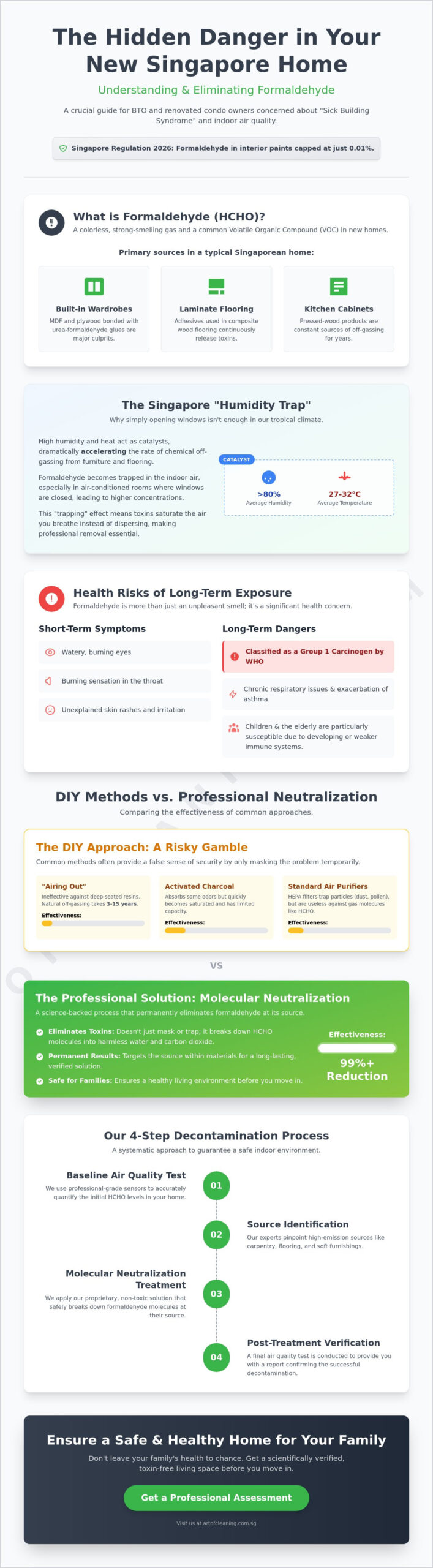
That distinct, sharp scent lingering in your new BTO or renovated condo isn’t just the smell of “freshness.” It’s often the first warning sign of chemical off-gassing. To understand the risks, we first need to define What is Formaldehyde. Scientifically known as HCHO, it’s a colorless, strong-smelling gas used extensively in industrial resins and adhesives. In the context of Singaporean interior design, these resins act as the primary bonding agent for the built-in wardrobes, kitchen cabinets, and laminate flooring that define our modern living spaces.
The prevalence of formaldehyde in Singapore is particularly high because of our preference for custom carpentry. Most local contractors use medium-density fibreboard (MDF) or plywood, which are manufactured using urea-formaldehyde glues. While these materials are cost-effective and versatile, they serve as a constant source of invisible pollution. Professional formaldehyde removal singapore becomes a critical health priority when you realize that these gases don’t just disappear after a few days of opening the windows. They’re baked into the very structure of your furniture.
Singapore’s climate creates a unique “humidity trap” that competitors often overlook. Our average relative humidity frequently exceeds 80%. High humidity and tropical heat act as catalysts, significantly accelerating the rate of chemical release from wood adhesives. In our localized environment, formaldehyde doesn’t just drift away; it saturates the air, especially in high-density HDB blocks where cross-ventilation might be limited by neighboring units or closed windows for air conditioning.
The Science of VOCs and Off-Gassing
Formaldehyde is a prominent member of the Volatile Organic Compounds (VOCs) family. These are chemicals that possess a high vapor pressure at room temperature, allowing them to transition easily from a solid state into the air we breathe. Off-gassing is the technical term for this slow, invisible leak. Because the resins are buried deep within the layers of your cabinets and flooring, this process isn’t a quick burst. Without intervention, materials can continue to release toxins for three to fifteen years. In tightly sealed, air-conditioned rooms, these concentrations can quickly exceed safety limits recommended by the NEA.
Health Risks of Long-Term Exposure
Exposure to these toxins isn’t just a matter of comfort; it’s a significant health concern. Short-term symptoms often mimic common allergies. You might experience watery eyes, a burning sensation in the throat, or unexplained skin rashes. However, the long-term implications are far more severe. The World Health Organization (WHO) classifies formaldehyde as a Group 1 carcinogen. Chronic inhalation can lead to respiratory issues and the exacerbation of asthma. Children and the elderly are particularly susceptible to these indoor air toxins. Their smaller lung capacities and developing immune systems mean that even low-level exposure can have a disproportionate impact on their long-term well-being.
The Singapore Humidity Trap: Why Ventilation Isn’t Enough
Many homeowners believe that simply keeping windows open for a few weeks will purge their new BTO of toxins. In Singapore’s unique environment, this assumption is dangerously incorrect. While ventilation helps dilute surface-level odors, it doesn’t address the internal reservoir of chemicals trapped within your carpentry. Natural off-gassing is a marathon, not a sprint; it can take anywhere from 3 to 15 years for urea-formaldehyde resins to stabilize on their own. Relying on “airing out” means your family remains exposed to adverse health effects for the better part of a decade.
The situation is often worse in commercial settings. Many Singaporean offices suffer from “Sick Building Syndrome” because they rely on centralized air conditioning with minimal fresh air intake. In these sealed environments, gaseous toxins accumulate rather than disperse. It’s a common misconception that standard air purifiers solve this. Most retail units use HEPA filters, which are excellent for trapping dust and pollen but are entirely porous to gas molecules like formaldehyde. Without specialized chemical filtration or source-level formaldehyde removal singapore, you’re simply circulating contaminated air.
Tropical Climate vs. Chemical Stability
Our local weather acts as a persistent catalyst for chemical release. Singapore’s average temperatures of 27-32°C provide the thermal energy needed to break down the chemical bonds in urea-formaldehyde resins found in plywood and MDF. Humidity plays an even more aggressive role, “wicking” these molecules out of porous wood cores and into your breathing zone. Singapore’s 80% average humidity doubles the off-gassing rate compared to dry climates. This constant environmental pressure means that even materials that might be considered “low emission” in temperate countries can become problematic in our tropical heat. Professional formaldehyde removal services are often the only way to stabilize these materials permanently.
The Myth of Indoor Plants and Charcoal Bags
Social media often suggests that a few snake plants or a handful of activated charcoal bags can purify a home. While these methods aren’t entirely useless, they are fundamentally passive. A few plants cannot possibly keep up with the active, high-volume off-gassing of a full kitchen cabinet set or a master bedroom wardrobe. Charcoal bags have a very limited “adsorption” capacity; once their pores are full, they stop working and may even release the trapped gases back into the air if the room gets too hot. There is a vast difference between masking a chemical odor and neutralizing a molecule at its source. True safety requires a proactive, scientific approach that goes beyond these decorative solutions.
Professional Formaldehyde Removal vs. DIY Methods
Online forums and social media groups often suggest that bowls of vinegar, sliced onions, or industrial fans are sufficient to clear the air in a new home. These anecdotal remedies might mask the sharp chemical odor, but they don’t address the underlying molecular structure of the gas. Because formaldehyde is linked to some types of cancer, relying on unverified DIY methods creates a false sense of security. True decontamination requires industrial-grade photocatalysts and molecular neutralizers that bond with and break down HCHO molecules at their source.
The most significant advantage of professional formaldehyde removal singapore is the use of calibrated HCHO and VOC meters. Without these tools, you’re essentially guessing whether your air is safe. A professional service provides a baseline reading before treatment and a final verification after, ensuring the levels fall below the NEA recommended limit of 0.1 mg/m³. This data-driven approach removes the anxiety of “Sick Building Syndrome” and provides scientific confirmation that your home is safe for occupancy.
When to Call a Professional Removal Service
The “danger zone” for chemical exposure is the period immediately following carpentry installation and before you move in your soft furnishings. If you notice persistent eye irritation, a scratchy throat, or a heavy chemical scent that doesn’t dissipate after 48 hours of ventilation, it’s time to seek expert help. While a thorough post renovation cleaning is essential for removing construction dust, it doesn’t neutralize the gases deep within your cabinets. Professional intervention should ideally happen after the dust is cleared but before you install curtains or mattresses, which can absorb the lingering gases.
Efficacy Comparison: DIY vs. Pro
Understanding the difference in outcomes helps in making an informed decision for your family’s health. DIY methods like ventilation are low-cost but have extremely low efficacy in our 80% humidity environment, often requiring up to five years to reach safe levels naturally. In contrast, professional formaldehyde removal singapore utilizes high-efficacy equipment like cold fogging machines and ozone generators to achieve results in as little as 24 hours.
- DIY Ventilation: Relies on air exchange; ineffective against source off-gassing; 3-15 year timeline.
- Air Ionizers: Can produce ozone as a byproduct; doesn’t remove the source; temporary results.
- Professional Treatment: Uses surface-active neutralizers; provides 24-hour decontamination; includes scientific air testing.
Meticulous safety protocols ensure that the environment is safe for pets and infants immediately after the service is completed. By investing in a professional solution, you avoid the hidden costs of delayed move-ins and, more importantly, protect your family from the long-term health risks of chemical exposure.
The Professional Removal Process: Molecular Neutralization
Achieving a safe home environment requires a systematic, five-step protocol that goes beyond surface-level cleaning. Our process begins with Baseline Air Quality Testing to quantify HCHO levels in mg/m³. This data provides a clear starting point, allowing us to measure the exact severity of the contamination. We then move to Source Identification, meticulously checking every built-in wardrobe, kitchen cabinet, and laminate flooring section for off-gassing hotspots. Identifying these sources ensures the treatment is targeted where it’s most needed.
The third step involves the Application of Photocatalyst or Nano-coating treatments. These specialized coatings are applied to surfaces to create a protective barrier. Next, we initiate the Active Neutralization phase, which often utilizes UV light or ozone to trigger the chemical breakdown of toxins. Finally, we conduct Verification Testing. This ensures the air quality meets the strict safety standards set by the NEA and WHO, providing you with documented proof of a healthy living space. For a thorough decontamination, consider our formaldehyde removal services to ensure your home is move-in ready.
How Photocatalysts Work (The Science)
The core of modern formaldehyde removal singapore lies in the Titanium Dioxide (TiO2) reaction. When TiO2 is exposed to light, it acts as a catalyst that decomposes organic pollutants. It effectively turns harmful formaldehyde gas into harmless carbon dioxide and water vapor through an oxidative process. Unlike temporary sprays that just mask odors, these nano-coatings are long-lasting. They continue to work silently as long as there is a light source present. This persistent protection is why this method is the gold standard for professional cleaning services singapore that prioritize long-term hygiene restoration over quick, superficial fixes.
Move-In Checklist Post-Treatment
Safety doesn’t end when the technicians leave. We recommend a 24-hour waiting period before bringing in sensitive items like unsealed food or children’s clothing. While the fogging process is safe, a final wipe-down of horizontal surfaces is essential to remove any neutralized chemical residues. For the first 30 days in your new home, maintain moderate ventilation to assist the final stages of the stabilization process. This ensures that any residual VOCs from minor sources are efficiently dispersed as the home settles into its new environment.
A Holistic Approach to Post-Renovation Hygiene
While neutralizing airborne gases is vital, a complete recovery of your living space requires looking beyond the air itself. Formaldehyde and other Volatile Organic Compounds (VOCs) don’t just float; they bond with microscopic construction dust and settle into every porous surface in your home. This is why specialized formaldehyde removal singapore must be integrated into a broader post reno cleaning singapore strategy. If you only treat the air, the chemical particulates trapped in your carpet fibers or sofa upholstery will continue to release toxins long after the initial fogging is complete.
Chemical dust is particularly stubborn. It settles into the crevices of built-in wardrobes and kitchen cabinets, creating a secondary source of irritation. Even after the “new house smell” seems to fade, these settled particulates can be kicked back into the air by ceiling fans or daily movement. Achieving true hygiene restoration means removing these physical carriers of toxins through a combination of HEPA-filtration vacuuming and specialized surface treatments. It’s about creating a sterile, safe foundation for your family to occupy. Many homeowners find that scheduling spring cleaning services singapore after formaldehyde treatment provides a comprehensive reset, addressing both chemical contaminants and the accumulated dust and allergens that thrive in our high-humidity climate.
Protecting Your Soft Furnishings
Soft surfaces act like chemical sponges. If your furniture was delivered or installed while carpentry work was ongoing, those fabrics have likely absorbed significant amounts of off-gassing chemicals. We strongly recommend professional mattress cleaning singapore to ensure your sleeping environment is truly decontaminated. Formaldehyde can linger in curtain fabrics and sofa upholstery for months, causing skin irritation or respiratory discomfort. There is a powerful synergy between air decontamination and steam cleaning; the heat helps release trapped molecules, allowing them to be neutralized and extracted simultaneously.
The Art of Cleaning Standard
Art of Cleaning approaches indoor air quality with the precision of an artisanal craft. We don’t believe in surface-level tidiness; we prioritize the invisible health of your home. Our health-first philosophy ensures that every corner of your living space is treated as a sanctuary, guarded against the hidden dangers of renovation. We use high-impact data to verify the removal of contaminants, providing you with the scientific confirmation required for total peace of mind. Our meticulous attention to detail and specialized training have made us a dependable leader in formaldehyde removal singapore. Don’t leave your family’s well-being to chance. Book a comprehensive formaldehyde and post-renovation hygiene assessment with Art of Cleaning today.
Securing a Breathable Future for Your New Home
Achieving a safe indoor environment in Singapore’s humid climate requires a strategy that goes beyond surface-level cleaning. We’ve established that natural ventilation often takes years to stabilize and that a truly healthy home requires the molecular neutralization of toxins at their source. By integrating professional formaldehyde removal singapore with deep cleaning for your upholstery, you effectively eliminate the hidden chemical reservoirs that threaten your family’s health.
Art of Cleaning takes pride in being a guardian of your home environment. Our artisanal approach to hygiene has been featured on major local broadcasting networks, reflecting our status as a trusted specialist. We utilize NEA-compliant air quality testing to provide the high-impact data you need for total peace of mind. Ensure your family’s safety with our expert Formaldehyde Removal services. Get a quote today!
You’ve worked hard to build your dream space, and you deserve a home that’s as healthy as it is beautiful. Take the final step toward a pristine living environment today and enjoy the comfort of knowing your air is scientifically safe.
Frequently Asked Questions
How long does formaldehyde stay in a new Singapore home?
Naturally, formaldehyde can linger in a new home for 3 to 15 years as it off-gasses from urea-formaldehyde resins. In Singapore, our high humidity and average temperatures of 30°C accelerate this release, but don’t eliminate it. Without professional formaldehyde removal singapore, these chemicals remain trapped within your built-in carpentry, kitchen cabinets, and flooring for the better part of a decade.
Is the “new house smell” always formaldehyde?
While formaldehyde is a primary component of that sharp scent, the “new house smell” is actually a cocktail of various Volatile Organic Compounds (VOCs). These include chemicals from paint, floor finishes, and synthetic adhesives used in laminate work. While the smell might fade over a few months, the actual chemical emissions often continue at levels that exceed WHO safety guidelines of 0.1 mg/m³.
Can an air purifier effectively remove formaldehyde from my BTO?
Standard HEPA air purifiers are designed to trap solid particles like dust and pollen but cannot capture gas molecules like formaldehyde. Only purifiers with heavy-duty activated carbon filters or photocatalytic oxidation technology can reduce airborne concentrations. However, these units don’t treat the source of the gas, meaning the toxins will return as soon as the purifier is turned off.
Is professional formaldehyde removal safe for babies and pets?
Yes, professional treatments are specifically designed to be safe for vulnerable family members once the process is complete. We use non-toxic, water-based catalysts that leave no harmful residues on your surfaces. We typically recommend a 24-hour waiting period before babies or pets occupy the space to ensure the air has stabilized and any active neutralization phases have concluded.
When is the best time to perform formaldehyde removal during the renovation process?
The ideal window for treatment is after all carpentry and painting are finished but before you move in your soft furnishings. Performing the service at this stage allows the neutralizers to reach the raw wood surfaces inside cabinets and wardrobes effectively. It also prevents your mattresses and sofas from absorbing lingering gases during the final stages of the renovation.
Does formaldehyde removal also get rid of other VOCs and paint smells?
Professional formaldehyde removal singapore treatments utilize broad-spectrum photocatalysts that break down various organic pollutants. This includes benzene, toluene, and the pungent odors associated with fresh interior paint. The chemical reaction transforms these complex VOCs into harmless water vapor and carbon dioxide, significantly improving the overall hygiene and air quality of your home.
How much does professional formaldehyde removal cost in Singapore?
Pricing for these services typically depends on the total floor area and the volume of built-in carpentry in your unit. Most firms provide tiered structures based on HDB flat types or condominium square footage to reflect the labor involved. Since every renovation project has different chemical loads, it’s best to request a customized assessment to ensure you’re getting a thorough treatment tailored to your home’s specific needs.
Will the formaldehyde smell return after the treatment is finished?
A professional molecular neutralization treatment is designed to be permanent by sealing and breaking down the chemical sources at the molecular level. Because we use long-lasting nano-coatings that continue to react with light, the treatment provides ongoing protection. While new furniture brought in later might introduce minor VOCs, the massive chemical load from your initial renovation will remain neutralized.
Pingback: What is a Professional Cleaning Company? The 2026 Guide to Hygiene & Asset Care – Art of Cleaning Pte Ltd
Pingback: Post Renovation Cleaning: The 2026 Guide to Construction Decontamination – Art of Cleaning Pte Ltd