
Saving a few dollars on an “under-the-table” cleaner could cost you up to $30,000 in Ministry of Manpower (MOM) fines and a potential lifetime ban on hiring foreign domestic help. For many Singaporean families, the central question remains: How Do We Know If The Part-Time Cleaner We Are Engaging Is Legal? It’s a valid concern because the line between a legal Household Services Scheme (HSS) professional and an illegally moonlighting maid often feels blurred. You shouldn’t have to risk your financial security or home safety just to maintain a hygienic and specialized living environment.
We understand that your home is a sanctuary that requires both meticulous care and strict legal compliance. This article provides the exact MOM regulations and verification steps you need to ensure your cleaner is working legally in Singapore. We’ll explore the critical differences between a domestic helper and a specialized cleaning professional; this provides you with a clear checklist to verify identity and insurance coverage. By the end of this guide, you’ll have the absolute peace of mind to choose a service that protects both your family’s health and your legal standing.
Key Takeaways
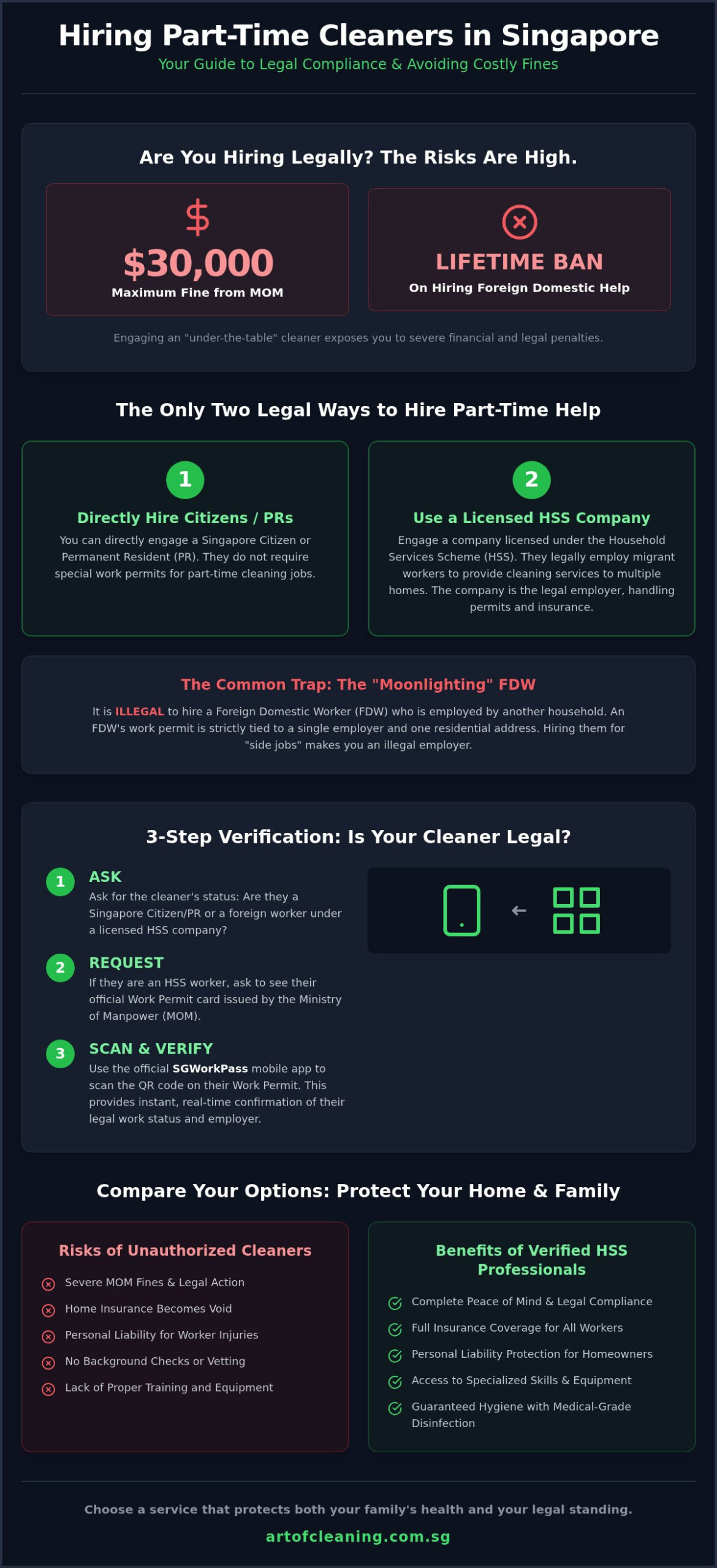
- Identify the only two legal methods for hiring part-time help in Singapore: engaging a Singapore Citizen or Permanent Resident directly, or using a licensed Household Services Scheme (HSS) company.
- Avoid the severe financial risks associated with the “FDW trap,” as hiring a Foreign Domestic Worker for part-time work can lead to Ministry of Manpower fines of up to $30,000.
- Learn the exact steps to answer the question: How Do We Know If The Part-Time Cleaner We Are Engaging Is Legal? by following our professional verification checklist.
- Master the use of the SGWorkPass mobile application to scan QR codes for real-time confirmation of a cleaner’s work permit status and legal eligibility.
- Understand the hygiene and safety advantages of choosing a specialized corporate partner that provides full insurance coverage and medical-grade disinfection for your home.
Understanding Singapore’s Part-Time Cleaning Regulations (Legal vs. Illegal)
In Singapore, the Ministry of Manpower (MOM) maintains strict boundaries to protect both workers and households. A legal part-time cleaner must be a Singapore Citizen, a Permanent Resident (PR), or a foreign worker employed by a company licensed under the Household Services Scheme (HSS). This scheme allows companies to hire migrant workers to provide part-time household services, such as cleaning and grocery shopping, across multiple homes. When you hire through an HSS-licensed provider, the company remains the legal employer, taking full responsibility for work permits, insurance, and the worker’s well-being.
The most common legal trap involves engaging a Foreign Domestic Worker (FDW) who is already employed by another household. Many residents ask, How Do We Know If The Part-Time Cleaner We Are Engaging Is Legal? The answer starts with understanding that an FDW is legally tied to a single employer and a specific residential address. Hiring them for “side jobs” is illegal. As of 2026, the penalties for illegal employment have become more stringent, with fines reaching up to $30,000 for homeowners who bypass official channels. Using an unauthorized freelancer means there is no “Employer of Record” to mediate disputes or handle injuries, leaving you entirely exposed to legal and financial fallout.
Why the Distinction Matters for Homeowners
Engaging an illegal cleaner isn’t just a regulatory risk; it’s a liability nightmare. Under the Employment in Singapore framework, homeowners who hire unauthorized help are classified as illegal employers. This status immediately voids your home insurance policy. If an illegal worker sustains an injury on your property, you’ll likely face personal lawsuits for medical expenses and lost wages. There’s no such thing as a “freelance” foreign cleaner in Singapore’s legal system; they are either legally employed by an HSS firm or they are working in violation of their visa conditions.
The Rise of Specialized Cleaning vs. General Housework
The demand for domestic help has shifted from general chores toward high-precision hygiene. A standard “maid” might handle daily tidying, but specialized technicians from companies like Art of Cleaning are trained for deep decontamination. This distinction is vital for home health. Illegal freelancers often lack the industrial equipment required for technical tasks like carpet cleaning or mattress sanitization. By choosing a verified professional service, you aren’t just complying with the law. You’re opting for professional deep cleaning that utilizes hospital-grade disinfectants and specialized machinery, ensuring your living space is both legally secure and scientifically clean.
MOM Guidelines: Who Is Legally Allowed to Work as a Part-Time Cleaner?
Identifying a legal worker requires more than just a quick glance at an ID card. In Singapore, only specific residency and permit categories grant an individual the right to perform part-time cleaning. Singapore Citizens and Permanent Residents (PRs) are the most straightforward hires. They don’t require specific work permits from the Ministry of Manpower (MOM) to work as cleaners. However, for foreign residents, the rules are significantly more nuanced and strictly enforced to prevent exploitation and maintain industry standards.
Foreigners residing in Singapore on a Dependant Pass (DP) or Long-Term Visit Pass (LTVP/LTVP+) may be eligible to work, but conditions apply. While LTVP+ holders generally have work rights, DP holders must navigate specific administrative hurdles. This evolution in the industry follows the successful transition of the permanent home-cleaning scheme, which has formalised the way migrant workers provide domestic support through approved companies. These Household Services Scheme (HSS) workers are the only foreign nationals legally permitted to provide part-time cleaning services across different households.
Many homeowners ask us: How Do We Know If The Part-Time Cleaner We Are Engaging Is Legal? The verification process involves checking for these specific statuses:
- Singapore Citizens/PRs: No work permit required.
- DP Holders: Must possess a valid Pre-approved Letter of Consent (PLOC).
- LTVP/LTVP+ Holders: Must have an MOM-issued letter of consent or a valid work pass.
- HSS Workers: Must be employed by an MOM-approved cleaning firm.
The FDW Moonlighting Warning
A common misconception is that a Foreign Domestic Worker (FDW) can “help out” a neighbor or friend for a small fee during her off-hours. This is a direct violation of MOM regulations. An FDW’s work permit is tied exclusively to the employer and the address listed on the card. Even if the work is occasional or framed as a favor, it constitutes illegal employment. The consequences for the homeowner are severe; you face heavy fines and could be barred from hiring a domestic helper in the future. If you’re unsure about the documentation of a freelance worker, it’s safer to engage a professional cleaning partner that handles all legal vetting for you.
Work Pass Categories and the Right to Work
Work permits in Singapore are sector-specific. A migrant worker licensed to work in the construction, shipyard, or manufacturing sector cannot legally moonlight as a part-time cleaner. Engaging them is considered a breach of the Employment of Foreign Manpower Act. As of 2026, Dependant Pass holders must obtain a Pre-approved Letter of Consent (PLOC) from the Ministry of Manpower before they can legally perform any part-time cleaning services in a residential setting. This ensures that every individual entering your home is accounted for and operating within the legal framework of Singapore’s labor laws.
The Financial and Legal Risks of Engaging Unauthorized Freelance Helpers
The allure of a low-cost “freelance” cleaner often masks a dangerous level of financial exposure. While the immediate savings might seem attractive, the potential penalties far outweigh the benefits. Homeowners who engage unauthorized help face Ministry of Manpower (MOM) fines that range from $5,000 to $30,000. In cases involving repeat offenses, you could even face up to 12 months of imprisonment. Beyond the legal repercussions, you must ask yourself: How Do We Know If The Part-Time Cleaner We Are Engaging Is Legal? If they cannot provide proof of HSS affiliation or valid residency status, you are essentially assuming the role of an illegal employer.
This lack of legal status creates a massive security vacuum. If an unverified individual has access to your home and a theft occurs, you have zero recourse through official employment channels. There’s no corporate entity to hold accountable and no background check to reference. Additionally, workplace injuries represent a significant liability trap. Because the hire is illegal, you are personally responsible for any medical bills or compensation if the cleaner falls or sustains an injury on your property. These costs can easily spiral into the tens of thousands, far exceeding any perceived savings from lower hourly rates. This uncertainty is exactly why we must be diligent and ask: How Do We Know If The Part-Time Cleaner We Are Engaging Is Legal?
Insurance Voids and Liability Traps
Standard home insurance policies strictly exclude coverage for illegal activities. If an unauthorized cleaner accidentally ruins your expensive marble or parquet flooring with the wrong chemicals, your insurer will deny the claim. Many homeowners find that the “cheap” labor they engaged ends up costing thousands in professional floor restoration. Legal cleaning specialists carry public liability insurance to protect your property. This ensures that any accidental damage is covered by a professional policy rather than your own pocket.
Cross-Contamination and Health Risks
The “hygiene gap” between a freelancer and a professional technician is scientific in nature. Illegal cleaners often use the same unwashed rags across multiple households, which leads to dangerous cross-contamination. Professional agencies prevent this through strict color-coded protocols and expert training in sofa cleaning. Domestic tools simply aren’t designed for deep decontamination. Professional-grade HEPA equipment removes up to 99.97% of dust mites and microscopic allergens, whereas standard domestic vacuums often redistribute these particles into the air. If your cleaner lacks the specialized machinery for carpet cleaning or medical-grade disinfection, you aren’t actually achieving a hygienic home.
Step-by-Step Verification: How to Ensure Your Cleaner is Legally Compliant
Confirming the legal status of a service provider shouldn’t be a matter of guesswork. When a technician arrives at your doorstep, you have the right and the responsibility to verify their credentials. This process protects you from the heavy MOM fines discussed earlier and ensures the person entering your private sanctuary is a vetted professional. Many residents wonder: How Do We Know If The Part-Time Cleaner We Are Engaging Is Legal? The answer lies in a systematic five-step verification protocol that leaves no room for ambiguity.
- Step 1: Request to see the original NRIC for Singapore Citizens or Permanent Residents. For foreign workers, ask for their physical Work Pass card.
- Step 2: Download and use the official SGWorkPass mobile application to scan the QR code located on the back of the Work Pass card.
- Step 3: Verify that the “Occupation” listed on the digital pass matches the service being performed and that the “Employer” is a registered cleaning entity.
- Step 4: Cross-reference the agency’s name with the Ministry of Manpower’s public list of licensed Household Services Scheme (HSS) providers.
- Step 5: Confirm that the agency provides a formal service agreement or a digital invoice for every session, which serves as your legal trail of engagement.
How to Use the SGWorkPass App
In 2026, a physical card is no longer sufficient proof of legal status; cards can be forged or cancelled without being surrendered. The SGWorkPass app provides real-time data directly from MOM’s database. After scanning the QR code, a “Green” status indicates the pass is valid. A “Red” status means the worker is no longer legally allowed to work. Check the “Sector” field specifically. For a foreign part-time cleaner to be legal, they must be tied to the “Services” sector under an HSS-approved firm. This digital check takes less than thirty seconds but provides a lifetime of legal security.
Red Flags to Watch Out For
Professionalism is often a mirror of legal compliance. Be extremely wary of helpers who refuse to show their identification or become defensive when you attempt to verify their pass. Agencies that insist on cash-only payments to personal bank accounts are often bypassing the Central Provident Fund (CPF) or tax regulations. Furthermore, if the hourly rates are significantly lower than the market average for licensed firms, it’s a strong indicator that the company is cutting corners on insurance, training, or legal work permits. To avoid these risks, you can contact our verified experts to book a fully compliant and insured cleaning session.
Reliable service providers don’t just offer a clean home; they provide documentation that proves their commitment to Singapore’s labor laws. By following these steps, you eliminate the anxiety of “what if” and replace it with the confidence that your home is being maintained by a legitimate professional. This diligence is the only way to answer the question: How Do We Know If The Part-Time Cleaner We Are Engaging Is Legal? and maintain a safe, hygienic environment for your family.
Choosing Verified Specialized Professionals for a Safer, Legal Home
Selecting a cleaning partner is an investment in both your property’s longevity and your family’s health. While the previous sections established the rigorous verification steps required for compliance, the most efficient way to secure your household is to engage a corporate-backed specialist. When you work with an established firm, the burden of asking How Do We Know If The Part-Time Cleaner We Are Engaging Is Legal? shifts from the homeowner to the provider. A professional company assumes full responsibility for work permits, CPF contributions, and comprehensive insurance, allowing you to focus on the results rather than the red tape.
Legal compliance is merely the baseline of a professional service. Beyond the avoidance of MOM fines, specialized technicians provide a level of hygiene that general “freelance” help cannot replicate. Standard mopping often redistributes surface-level dirt without addressing the microscopic pathogens trapped in porous materials. This is why professional deep cleaning is essential for maintaining a truly sanitary environment. By utilizing industrial-grade equipment and hospital-strength disinfectants, specialized pros eliminate hidden contaminants that domestic tools leave behind. This scientific approach ensures your home isn’t just visually tidy, but biologically safe.
Specialized care also protects the high-value finishes of a modern Singaporean home. Improper chemical use by untrained individuals can permanently etch marble, warp parquet, or strip the protective layer off vinyl flooring. Our technicians are trained to identify specific material requirements, ensuring that every surface is treated with the correct pH-neutral solution. This meticulous attention to detail preserves your home’s long-term market value while providing the peace of mind that every person on your property is 100% legal and fully insured.
The Art of Cleaning Advantage
Art of Cleaning has built a reputation as a meticulous guardian of the home environment. As a specialist featured on major national media platforms, we maintain a level of craft that goes far beyond standard domestic labor. Our technicians aren’t just “helpers”; they are hygiene experts who undergo rigorous training in upholstery decontamination and environmental health. We believe in complete transparency, which is why our pricing and service lists are clearly defined. This ensures you receive a premium, legally compliant service without hidden costs or administrative risks.
Next Steps for a Hygienic and Legal Home
Transitioning from high-risk freelance help to a professional maintenance strategy is a straightforward process. It begins with identifying the specific needs of your space, whether you require specialized carpet care or a full-home disinfection. We recommend scheduling a professional site assessment to determine the most effective cleaning protocols for your specific layout and materials. This proactive approach eliminates the anxiety of asking: How Do We Know If The Part-Time Cleaner We Are Engaging Is Legal? because you are supported by a verified Singaporean specialist. Contact Art of Cleaning today to secure a verified, professional cleaning experience that prioritizes your family’s well-being and your legal security.
Secure Your Home with Verified Professional Hygiene
Maintaining a healthy home environment requires more than just surface-level tidiness; it demands a commitment to legal and professional standards. By understanding strict MOM regulations and utilizing digital verification tools, you protect your family from the severe financial and security risks associated with unauthorized help. You no longer have to worry about the question: How Do We Know If The Part-Time Cleaner We Are Engaging Is Legal? when you partner with a registered specialist that prioritizes your well-being over mere visual results.
Art of Cleaning provides the absolute peace of mind that comes with MOM-compliant and fully insured staff. As a trusted provider featured on Channel NewsAsia and MediaCorp, we specialize in scientific hygiene and deep allergen removal that far exceeds standard domestic chores. Our technicians are trained to treat your high-value surfaces with the precision they deserve while ensuring total legal compliance. Don’t risk your home’s safety or your legal standing on unverified freelancers. Book a Verified Specialized Cleaning Session with Art of Cleaning today to ensure a safer, healthier sanctuary for your loved ones.
Frequently Asked Questions
Is it legal to hire my neighbor’s domestic helper to clean my house for a few hours?
No, it’s strictly illegal to hire your neighbor’s Foreign Domestic Worker (FDW) for any amount of time. An FDW’s work permit is address-specific and employer-specific. Engaging them for “side jobs” violates the Employment of Foreign Manpower Act, which protects the welfare of the helper and ensures they aren’t overworked beyond their primary contract. You’ll be liable for illegal employment even if the work is occasional.
What are the penalties for homeowners who hire illegal part-time cleaners in Singapore?
Homeowners face severe financial and legal consequences, including fines ranging from $5,000 to $30,000 per unauthorized worker. Repeat offenders may face up to 12 months in prison. Additionally, the Ministry of Manpower may impose a permanent ban, preventing you from ever hiring a full-time domestic helper in the future. These measures reflect the seriousness of unauthorized employment and its impact on labor standards.
Can a Dependant Pass (DP) holder work as a part-time cleaner legally?
Yes, Dependant Pass (DP) holders can work legally, but they must first obtain a Pre-approved Letter of Consent (PLOC) from the Ministry of Manpower. Without this specific digital authorization, they aren’t permitted to perform any gainful employment. This is a critical factor when asking: How Do We Know If The Part-Time Cleaner We Are Engaging Is Legal? Always verify the PLOC status via the SGWorkPass app before they begin work.
How do I check if a cleaning agency is licensed by the MOM?
You can verify an agency’s legitimacy by searching the Ministry of Manpower’s online directory of licensed employment agencies or the specific Household Services Scheme (HSS) provider list. A licensed agency will have an EA license number clearly displayed on its website and invoices. This verification step ensures the company is the actual employer of record and handles all necessary insurance and work permit requirements for their technicians.
What should I do if I suspect my current part-time cleaner is working illegally?
If you suspect your cleaner is unauthorized, you should immediately request to see their identification and scan their card using the SGWorkPass app. If they refuse or the app shows a “Red” status, you must cease their services to avoid personal liability. Reporting unauthorized employment to the Ministry of Manpower helps maintain industry standards and protects other households from the security and health risks of unvetted labor.
Does my home insurance cover damages caused by an illegal part-time helper?
No, your home insurance policy won’t cover any damages or injuries caused by an illegal part-time helper. Insurance companies classify unauthorized employment as a breach of policy terms. If a cleaner ruins your expensive parquet flooring or sustains a fall, you’ll be personally liable for the restoration costs and medical expenses, which can easily reach five-figure sums. Only legal, corporate-backed providers carry the necessary public liability insurance.
What is the Household Services Scheme (HSS) and how does it affect me?
The Household Services Scheme (HSS) is an MOM initiative that allows licensed companies to hire migrant workers specifically for part-time domestic services. For you, this means you can access professional cleaning help without the legal responsibilities of being a direct employer. It provides a safer, regulated alternative to the “freelance” market, ensuring all workers are vetted, insured, and trained in specialized hygiene and decontamination protocols.
Can I hire a student on a Student Pass for part-time cleaning?
Generally, international students on a Student Pass aren’t allowed to work in private households. While some students from specific government-linked institutions have limited work rights, these rights usually don’t extend to residential cleaning services. When considering: How Do We Know If The Part-Time Cleaner We Are Engaging Is Legal? remember that a Student Pass is rarely a valid work authorization for domestic hygiene tasks. Hiring them puts your legal status at risk.