
Did you know that the “new home smell” following a median $15,000 renovation often masks a cocktail of respirable crystalline silica and formaldehyde? While you might see a fine white film settling on your surfaces, the real danger lies in the invisible particles that lodge deep within your upholstery and respiratory system. It’s frustrating to watch your beautiful new finishes disappear under layers of persistent grit, especially when standard cleaning methods only seem to stir the problem back into the air. You deserve a space that’s actually safe for your family, not just one that looks tidy at a glance.
We understand that you want to protect both your investment and your health. This guide explains exactly how to get rid of renovation dust using a scientific, decontamination-focused approach. With the global indoor air quality market expected to exceed $8.1 billion by 2026, the focus has shifted from simple aesthetics to rigorous environmental hygiene. We’ll preview the professional tools required to capture microscopic irritants, the importance of high-efficiency particulate air (HEPA) extraction, and the systematic steps needed to ensure your home meets health-conscious safety levels. You’re about to discover how to transform a dusty construction zone back into a healthy, breathable sanctuary.
Key Takeaways
- Understand the complex composition of construction debris and why microscopic silicates make it so difficult to learn how to get rid of renovation dust using standard household equipment.
- Master a systematic decontamination sequence that uses strategic air scrubbing and dry HEPA vacuuming to capture particles before they settle on your new finishes.
- Locate the hidden “dust magnets” in your home, including upholstery and curtains, where fine particulates remain trapped long after the surfaces look clean.
- Learn to identify and neutralize invisible chemical residues like formaldehyde and VOCs that contribute to poor indoor air quality following a remodel.
- Recognize the difference between surface-level tidying and professional-grade hygiene to ensure your living space is clinically safe for your family.
The Science of Renovation Dust: Why Standard Cleaning Fails
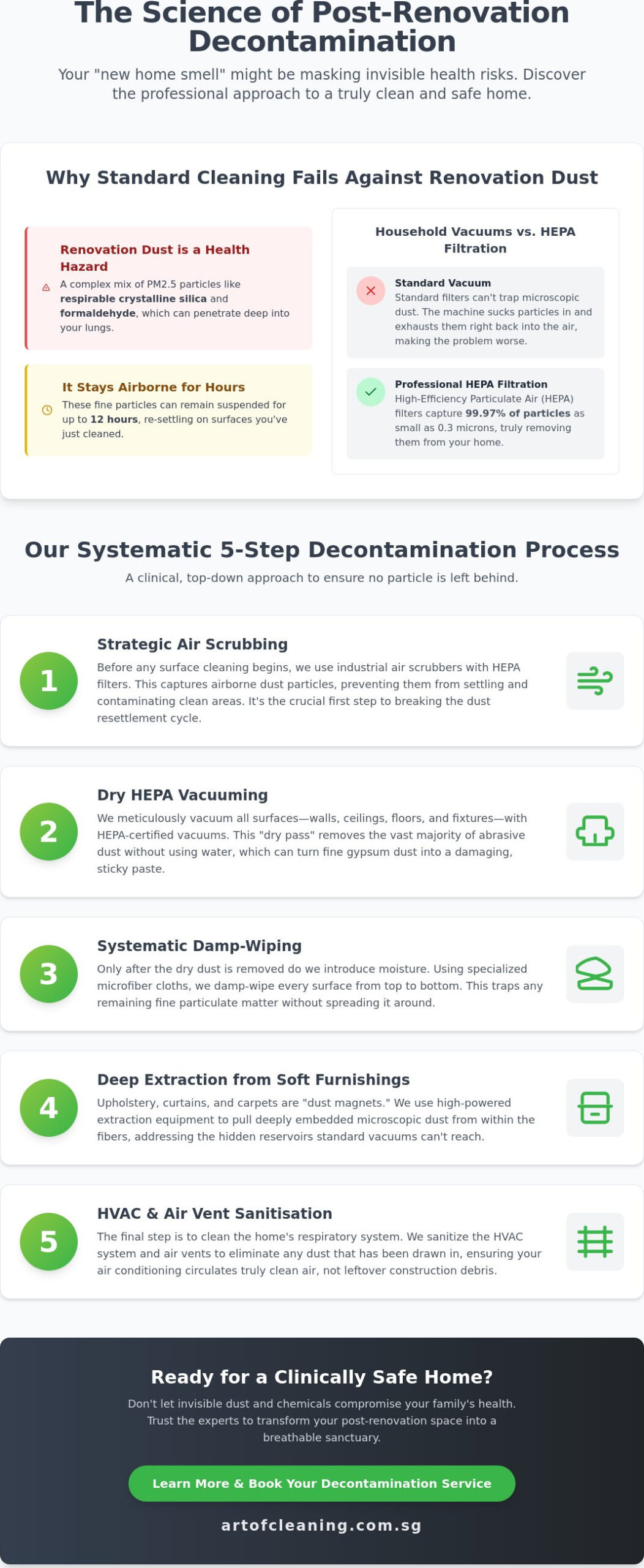
Renovation dust isn’t simply a messier version of the lint you find under your bed. It is a complex, abrasive cocktail of industrial materials including gypsum from drywall, cement silicates, and wood fibers. Understanding The Science of Renovation Dust is the first step in realizing why your usual cleaning routine feels like an uphill battle. These particles are often categorized as PM2.5, meaning they’re smaller than 2.5 micrometers in diameter. Because they’re so light, they can remain suspended in the air for up to 12 hours or even days before finally landing on your freshly wiped surfaces. This “settling cycle” is exactly why homeowners often wake up to a fine white film the morning after a deep clean.
When you’re figuring out how to get rid of renovation dust, you must account for the health risks of these microscopic invaders. Unlike larger household fibers, PM2.5 particles are small enough to bypass the body’s natural defense systems in the nose and throat. They travel directly into the lower respiratory tract and can even enter the bloodstream. This isn’t just a matter of tidiness; it’s a critical hygiene issue for your family, especially for those with existing respiratory sensitivities. Professional decontamination services focus on capturing these invisible threats rather than just moving them around.
The Composition of Construction Debris
Different materials require specific handling to prevent permanent damage to your new home finishes. Drywall dust, primarily made of gypsum, is incredibly fine and becomes a sticky paste when it meets water, which can ruin new paint or flooring. Masonry dust is heavier but highly abrasive, often containing silica. Respirable crystalline silica is a microscopic mineral particle released when cutting or grinding stone and concrete that can cause permanent lung scarring if inhaled. Sawdust might seem harmless, but it often carries chemical resins and adhesives used in modern cabinetry. Each of these components demands a specialized extraction method to avoid scratching delicate new surfaces.
Why Your Household Vacuum is Not Enough
Most domestic vacuum cleaners are designed to trap hair and crumbs, not microscopic silicates. Standard filters often have pores larger than the renovation dust itself, meaning the machine sucks the grit in and immediately exhausts it back out into your living space. This creates a dangerous cycle of aerosolizing the particles you’re trying to remove. Sweeping with a traditional broom is equally counterproductive, as the mechanical action launches fine dust back into the air. True decontamination requires High-Efficiency Particulate Air (HEPA) filtration, which is rated to capture 99.97% of particles as small as 0.3 microns. Without this industrial-grade equipment, you aren’t actually cleaning; you’re just redistributing the hazard.
A Systematic 5-Step Process to Eliminate Construction Dust
Effectively learning how to get rid of renovation dust requires a clinical mindset rather than a domestic one. Standard cleaning often fails because it lacks a logical sequence, causing dust to simply circulate from one surface to another. A successful decontamination plan follows a strict five-step protocol designed to isolate and remove particulates at the source.
- Step 1: Strategic Ventilation and Air Scrubbing. In regions with high humidity, simply opening windows can be a mistake. Moisture in the air binds with fine gypsum dust to create a sticky “sludge” that adheres to walls and inside crevices. We use industrial air scrubbers to filter airborne particles while maintaining controlled humidity levels.
- Step 2: Dry HEPA Vacuuming. This is the most critical phase. You must remove the majority of the dry grit using industrial-grade filtration before introducing any liquid to the environment.
- Step 3: Systematic Damp-Wiping. Once the bulk is removed, specialized microfibre cloths are used to trap remaining residue.
- Step 4: Deep Extraction. This addresses invisible reservoirs in sofas, mattresses, and carpets where fine dust settles deep within the fibers.
- Step 5: HVAC and Air Vent Sanitisation. This final step ensures your air conditioning system isn’t recirculating construction debris back into your living space.
While you might be tempted to start with the floors, our post renovation cleaning specialists always follow a top-down approach to ensure no surface is re-contaminated during the process.
The Top-to-Bottom Cleaning Strategy
Gravity is your enemy if you don’t plan for it. Cleaning must always begin at the highest point, including ceiling fans, light fixtures, and the tops of window frames. If you clean the floors first, the dust from the ceiling will settle on them hours later, forcing you to restart. When cleaning walls, use a dry microfibre mop to avoid damaging fresh paint or creating streaks. You should also address hidden reservoirs like the tops of kitchen cabinets and door frames, where dust can sit undisturbed for months before being disturbed by a draft.
Damp-Wiping vs. Wet-Mopping
A common error in how to get rid of renovation dust is using too much water too early. When fine construction dust meets a wet mop, it creates a “slurry” or liquid grit. This mixture can seep into tile grout or wood grains, causing permanent staining or a cloudy haze that is nearly impossible to remove once it dries. Microfibre technology is essential here because its hooked structure physically grabs the dust rather than pushing it across the surface. You should expect to perform at least 2 to 3 rounds of damp-wiping to achieve a clinically clean surface. This process is also vital for Managing Formaldehyde and VOCs, as chemical residues often cling to these fine dust particles and must be physically removed.
The Invisible Reservoir: Extracting Dust from Soft Furnishings
While hard surfaces are easily wiped, your soft furnishings often act as invisible reservoirs for construction debris. During a remodel, items like sofas, mattresses, and curtains function as “dust magnets,” pulling fine particulates out of the air and trapping them within porous fibers. This is a critical hurdle when learning how to get rid of renovation dust effectively. Unlike a marble countertop, a fabric sofa has a deep, three dimensional structure that allows gypsum and silicates to settle far beyond the reach of a standard wipe down.
The real danger lies in what you cannot see. These trapped contaminants are often the primary source of post construction sneezing and respiratory irritation. When you sit on a sofa or lay on a mattress that hasn’t been properly decontaminated, you physically displace the air within the foam, forcing a puff of microscopic dust directly into your breathing zone. To ensure a truly healthy home environment, we look to EPA’s lead-safe work practices as the gold standard for handling fine, hazardous particulates. For families moving into a newly finished space, securing Professional Carpet Cleaning Singapore is a necessary step for total environmental recovery.
Deep Upholstery Extraction
Surface level vacuuming is fundamentally insufficient for post renovation hygiene. It typically only removes the top layer of debris, leaving up to 80% of the fine grit lodged two or three inches deep within the upholstery foam. Specialized extraction restores hygiene by using high pressure systems to flush out these contaminants without damaging the fabric. For comprehensive care of your living room centerpieces, our guide on Sofa Cleaning in Singapore details the meticulous processes required to protect your investment while ensuring a clinically clean result.
Curtain and Mattress Decontamination
Curtains serve as vertical filters for airborne dust. Because they are usually positioned near windows where airflow is highest, they catch a significant volume of construction grit. This dust must be removed via professional curtain steam or dry cleaning to prevent it from shedding back into the room every time the fabric moves. Your mattress also requires serious attention. Fine dust can settle through bedsheets and embed itself into the mattress surface during the final stages of a build. Art of Cleaning offers specialized curtain and mattress decontamination services that prioritize long term health and safety over mere surface level tidiness.
Beyond Dust: Managing Formaldehyde and VOCs
While learning how to get rid of renovation dust is the immediate priority, the invisible chemical residues left behind are equally critical to your family’s health. That distinctive “new house smell” you notice upon entry is actually the off-gassing of Volatile Organic Compounds (VOCs) and formaldehyde. These chemicals are released from new cabinetry, industrial adhesives, fresh paints, and synthetic flooring materials. In the enclosed, air-conditioned environments typical of modern homes, these toxins can accumulate to levels that trigger chronic headaches and respiratory distress. As of February 2026, the EPA has proposed even stricter standards for formaldehyde emissions in composite wood products, highlighting the growing global concern for indoor safety. Addressing these threats requires professional formaldehyde removal services that go beyond mere ventilation to actively neutralize chemical bonds at the molecular level.
Dust particles are not just inert grit; they act as microscopic vehicles, carrying chemical residues deep into your lungs. When you’re researching how to get rid of renovation dust, you are also researching how to lower your chemical exposure. This synergy makes air quality management a two-pronged battle that requires specialized extraction. To ensure your home is truly safe for move-in, we recommend engaging a specialist for professional decontamination to secure your family’s well-being.
The Synergy of Dust Removal and Air Quality
Aircon cleaning is an essential post-reno step that many homeowners overlook. During construction, the cooling coils in your air conditioning unit act as a magnetic trap for both fine dust and chemical vapors. If left uncleaned, the system will recirculate these irritants every time it’s turned on. Combining professional coil cleaning with high-grade air purification during the first 30 days post-renovation is the only way to ensure the global indoor air quality standards, a market now exceeding $8.1 billion, are met in your private residence. This proactive approach prevents the secondary “dust storm” that often occurs when the AC is first engaged after a long build.
Floor Restoration After the Cleanup
The final stage of property restoration involves more than just removing the fine white film. Heavy construction traffic often leaves marble or parquet flooring looking dull and scuffed. There is a significant technical difference between standard cleaning and professional vinyl or marble polishing. While a mop removes the dust, polishing restores the protective seal and aesthetic brilliance of the material, ensuring your investment is protected from future wear. For a complete property transformation that balances health with aesthetics, consider our Professional Deep Cleaning Services Singapore to address both the hygiene and the visual integrity of your new home.
Why Professional Post-Renovation Cleaning is Essential
Learning how to get rid of renovation dust is an exhausting process that often traps homeowners in an endless cycle of wiping and re-wiping. Despite your best efforts, that fine white film usually reappears within hours as airborne particles finally settle. This is where Art of Cleaning’s “Hygiene-First” philosophy changes the outcome. We don’t just aim for a space that looks tidy; we execute a clinical decontamination process. By utilizing industrial-grade HEPA extractors and specialized chemical neutralizers, we remove the microscopic silicates and VOCs that standard domestic tools simply cannot touch. Investing in a professional intervention actually saves you money by preventing the abrasive dust from scratching your new marble floors or clogging your expensive air conditioning units.
For families with young children or pets, verified decontamination provides essential peace of mind. Infants spend a significant amount of time near floor level, where the highest concentration of heavy construction particulates resides. Our systematic approach ensures that every square inch of your home is safe for immediate move-in. We take pride in our status as a trusted specialist, a reputation bolstered by being featured on major national media platforms. When we step into a property, we treat the labor as an artisanal craft, ensuring that your health is protected alongside your home’s aesthetic beauty.
The Art of Cleaning Methodology
Our meticulous process leaves no stone unturned, literally. We pay special attention to the hidden reservoirs that DIY cleaning often misses, such as the internal tracks of sliding doors, the undersides of cabinetry, and the deep crevices of built-in wardrobes. Every technician is trained to handle regional environmental factors, particularly how high humidity interacts with gypsum dust to create stubborn residues. This localized expertise allows us to tailor our decontamination methods to the specific needs of your property, ensuring a level of precision that goes far beyond a standard surface wipe.
For property managers or business owners in Europe who require this same level of clinical precision for their commercial environments, you can visit HERA Cleaning to explore their professional office cleaning services in Belgium.
For readers in the UK, Apartment Clean provides professional domestic cleaning across Manchester to ensure your home stays pristine after the initial post-construction cleanup.
Booking Your Decontamination Session
Transitioning from a construction site to a sanctuary should be a low-friction experience. Our responsive team is dedicated to providing an efficient, organized journey from the moment you reach out. We believe in transparency and reliability, which is why we provide a clear breakdown of our services for various property sizes. You can view our transparent pricelist to understand the value we bring to your specific renovation project. Don’t let persistent grit and chemical odors linger in your new living space. Contact Art of Cleaning today to restore your home to a healthy, breathable state and ensure your family’s well-being is the top priority.
Step Into a Healthier, Dust-Free Home
Your renovation represents a significant investment in your future, but the lingering microscopic silicates and chemical residues shouldn’t be part of that legacy. We’ve explored why standard cleaning methods often fail to capture dangerous PM2.5 particles and why a systematic, top-down decontamination is the only way to ensure total hygiene. By addressing the invisible reservoirs in your upholstery and neutralizing off-gassing VOCs, you protect your family from respiratory irritants that standard domestic vacuums simply exhaust back into the air.
Understanding how to get rid of renovation dust is about more than just aesthetics; it’s about clinical safety for your loved ones. As a trusted specialist featured on major national media platforms, Art of Cleaning utilizes specialized HEPA-certified equipment and comprehensive formaldehyde removal options to restore your property. You don’t have to settle for a home that merely looks clean when you can have one that’s scientifically verified as safe. Ready to transform your living space into a breathable sanctuary? Book Your Professional Post-Renovation Cleaning Now and enjoy the peace of mind that comes with a truly decontaminated home.
Frequently Asked Questions
How long should I wait after a renovation before starting the deep clean?
You should wait at least 24 to 48 hours after the final construction activity before beginning a deep clean. This waiting period is essential because fine particulates stay suspended in the air for hours. If you start the process too early, you’ll find a fresh layer of white film settling on your surfaces the following morning.
Is it safe to sleep in a house immediately after a renovation?
It isn’t recommended to sleep in a freshly renovated space until a thorough decontamination has occurred. Construction debris often contains respirable crystalline silica and gypsum that trigger respiratory distress. Without professional extraction of these PM2.5 particles and VOCs, the air quality remains poor, which can lead to sneezing, coughing, or long term health complications.
Can I use a regular vacuum cleaner for construction dust?
No, you shouldn’t use a standard domestic vacuum for construction debris. Most household filters are too porous to trap microscopic silicates, which means the machine simply exhausts the dust back into your breathing zone. To effectively learn how to get rid of renovation dust, you need industrial grade HEPA filtration that prevents motor damage and ensures total particle capture.
Why does renovation dust keep appearing weeks after the project is finished?
Dust reappears because it’s trapped in hidden reservoirs like air conditioning ducts, ceiling fan blades, and soft furnishings. Every time you open a window or turn on the AC, these trapped particles are redistributed throughout your home. A single surface wipe is rarely enough; you need a systematic extraction process to clear these invisible reservoirs permanently.
How much does professional post-renovation cleaning cost in Singapore?
The cost of professional cleaning in Singapore depends on the property’s square footage and the complexity of the renovation. Factors such as the number of built in cabinets, the presence of soft furnishings, and the need for specialized floor polishing will influence the final quote. We provide transparent pricing based on your specific property size to ensure you receive a fair and accurate estimate.
What is formaldehyde removal and do I really need it?
Formaldehyde removal is a specialized chemical neutralization process that targets toxic off-gassing from new cabinetry, adhesives, and flooring. You need this service if you want to eliminate the “new house smell,” which is actually a health hazard. It is a critical step for families with children or pets who are more sensitive to chemical vapors in enclosed spaces.
Will professional cleaning remove the “new paint” smell?
Yes, professional cleaning combined with formaldehyde removal services can effectively eliminate paint odors. While standard ventilation helps, it doesn’t always address the chemical residues that cling to walls and furniture. Our methodology uses specialized neutralizers to target these VOCs at the source, ensuring your home smells fresh and is clinically safe for your family to inhabit.
Do you provide cleaning for aircon units clogged with construction dust?
Yes, we provide specialized aircon cleaning to remove construction grit from cooling coils and internal filters. During a remodel, AC units often pull in fine dust, which then clogs the system and reduces its efficiency. Addressing your aircon is a vital part of how to get rid of renovation dust because it prevents the system from recirculating irritants into your clean rooms.