
What if the cloudy film on your stone is actually a sign of microscopic surface damage that traps environmental contaminants? It’s deeply frustrating to mop your home only to have the floors look perpetually soiled and lackluster. You might even fear that using a standard cleaner will cause permanent etching or that bacteria are settling into tiny surface pits. Learning how to restore shine to dull marble floors is about more than just visual appeal; it’s a vital hygiene strategy for maintaining a truly healthy living space.
This 2026 professional guide reveals the scientific methods and artisanal secrets needed to transform dull stone into a radiant, hygienic masterpiece. You’ll gain a clear understanding of the restoration process and the professional-grade chemistry required to achieve a mirror-like finish. We’ll outline the specific criteria for when a DIY approach is safe and identify the exact moment when a specialist’s precision is necessary to protect your home’s most valuable surfaces. By the end of this guide, you’ll know how to turn a porous, dull surface into a smooth, light-reflecting floor that is easier to sanitize and maintain.
Key Takeaways
- Identify why microscopic surface irregularities cause dullness and how to protect the stone’s chemical vulnerability to acidic substances.
- Master the essential “dry prep” phase and pH-neutral cleaning protocols to safely refresh the stone’s surface without causing chemical damage.
- Learn exactly how to restore shine to dull marble floors by identifying the difference between surface stains and structural etching.
- Utilize the “Water Bead Test” as a scientific method to verify sealant integrity and ensure a hygienic, contaminant-free home environment.
- Recognize the clear criteria for when to engage professional diamond abrasive grinding to restore a mirror-like finish and long-term durability.
Understanding Why Marble Floors Lose Their Luster
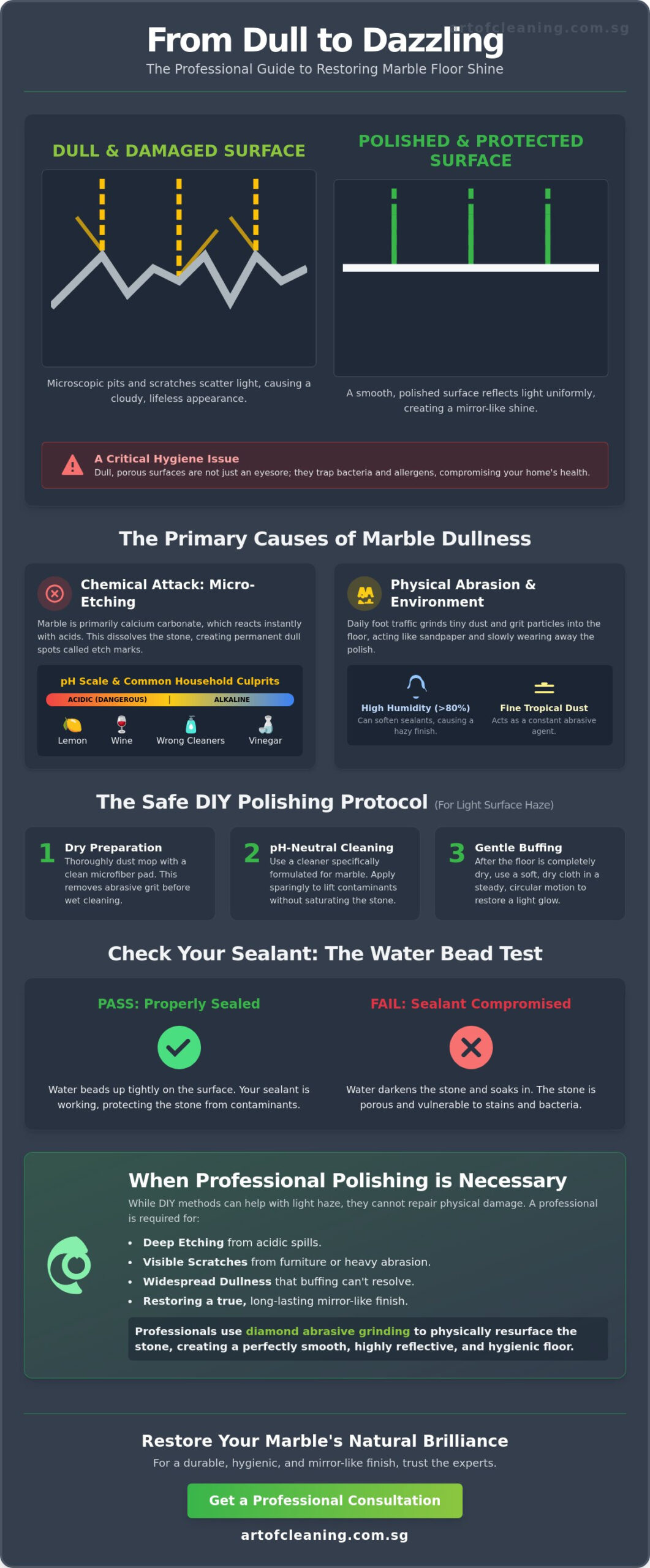
Marble floors are prized for their radiant, mirror-like finish. This brilliance is often fleeting in a busy household. Dullness isn’t just a surface layer of dirt that you can wipe away; it’s a physical change in the stone’s topography. When homeowners ask how to restore shine to dull marble floors, they’re usually dealing with microscopic surface irregularities. These tiny pits and scratches scatter light in various directions rather than reflecting it back to your eyes. This loss of reflectivity is the primary cause of a cloudy or lifeless appearance. It’s essential to distinguish between surface dirt, which sits on top of the stone, deep-seated stains that have penetrated the pores, and physical etching that has eaten into the material itself.
The geological properties of marble make it highly susceptible to chemical damage because it consists mainly of calcium carbonate. This mineral reacts violently with acids. From a health perspective, a dull floor is often a compromised floor. Professional observations indicate that even a 1% increase in surface porosity can significantly increase the retention of bacteria and allergens within the stone. A smooth, polished surface isn’t just for aesthetics; it’s a critical barrier for a hygienic home.
The Science of Micro-Etching and Porosity
Any liquid with a pH level below 7, such as lemon juice, vinegar, or certain all-purpose cleaners, triggers an immediate reaction on marble. This process creates microscopic pits in the stone that trap light instead of reflecting it. These pits also act as reservoirs for grime and moisture. Etching is a chemical reaction that physically changes the stone surface by dissolving the calcium carbonate on contact. Once this reaction occurs, standard mopping cannot fix the damage because the stone’s physical structure has been altered.
Environmental Factors in Singaporean Homes
In Singapore, the challenges to stone care are unique and often overlooked. Our high humidity levels, frequently exceeding 80%, can cause topical sealants to soften or blush, which leads to a hazy finish. Fine tropical dust also acts as a constant abrasive agent. As family members walk across the floor, these tiny particles act like sandpaper, grinding away the factory polish over time. Many local households unknowingly accelerate this damage by mopping daily with the wrong solutions. This routine often strips the stone’s natural oils and protective layers, making the search for how to restore shine to dull marble floors a recurring necessity for many homeowners. Understanding these environmental pressures is the first step toward a more scientific and effective maintenance strategy.
DIY Methods to Restore Light Surface Shine
Attempting a DIY restoration requires a precise understanding of stone chemistry. While deep etching requires professional intervention, you can address light surface haziness with the right tools. The most critical rule is maintaining a neutral pH environment. Many homeowners mistakenly reach for supermarket “all-purpose” cleaners, but these products often contain hidden acidic or highly alkaline components that worsen the problem. Following professional stone care guidelines ensures you don’t inadvertently dissolve the very surface you’re trying to save. When exploring how to restore shine to dull marble floors, always prioritize chemical safety over aggressive scrubbing.
Strictly avoid using vinegar, lemon juice, or any “natural” acidic solutions. These substances react instantly with the calcium carbonate in the stone, creating permanent etch marks. If your floor lacks brilliance, the issue is likely a buildup of soap scum or very fine surface scratches. You can often stimulate a surface glow through a controlled buffing motion using a dry, soft cloth. This process requires patience and a steady, circular hand movement to generate the slight friction needed to smooth out minor irregularities. For surfaces that have lost their luster due to years of heavy foot traffic, a professional marble polishing service can provide a deeper, more resilient finish than manual buffing alone.
The Safe DIY Polishing Protocol
- Step 1: Dry Prep. Use a clean microfiber pad to perform a thorough dust mopping. This removes abrasive grit that acts like sandpaper if dragged across the stone during the wet cleaning phase.
- Step 2: Spot Cleaning. Apply a specialized marble poultice or a pH-neutral cleaner to organic stains. Avoid saturating the stone; use just enough moisture to lift the contaminant.
- Step 3: Gentle Buffing. Once the floor is completely dry, use a dry chamois or a specialized stone cloth. Buff in small, overlapping circles to restore a light, clean reflection.
Natural Ingredients: What is Truly Safe?
Baking soda is a frequent recommendation, but it must be used with extreme caution. It’s a mild abrasive. If you scrub too hard or use a concentrated paste, you risk creating a new pattern of fine scratches. It’s safer to use it as a highly diluted solution for grease removal rather than a scouring agent. Distilled water is superior for the final rinse because it lacks the minerals found in tap water. These minerals often leave behind “hard water spots” that contribute to a cloudy appearance. For oily residue, a single drop of mild liquid dish soap acts as a safe surfactant, breaking down grease without compromising the stone’s integrity. Learning how to restore shine to dull marble floors at home is a delicate balance of removing buildup while protecting the stone’s fragile surface structure.
Treating Deep Stains and Physical Surface Damage
Understanding the nature of the damage is the first step in deciding how to restore shine to dull marble floors. There is a fundamental difference between a stain that is “on” the stone and etching that is “in” the stone. Stains occur when pigments or oils penetrate the porous structure, whereas etching is a physical change caused by chemical reactions that dissolve the stone’s surface. A common question homeowners ask is whether they can simply sand down the stone themselves. This is highly discouraged. Manual sanding without specialized equipment often creates uneven “dips” and creates a wavy reflection that is impossible to fix without extensive professional grinding.
To help you decide between a home remedy and professional help, use the “fingernail test.” If you can feel a scratch with your fingernail, it is typically deeper than 0.05mm. At this depth, DIY buffing or topical kits won’t suffice. Deep damage requires a systematic honing and polishing process to level the stone and recreate a uniform surface. For damage of this magnitude, it’s safer to contact Art of Cleaning specialized restoration services to ensure the structural integrity of your floor remains intact.
Removing Organic and Oil-Based Stains
Singaporean kitchens often face stubborn stains from coffee, red wine, or turmeric-heavy curries. These organic pigments require a poultice to “wick” the contaminant out of the stone’s pores. For light-colored marble, a 12% hydrogen peroxide solution mixed with an absorbent powder, like talc or chalk, creates an effective paste. Apply this mixture directly to the stain, cover it with plastic wrap, and poke a few small holes in the top. Leave this active for 24 to 48 hours. As the paste dries, it draws the liquid stain up into the absorbent material, effectively cleaning the stone from the inside out.
Addressing Physical Etching and Scratches
Minor surface “water rings” or very light etch marks can sometimes be addressed with ultra-fine #0000 steel wool. This should be done with extreme care and only on dry stone. However, this method is strictly for surface-level imperfections. If the etching has created a visible texture or the scratch is deeper than 0.05mm, mechanical grinding with diamond abrasives is necessary. This professional method removes a microscopic layer of the stone to reveal a fresh, undamaged surface. This level of precision is why knowing how to restore shine to dull marble floors often involves acknowledging the limits of domestic tools and prioritizing the long-term health of your home environment.
Preventive Maintenance: Keeping Marble Radiant Long-Term
Prevention is a science that begins the moment your floors are restored. While knowing how to restore shine to dull marble floors is essential for recovery, maintaining that brilliance requires a systematic approach to surface protection. The most effective way to monitor your floor’s health is through the “Water Bead Test.” Simply place a few drops of water on various areas of the stone. If the water beads up on the surface, your sealant is intact. If the stone darkens or absorbs the liquid within 30 seconds, your protective barrier has failed. This failure isn’t just an aesthetic concern; it means the stone’s pores are open to microscopic contaminants and bacteria that are difficult to remove through standard cleaning.
In Singapore’s urban environment, fine grit and tropical dust are constant threats. These particles act like sandpaper under foot traffic, grinding away the factory finish with every step. High-quality entrance mats at every doorway are your first line of defense, trapping up to 80% of abrasive debris before it touches your marble. To ensure the long-term health of your home, establish a professional maintenance schedule every 12 to 18 months. This proactive cycle prevents the deep etching that necessitates aggressive grinding and keeps your living space in a state of peak hygiene. For a comprehensive home health strategy, you can view our Professional Deep Cleaning Services Singapore guide to see how stone care fits into a total sanitation plan.
The Role of Penetrating Sealers
There’s a critical difference between topical “shiners” and professional penetrating sealers. Topical products often contain waxes that create a temporary glow but eventually peel, yellow, and trap dirt against the stone. In contrast, penetrating sealers move into the pores of the marble to provide a deep, invisible barrier. It’s vital to understand that sealants don’t make marble “bulletproof” against acids, but they do provide a “reaction window” that gives you time to clean spills before they can cause permanent damage. This chemical protection is the foundation of a low-maintenance, high-shine floor.
Daily Hygiene Habits for Stone Floors
Your daily routine determines how long your floor remains radiant. Always follow the “blot, don’t wipe” rule for liquid spills. Wiping spreads acidic substances across a larger surface area, increasing the risk of widespread etching. Microfiber is the only tool that should touch your marble daily; its split fibers are designed to lift dust rather than just pushing it around. If your floors have already lost their luster and the Water Bead Test shows immediate absorption, it’s time for professional intervention. You can contact our stone specialists today to schedule a diagnostic assessment and restore your floor’s protective seal.
When Professional Marble Polishing is Necessary
DIY methods are excellent for removing surface oils and soap scum, but they cannot repair structural damage. If your floor remains cloudy after a thorough pH-neutral cleaning, you’ve moved from the realm of “shining” to “restoration.” Professional intervention becomes necessary when the stone’s surface topography has been altered by deep etching, heavy abrasion, or years of foot traffic. At Art of Cleaning, we utilize advanced machinery that performs a complete resurfacing, a task that manual hand-buffing simply cannot match in terms of clarity and depth. Knowing how to restore shine to dull marble floors at this level requires a mastery of mechanical grinding and chemical hardening that goes far beyond domestic capabilities.
The transition to a professional service is often triggered by the realization that the floor looks “dirty” even after it’s been mopped. This is because the light is no longer reflecting off a flat surface; it’s being swallowed by microscopic pits. Our specialized process doesn’t just add a layer of wax; it physically changes the stone to reveal its original beauty. This is a permanent improvement to the stone’s structure rather than a temporary cosmetic fix. By investing in professional restoration, you’re not just improving the look of your home; you’re restoring a foundational element of your interior design to its factory-new condition.
The Diamond Grinding and Honing Process
Our restoration protocol involves the use of progressively finer diamond-impregnated pads to physically level the stone surface. The process begins with coarse abrasives to remove deep scratches and etch marks, followed by a sequence of honing stages that refine the stone’s texture. This mechanical leveling is what creates the high-definition clarity that distinguishes a professional finish from a DIY attempt. Once the surface is perfectly flat, we apply a chemical crystallization process. This reaction hardens the calcium carbonate in the marble, creating a durable, mirror-like finish that is significantly more resistant to future scratches. Modern professional polishing also employs “dust-free” wet-grinding technology. This ensures that no fine particulates are released into your home’s air, protecting your family’s respiratory health while we work.
The Hygiene Advantage: Eliminating Micro-Pockets
A perfectly smooth floor is a fundamental component of a healthy home environment. When marble is etched or dull, its surface area increases exponentially at a microscopic level. This jagged, porous terrain traps environmental pollutants, skin cells, and moisture, creating an ideal breeding ground for bacteria and allergens. These contaminants are nearly impossible to remove with a standard mop because they’re lodged deep within the stone’s surface irregularities. By restoring the stone to a mirror-smooth finish, we eliminate these micro-pockets. This reduces the total surface area available for bacterial colonization and prevents the retention of fine dust, which directly improves your indoor air quality. A smooth floor doesn’t just reflect light; it reflects a commitment to a higher standard of hygiene. To ensure your stone is both beautiful and biologically safe, contact Art of Cleaning for a professional marble assessment today.
Secure the Future of Your Home’s Surfaces
We’ve explored the chemical vulnerabilities of calcium carbonate and the technical precision required to reverse years of environmental wear. You now understand that a mirror-like finish is an indicator of a hygienic, allergen-free environment. It is not just a cosmetic luxury. Whether you’re applying pH-neutral protocols at home or identifying the exact depth of a scratch that requires mechanical grinding, you’re now equipped to make informed decisions about your property’s health. Mastering the science of how to restore shine to dull marble floors involves balancing daily microfiber care with periodic professional resurfacing.
As a specialist featured on major national broadcasting networks, Art of Cleaning brings artisanal precision to every project. Our specialized diamond abrasive technology removes microscopic contaminants that standard mopping simply cannot reach. We maintain a 100% focus on home hygiene and family safety in every restoration we perform. Restore your floor’s brilliance with Art of Cleaning’s Marble Polishing services. Your marble floors represent a significant investment in your home’s value and your family’s well-being. Take the first step toward a more radiant and safer living space today.
Frequently Asked Questions
Can I use vinegar or lemon juice to clean my marble floors?
You should never use vinegar, lemon juice, or any acidic substances on marble surfaces. These liquids react chemically with the calcium carbonate in the stone, causing immediate etching that physically dissolves the surface. This reaction creates permanent dull spots that no amount of standard mopping can fix. To maintain a healthy and radiant home, always utilize pH-neutral cleaners specifically formulated for natural stone.
How often should I professionally polish my marble floors in Singapore?
Most Singaporean households require professional polishing every 12 to 18 months to maintain peak hygiene and brilliance. This frequency accounts for the high humidity and fine tropical dust that accelerate surface wear in local urban environments. Regular maintenance prevents deep-seated damage and ensures that your floors remain easy to sanitize and free from microscopic bacterial reservoirs that hide in pitted stone.
What is the difference between marble cleaning and marble polishing?
Marble cleaning involves the removal of surface dirt, grease, and topical contaminants using specialized surfactants. In contrast, marble polishing is a restorative process that uses diamond abrasives to physically level the stone and remove etch marks. While cleaning is a daily hygiene habit, polishing is a technical intervention that resets the stone’s light-reflecting properties and restores its original mirror-like finish.
Will professional marble polishing remove deep scratches and cracks?
Professional polishing effectively removes surface scratches that are shallower than 0.05mm by grinding away a microscopic layer of stone. However, deep cracks that penetrate through the tile usually require specialized epoxy resin repair or tile replacement. If you are researching how to restore shine to dull marble floors that have structural damage, a diagnostic assessment is necessary to determine the best restoration path.
Is the marble polishing process messy or dusty for my home?
The modern professional polishing process is exceptionally clean and virtually dust-free. We utilize specialized wet-grinding technology that traps all stone particulates in a water-based slurry. This prevents fine dust from circulating in your home’s air, protecting your family’s respiratory health and ensuring that your furniture and belongings remain completely clean throughout the entire restoration and crystallization process.
How can I tell if my marble floor needs to be resealed?
You can determine if your floor needs resealing by performing a simple “Water Bead Test” on various areas of the stone. If water droplets absorb into the marble or leave a dark spot within 30 seconds, the protective barrier has failed. A failed seal means the stone is vulnerable to deep-seated stains and bacterial colonization, indicating an immediate need for professional intervention to protect the stone’s integrity.
Are the chemicals used in marble polishing safe for pets and children?
All specialized solutions and sealants used in our restoration process are selected with a primary focus on family safety and environmental health. Once the crystallization and sealing phases are complete, the surface is inert and safe for both pets and children. We prioritize non-toxic, low-VOC materials to ensure your home environment remains a healthy sanctuary after our meticulous work is finished.
Can dull marble be restored without using heavy machinery?
You can restore a very light surface glow using manual buffing and pH-neutral cleaners, but significant restoration requires specialized machinery. Learning how to restore shine to dull marble floors that have experienced etching or heavy foot traffic involves mechanical grinding. This process levels the stone’s topography to achieve a level of clarity and hygiene that hand-polishing simply cannot provide for damaged surfaces.