
Research suggests that marble floors in residential homes should undergo professional marble polishing singapore every 12 to 24 months to prevent permanent structural deterioration. If your floors have become dull or cloudy, they are likely trapping microscopic contaminants within an increasingly porous surface. You’ve probably spent hours mopping, only to find that the haze remains and the etch marks from that accidental acidic spill are still visible. It’s frustrating when your investment in luxury stone feels like a magnet for dirt and bacteria that standard cleaning can’t reach.
This restoration process is a scientific necessity rather than a simple cosmetic fix. By utilizing specialized diamond-grinding techniques, we strip away damaged layers to reveal the stone’s natural brilliance. At Art of Cleaning, we apply a level of artisanal precision that serves as our signature of quality, ensuring your floor isn’t just beautiful, but also a hygienic, bacteria-resistant environment for your family. This 2026 guide details the essential steps of stone restoration, from removing deep stains to combatting the effects of Singapore’s high humidity on your home’s surfaces.
Key Takeaways
- Learn how Singapore’s high humidity affects porous stone and why “etching” is a molecular chemical burn rather than a surface stain.
- Understand the critical difference between temporary cosmetic buffing and professional diamond-grinding restoration that physically removes damaged stone layers.
- Discover the “Cloudy Film” test to identify surface oxidation and determine the exact moment your home requires professional marble polishing singapore.
- Identify which common “natural” household cleaners are actually marble’s worst enemies and how to implement a pH-neutral maintenance routine.
- Explore our multi-stage decontamination protocol that prioritizes both visual brilliance and a bacteria-resistant environment for your family.
The Science of Marble Deterioration in Singapore’s Climate
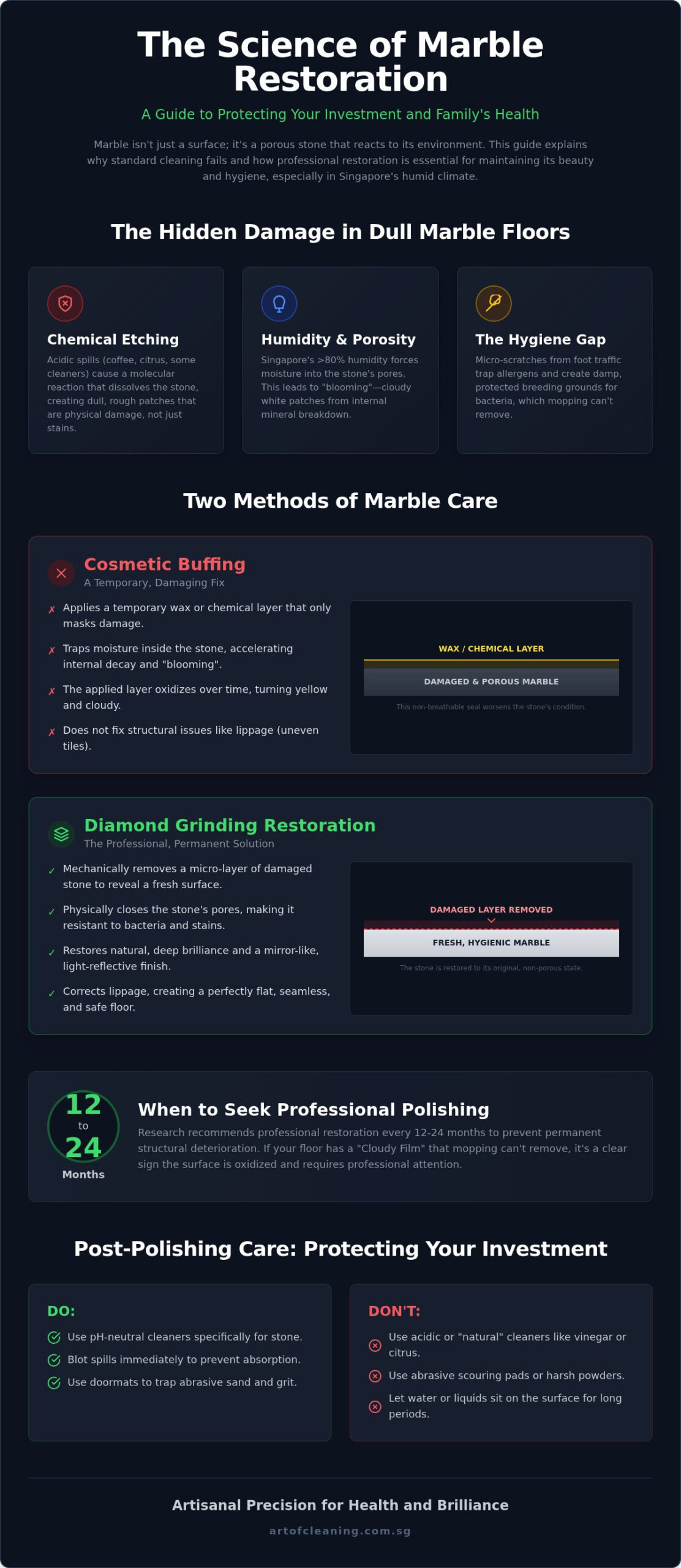
Marble isn’t a static, indestructible surface. It’s a dynamic, porous material that reacts constantly with its environment. Understanding the geological composition of marble is essential for homeowners who want to maintain its integrity. Primarily composed of recrystallized carbonate minerals, this stone is chemically alkaline. When acidic substances like coffee, citrus, or even certain “natural” cleaners touch the surface, a chemical reaction occurs. This reaction, known as etching, physically dissolves the stone at a molecular level. It leaves behind dull, rough patches that aren’t just surface stains; they’re actual structural damage. Over time, these etched areas lose their light-reflective properties, resulting in the cloudy appearance many residents struggle to fix with standard cleaning.
Humidity and Stone: The Singapore Factor
Singapore’s average relative humidity often exceeds 80 percent. This constant moisture pressure forces water vapor into the stone’s internal network. When moisture becomes trapped beneath the surface, it can lead to “blooming,” a cloudy discoloration where minerals react with water to create unsightly white patches. Condensation on unsealed marble creates a persistent damp environment that weakens the stone’s bond over time. Porosity in marble refers to the volume of open spaces within the stone, which dictates how easily liquid contaminants and moisture can penetrate the surface and degrade indoor air quality. Without professional marble polishing singapore, these pores remain open, allowing the humid air to accelerate internal mineral breakdown.
The Hygiene Gap in Dull Marble
As your floor endures daily foot traffic, microscopic grains of sand and dust act like abrasive sandpaper. These create thousands of micro-scratches that are invisible to the naked eye but significant to microscopic life. Over time, these scratches evolve into deep pockets where household contaminants hide. This creates a hidden hygiene gap that most families overlook until the floor looks visibly soiled.
- Trapped Allergens: Dust mites and pollen settle into these microscopic valleys, resisting the suction of standard vacuums.
- Bacterial Breeding Grounds: In a tropical climate, these damp, protected pores provide the perfect incubator for microbial growth.
- Cleaning Failure: Standard mopping often pushes dirty water deeper into these eroded pores rather than extracting the grime.
A dull floor is more than an aesthetic issue. It’s a signal that the stone’s protective barrier has failed. Investing in marble polishing singapore is the only way to mechanically close these pores and restore a smooth, hygienic surface that bacteria can’t cling to. By removing the damaged top layer, you’re not just restoring a mirror-like finish; you’re eliminating the microscopic “pockets” that compromise your home’s environmental health.
Understanding Restoration: Diamond Grinding vs. Cosmetic Buffing
Many homeowners mistake a temporary surface shine for true stone health. While quick-fix sprays might offer an immediate gloss, they often mask underlying structural issues. True restoration requires a mechanical approach that addresses the stone’s physical condition. Professional marble polishing singapore relies on diamond grinding, a process that utilizes heavy machinery and resin-bonded diamond pads to physically remove a micro-layer of damaged stone. This isn’t just about aesthetics; it’s about removing the etched, porous surface that traps the contaminants discussed in our previous section. By stripping away this compromised layer, we reveal the fresh, untainted marble beneath.
One significant benefit of this mechanical process is the correction of lippage. Lippage occurs when tiles are installed unevenly, creating small “lips” or edges that catch dirt and pose a tripping hazard. Diamond grinding flattens these transitions, creating a perfectly level, seamless floor. This level of precision is what separates artisanal restoration from standard janitorial cleaning.
Why Surface-Level Buffing Fails
Cosmetic buffing typically involves applying a layer of wax or chemical crystallizer to the stone. While this creates a fast reflection, it initiates a destructive “wax build-up” cycle. These chemicals sit on top of the stone, eventually oxidizing and turning yellow or cloudy. Because marble is a living, breathing material, sealing it under a non-breathable chemical mask traps moisture inside. This can lead to internal rot or “spalling,” where the stone begins to flake and crumble from within. These surface treatments often trap existing bacteria and microscopic dust under the new layer, creating a sandwich of grime that mopping cannot reach. In high-traffic areas, this artificial shine often vanishes within weeks, leaving the floor looking worse than before.
The Diamond Grinding Advantage
The transition from a dull, damaged floor to a mirror-like finish is a systematic journey through the grit scale. In the world of professional stone restoration, the grit scale typically ranges from a coarse 50-grit for aggressive damage removal to a microscopic 3000-grit for achieving a high-gloss finish. We begin with coarse metal-bond diamonds to erase deep scratches and etch marks. As we progress to finer resin-bonded pads, the stone’s surface becomes increasingly smooth. Understanding The Science of Marble Deterioration helps us determine exactly how deep we must grind to ensure the stone is fully decontaminated and structurally sound.
This “Mechanical Shine” is achieved without the use of heavy waxes. Because the stone itself is polished to a high level of smoothness, it reflects light naturally. This finish is significantly more durable and easier to maintain than chemical coatings. To see how this artisanal approach can transform your living space, you can explore our specialized floor restoration services. By choosing a mechanical polish, you ensure your home remains a safe, hygienic environment for years rather than months.
When to Seek Professional Marble Polishing in Singapore
Identifying the right time for intervention is a matter of stone health, not just vanity. You can perform several diagnostic tests at home to evaluate the current state of your stone. First, look for a “cloudy film” that persists even after a thorough mopping. This haze is often surface oxidation, a sign that the marble’s surface has become micro-pitted and is reflecting light unevenly. Next, try the “Water Bead” test. Place a few drops of water on your floor; if the water fails to bead and instead darkens the stone within 30 seconds, your protective seal has failed. This means your floor is currently absorbing every spill and contaminant, making marble polishing singapore a priority to prevent permanent staining.
Tactile indicators are equally revealing. Run your hand across the joints between tiles. If you feel sharp or uneven edges, you’re experiencing lippage. This occurs when tiles shift or were improperly leveled during installation, creating small ledges that trap dirt and can cause trips. These edges are physically impossible to clean with a mop and require mechanical re-leveling through professional diamond grinding to restore a flat, safe surface.
Identifying Etch Marks and Deep Scratches
Many homeowners confuse etch marks with simple water rings. In reality, these are chemical burns caused by acidic substances. Common Singaporean staples like vinegar, lemon juice, or even certain carbonated drinks react instantly with the calcium carbonate in the stone. While a surface scratch might only catch the light, a deep fissure feels like a distinct crack and can harbor significant bacterial colonies. Prompt restoration is vital. If you leave these etches untreated, they act as conduits that allow liquids to migrate deeper into the geological structure of the tile, eventually leading to permanent discoloration that no amount of surface cleaning can fix.
The Hidden Costs of Postponing Care
Neglecting your stone doesn’t just affect its appearance; it impacts your property’s long-term value. In the competitive Singapore real estate market, pristine marble flooring is a high-value asset. Allowing the stone to deteriorate until it pits or flakes means you may eventually face the massive expense of tile replacement rather than the lower cost of restoration. Beyond the stone itself, a degraded floor compromises your home’s environmental safety. For those managing a full household, integrating stone care with Professional Deep Cleaning Services Singapore ensures that every surface, from your marble floors to your upholstery, meets the highest standards of sanitation. Taking action now protects both your financial investment and your family’s well-being.
Post-Polishing Care: Protecting Your Stone Investment
After completing a professional marble polishing singapore, your floor is at its peak brilliance and hygiene. Maintaining this state requires a shift from aggressive scrubbing to scientific preservation. Many homeowners believe that because marble is stone, it requires “strong” cleaners to stay sanitized. This is a dangerous misconception that can undo months of restoration work in a single cleaning session. True stone care is about maintaining a delicate chemical balance that protects the stone’s surface from reactive damage.
The Chemistry of Safe Cleaning
Marble is chemically composed of calcium carbonate, making it highly reactive to pH imbalances. The pH scale ranges from 0 (highly acidic) to 14 (highly alkaline), with 7 being neutral. When you use “natural” cleaners like vinegar (pH ~2.4) or lemon juice, you’re applying a mild acid that immediately begins dissolving the stone’s surface. Even many supermarket “shine-enhancing” floor cleaners contain hidden acids or heavy waxes that create a sticky residue. This residue traps the very bacteria and allergens we worked to remove during the polishing process, eventually turning the floor cloudy. For high-traffic living areas, we recommend a daily dust mop and a weekly wet mop using only professional-grade, pH-neutral solutions.
Frequency matters in Singapore’s urban environment. Dust mopping should be a daily ritual to remove the fine, abrasive grit that enters through open windows or on footwear. If left on the floor, this grit acts like sandpaper under your feet, creating micro-abrasions that dull the finish. Use microfiber technology for both dusting and wet mopping. Microfiber filaments are significantly thinner than a human hair, allowing them to lift contaminants from the stone’s surface without scratching the delicate polish. This method is far superior to traditional cotton mops, which often just push dirt around rather than extracting it.
Preventative Measures for Longevity
Longevity is built on prevention. High-quality entry mats are non-negotiable for trapping outdoor grit before it reaches your marble surfaces. In Singapore’s humid climate, these mats also help absorb moisture that could otherwise lead to the “blooming” issues mentioned in previous sections. Additionally, ensure all furniture legs are fitted with thick felt protectors. A single heavy chair dragged across a polished floor can create a deep gouge that requires mechanical grinding to repair. You can review our maintenance service options and current rates on our Pricelist to help plan your long-term stone care strategy.
Protecting your investment is about consistency and using the correct tools. If you’re unsure about the current state of your floor’s seal or need a professional assessment, you can book a stone health consultation with our specialists today. By following these scientific cleaning protocols, you ensure your marble remains a brilliant and hygienic centerpiece of your home.
Art of Cleaning: Artisanal Marble Polishing for Health and Brilliance
Every marble floor tells a story of geological history. At Art of Cleaning, we believe the “Art” in our name represents a commitment to artisanal precision that transcends standard janitorial work. We don’t just see a floor; we see a unique piece of stone art that requires a customized restoration strategy based on its specific mineral composition and current level of deterioration. Our philosophy is rooted in the belief that a beautiful home must first be a healthy one. This is why we’ve shifted the narrative of marble polishing singapore from mere aesthetics to a rigorous standard of environmental hygiene.
Our Meticulous Restoration Protocol
Our technicians are trained as stone health specialists rather than general cleaners. They understand the nuances of various stone types and the specific environmental pressures found in Singapore. Every project begins with a comprehensive pre-inspection, including moisture testing to identify subsurface issues like blooming or hidden mineral reactions. This data-driven start ensures we apply the correct grit sequence for your specific floor condition.
- Decontamination: We begin by extracting deep-seated grime and bacteria that have settled into the stone’s pores over years of use.
- Italian Diamond Abrasives: We utilize industrial-grade Italian diamond pads to achieve superior clarity. These abrasives are far more precise than standard pads, allowing us to remove etch marks and scratches with microscopic accuracy.
- Breathable Sealing: Unlike the suffocating waxes discussed in earlier sections, we finish with premium, breathable impregnators. These allow water vapor to escape while preventing liquid spills from penetrating the surface.
This systematic journey from coarse grinding to fine diamond honing ensures that the resulting shine is a natural reflection of the stone itself. By avoiding heavy chemical coatings, we ensure your floor remains easier to maintain and stays brilliant for a significantly longer period.
The Trusted Choice for Singaporean Homes
Families across the island prioritize safety and health, which is why our specialized approach has been featured on major national media platforms. This regional endorsement acts as a hallmark of our verified identity and artisanal standards. We recognize that your home is a living sanctuary, not a construction site. Our restoration process is engineered to be entirely dust-free. We utilize the “wet method” of polishing, which uses water to cool the diamond discs and trap all stone particulates before they can become airborne. This protects your indoor air quality and ensures a clean environment for children and pets throughout the service.
Choosing Art of Cleaning means trusting a team that values the precision of their craft and the well-being of your family. If your floors have lost their natural luster or you’re concerned about the hygiene of your stone surfaces, it’s time to speak with a specialist. Contact our team for a Marble Polishing Consultation to discover how our scientific restoration protocol can revive your home’s natural brilliance while ensuring a bacteria-resistant environment.
Secure the Longevity and Health of Your Natural Stone
Restoring the brilliance of your marble is a scientific investment in your home’s long-term environmental health. We’ve established that the distinction between temporary cosmetic fixes and expert diamond-grinding technology is the difference between masking grime and physically removing it. By choosing professional marble polishing singapore, you eliminate the microscopic pores that trap bacteria and allergens in our humid climate. This artisanal approach ensures your floors remain a hygienic sanctuary for your family rather than a hidden breeding ground for contaminants. It’s a precise methodology that preserves the geological integrity of your stone while delivering a mirror-like finish.
Our specialized hygiene-first approach has been featured on national media, reflecting our commitment to meticulous craftsmanship and verified quality. We combine industrial-grade Italian abrasives with a dust-free restoration process that prioritizes your well-being. Don’t let dull, etched stone compromise the elegance and sanitation of your living space. We invite you to Restore Your Marble’s Health and Shine with Art of Cleaning and experience the standard of care your home deserves. We look forward to helping you rediscover the natural beauty of your stone.
Frequently Asked Questions
How much does marble polishing cost in Singapore for 2026?
Rates for marble polishing singapore in 2026 generally fluctuate based on the stone’s current condition and the total surface area. While industry averages for basic polishing often range from S$1.20 to S$4.80 per square foot, a full restoration involving diamond grinding typically requires a higher investment. Factors like deep etching or lippage correction will influence the final quote. It’s always best to request a physical site assessment to ensure an accurate, transparent estimate for your specific stone type.
How long does the marble polishing process take for a standard HDB or Condo?
A standard residential project usually requires one to three days to complete, depending on the floor’s current state. For a typical HDB or condominium unit, we often finalize the process within 48 hours. This timeline includes the meticulous multi-stage diamond honing and final sealing phases. We prioritize efficiency without compromising the artisanal precision required to reveal the marble’s natural brilliance and ensure a thoroughly decontaminated living environment for your family.
Will professional marble polishing create a lot of dust in my home?
Professional marble polishing singapore utilizes a “wet method” that effectively eliminates dust throughout the restoration. By using water as a cooling and trapping agent for the diamond discs, we prevent stone particulates from becoming airborne and settling in your home. This approach is essential for maintaining high indoor air quality and protecting your family from respiratory irritants. Our technicians ensure a residential-friendly experience that requires minimal cleanup after the service is finalized.
Can deep stains and scratches be completely removed from marble?
Most deep scratches and chemical etch marks can be successfully removed through mechanical diamond grinding. This process physically strips away the thin, damaged micro-layer of the stone to reveal the fresh, untainted marble beneath. While surface-level stains usually vanish during this process, some organic stains that have migrated deep into the stone’s pores may require specialized poultice treatments. Our specialists assess the depth of each fissure to determine the most effective restoration protocol.
How often should I have my marble floors professionally polished?
Residential marble floors typically require professional attention every 12 to 24 months to maintain their protective seal and luster. In high-traffic zones or homes with pets, you might notice dulling sooner, necessitating more frequent care. Adhering to this schedule prevents the stone from becoming overly porous, which reduces the risk of permanent bacterial colonization. Consistent maintenance is a scientific necessity that protects both your financial investment and your home’s hygiene standards.
Is it possible to change the finish from glossy to matte (honed)?
You can absolutely transition your floor’s finish from a high-gloss to a matte or honed appearance. This change is achieved by stopping the diamond honing process at a lower grit level, which creates a smooth but non-reflective surface. Matte finishes are increasingly popular in modern Singaporean homes for their understated elegance and ability to hide minor scratches more effectively. Our artisanal specialists can customize the gloss level to match your specific aesthetic preferences and home design.
What is the difference between marble polishing and marble crystallization?
Mechanical polishing uses diamond abrasives to smooth the stone, whereas crystallization is a chemical reaction that creates a temporary surface film. Mechanical polishing is a permanent restoration of the stone’s own surface, providing a durable and natural “mechanical shine.” Crystallization often relies on acidic chemicals to create a fast gloss that can eventually damage the stone’s internal structure. We emphasize diamond grinding because it ensures long-term health and a truly hygienic, breathable finish for your marble.
Can I walk on the floor immediately after the polishing service is done?
You can generally walk on the floor with clean socks immediately after we finish the polishing and sealing process. However, we recommend avoiding heavy foot traffic or moving furniture back for at least 24 hours to allow the breathable impregnator to cure completely. It’s also vital to keep the surface dry during this initial curing period. Following these simple post-service steps ensures the protective barrier remains intact, guarding your marble against moisture and deep-seated contaminants.