
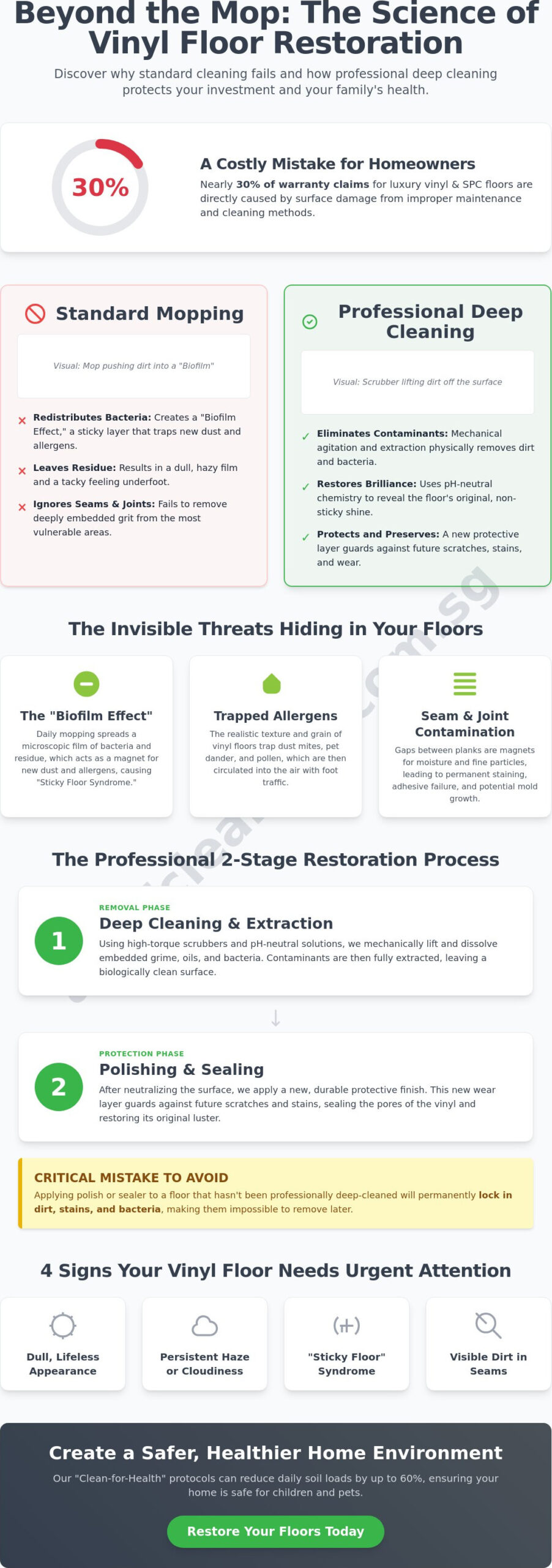
Did you know that nearly 30% of warranty claims for luxury vinyl and SPC planks are directly linked to surface damage from improper maintenance? You’ve likely spent hours mopping, only to find a dull, hazy film remains or that sticky residue still clings to the surface. Professional vinyl floor deep cleaning and polishing is the only way to reach the grit trapped in seams and joints that standard household tools simply ignore. It’s a common frustration for homeowners who prioritize a healthy environment but find their current routine isn’t delivering the results their family deserves.
You deserve a space that’s as hygienic as it is beautiful. This guide reveals how to eliminate microscopic contaminants and restore the original brilliance of your floors through scientific restoration. Research from 2025 shows that specialized “clean-for-health” protocols can reduce daily soil loads by up to 60%, creating a safer environment for children and pets. We’ll explore the importance of pH-neutral chemistry and the latest 2026 standards for long-term protection against scratches and stains, ensuring your home remains a sanctuary of wellness.
Key Takeaways
- Learn why standard mopping often fails by redistributing bacteria and how mechanical agitation is required to disrupt the hidden “Biofilm Effect.”
- Understand the vital distinction between the removal and protection phases to prevent sealing existing stains and grime into your floor’s texture.
- Discover the professional 5-step workflow for vinyl floor deep cleaning and polishing that utilizes pH-neutral chemistry to preserve your floor’s long-term durability.
- Identify the specific warning signs, such as “Sticky Floor Syndrome” and persistent cloudiness, that signal a need for deep-level hygiene intervention.
- Explore how a specialized, health-first approach to restoration creates a non-toxic environment that is safe for high-traffic family spaces.
The Science of Vinyl Floor Degradation: Why Surface Mopping Isn’t Enough
Many homeowners view vinyl as a “set and forget” material due to its reputation for durability. However, even high-quality Vinyl composition tile and luxury planks are susceptible to microscopic degradation that a standard mop cannot address. Surface mopping often creates a false sense of security. While the floor might look wet and shiny for a few minutes, the reality is that traditional cleaning methods often work against the material’s longevity.
True vinyl floor deep cleaning and polishing is a restorative process, not a maintenance chore. It requires mechanical agitation to break the surface tension of accumulated oils and carbon-based soils. This is followed by professional chemical extraction. This step ensures that suspended contaminants are physically removed from your environment rather than being pushed into the corners or joints of the room. Without this mechanical intervention, dirt remains trapped within the floor’s grain.
A primary concern for health-conscious families is the “Biofilm Effect.” This occurs when daily mopping redistributes a thin layer of bacteria and cleaning residue across the floor. Over time, this layer hardens into a microscopic film that acts as an adhesive for new dust and allergens. It’s why floors often feel sticky or tacky shortly after they’ve been cleaned. This biofilm isn’t just a nuisance; it’s a reservoir for pathogens that regular household chemicals fail to disrupt.
The vulnerability of vinyl is most apparent at the seams and joints. These narrow gaps are magnets for moisture and fine particulate matter. High-traffic friction eventually thins the factory-applied wear layer, which is the floor’s only defense. Once this barrier is compromised, dirt migrates into the core of the planks. This leads to permanent staining and structural issues like “cupping,” where the edges of the vinyl begin to lift.
The Role of Humidity in Vinyl Floor Hazing
High ambient moisture levels frequently lead to microscopic “clouding” on the surface of the vinyl. This hazing effect is often the result of moisture interacting with improper cleaning residues. If left unaddressed, moisture seepage can cause adhesive failure. More importantly, it creates a damp environment beneath the planks that is ripe for mold growth. Professional restoration includes controlled dehumidification to ensure the surface is perfectly prepared for a new protective finish.
Microscopic Contaminants: The Invisible Threats
Vinyl textures are designed to mimic natural wood or stone, but these realistic grains also trap allergens. Dust mites, pet dander, and pollen settle deep into these crevices. Data from environmental health studies suggest that bacteria concentrations in floor joints can be significantly higher than on the flat surface areas. These invisible threats circulate through your home every time someone walks across the room. A scientific approach to cleaning is the only way to verify that these contaminants are truly gone.
Deep Cleaning vs. Polishing: Understanding the Two-Stage Restoration Process
Restoration isn’t a single action; it’s a systematic sequence. To achieve a truly hygienic result, one must respect the boundary between the removal and protection phases. Many DIY attempts fail because they conflate these two steps. Applying a polish or sealer over a floor that hasn’t been deep-cleaned is a critical error. This effectively “locks in” microscopic dirt, bacteria, and existing stains under a hard, clear layer, making them impossible to remove without a full chemical strip later.
Professional vinyl floor deep cleaning and polishing relies on industrial power scrubbers that far exceed the capabilities of consumer mops. While a standard mop often redistributes a thin layer of grime, industrial scrubbers use high-torque mechanical action to lift embedded contaminants. Following this intensive scrub, the floor must undergo chemical neutralization. This step ensures that no alkaline residue remains, which would otherwise interfere with the adhesion of the polish. Adhering to professional sanitation and infection control procedures ensures that the surface is not just visually bright but biologically clean before the first coat of protection is applied.
Phase 1: Deep Mechanical Scrubbing
This phase targets the accumulated grease and protein-based stains that bond to the floor’s surface. We utilize specialized alkaline cleaners designed to penetrate the “Biofilm Effect” discussed previously. Soft-bristled power brushes are essential here; they’re engineered to reach into the embossed textures of luxury vinyl tiles (LVT) that flat pads miss. The process concludes with a high-suction extraction that removes the dirty slurry, preventing it from settling back into the joints. If you’re noticing persistent tackiness, you might need a professional assessment of your floor’s condition.
Phase 2: The Art of Vinyl Polishing
Once the floor is stripped of contaminants, we move to the protection phase. It’s vital to distinguish between “buffing” and “polishing.” Buffing merely uses friction to shine an existing, often worn, wax layer. Professional polishing involves applying entirely new protective coats. These layers fill in hairline scratches that would otherwise act as dirt traps, smoothing the surface at a microscopic level. Depending on your home’s aesthetic, you can choose between Matte, Satin, or High-Gloss finishes to restore the floor’s original vibrancy and color depth.
The Restoration Process: How Professionals Revive Your Floors
Professional restoration is a precise science that goes beyond the surface. It involves a systematic 5-step workflow designed to eliminate contaminants while preserving the material’s structural integrity. This process begins with a detailed inspection to identify compromised seams and ends with a controlled curing phase. Each step is calculated to transition the floor from a state of degradation to one of clinical hygiene.
The middle stages of vinyl floor deep cleaning and polishing are where the most significant health benefits occur. After mechanical scrubbing, a pH-neutral rinse is mandatory. Using cleaners with a pH level between 7.0 and 9.0 is critical for long-term maintenance. Research shows that highly alkaline cleaners, such as those with a pH of 10, can strip 15 microns of the floor’s wear layer over just six months. In contrast, a neutral rinse ensures the vinyl remains supple and prevents the yellowing or brittleness associated with harsh chemical residues.
The standard professional workflow includes:
- Site Inspection: Identifying scratches, deep stains, and adhesive failures.
- Mechanical Agitation: Utilizing high-torque scrubbers to disrupt the biofilm.
- High-Suction Extraction: Removing the toxic slurry of dirt and bacteria.
- Neutralization: A final pH-balanced rinse to stabilize the surface.
- Polymer Shielding: The application of protective layers to seal the grain.
Advanced Floor Scrubbing Technology
We utilize high-performance systems like Bona® PowerScrubbers to achieve results that manual labor can’t match. These machines use counter-rotating brushes to dig into the embossed textures of the vinyl. Unlike traditional mopping, which leaves dirty water to dry in the grain, our systems use integrated vacuum extraction. This instantly removes liquid waste before it can settle back into the floor. This technology allows for edge-to-edge precision, reaching tight corners and skirting boards where allergens typically accumulate.
Protective Coatings: The “Shield” Against Daily Wear
The final stage involves applying polymer-based protective coatings. These modern finishes are engineered for water-resistance and UV protection, preventing the fading caused by sunlight exposure. By sealing the floor, these coatings can extend the material’s lifespan by 5 to 10 years. Safety isn’t sacrificed for shine. We ensure the finish meets industry benchmarks for slip resistance, typically ranging from R10 to R12. Once applied, the floor requires a curing period, usually 4 to 24 hours depending on local humidity, before it can withstand heavy foot traffic.
When to Call the Experts: Signs Your Vinyl Needs Urgent Attention
Recognizing the tipping point where household maintenance fails is essential for preserving your home’s hygiene. Many owners wait until the floor is visibly damaged before seeking help, but the most dangerous contaminants are often invisible. If your daily routine no longer produces a clean result, your floor has likely reached its “saturation point.” At this stage, professional vinyl floor deep cleaning and polishing is no longer optional; it’s a necessary intervention to prevent permanent material failure.
One of the most common red flags is “Sticky Floor Syndrome.” If your feet feel a slight pull or tackiness after mopping, you aren’t actually cleaning the surface. Instead, you’re likely adding to a chemical buildup of surfactants and trapped oils. This residue acts as a magnet for bacteria. Similarly, visible hazing or cloudiness suggests that the floor’s original pattern is buried under a biofilm or has been abraded by fine grit. When you notice dark grime accumulating in the seams between planks, it’s a sign that moisture has carried organic matter into the joints, where it can trigger mold growth beneath the surface.
Post-Renovation and Move-In Requirements
New or recently renovated homes present unique challenges. Construction dust is often microscopic and highly abrasive, requiring specialized HEPA-filtered extraction to prevent it from scratching the vinyl during the cleaning process. It’s also vital to ensure the space is decontaminated from formaldehyde and other VOCs often found in new building materials. For those moving into a new space, our Post Renovation Cleaning Singapore guide provides a deeper look at how to achieve total home decontamination before you unpack.
Health Indicators for Families and Pet Owners
For households with crawling toddlers or pets, floor hygiene is a primary health concern. The floor is a major contact surface that directly impacts respiratory health. If pet odors persist despite constant mopping, it’s because those scents have been absorbed into the floor’s microscopic pores. Deep cleaning removes these embedded odors and allergens that standard tools miss. If you’ve reached the “Scuff Mark Threshold” where surface scratches are too deep for DIY removal, it’s time to contact our team for a professional assessment. We can help you determine if a restorative polish can save your floor from a costly replacement.
Art of Cleaning’s Scientific Approach to Vinyl Floor Care
Art of Cleaning operates as a guardian of your home environment. Our methodology for vinyl floor deep cleaning and polishing is rooted in the belief that a truly clean floor is a biological necessity, not just an aesthetic preference. We apply the same level of meticulous care to vinyl that we bring to our specialized marble polishing and parquet restoration services. Every project is treated with an artisanal touch, ensuring that the precision of our labor matches the high standards expected by our clients. We view professional maintenance as a strategic investment that preserves both your property’s market value and your family’s respiratory health.
Safety remains our primary directive. We exclusively use professional-grade, non-toxic chemicals that are engineered to be effective against deep-seated pathogens while remaining gentle on the living environment. These solutions are safe for high-traffic offices and domestic spaces alike, leaving no harmful residues behind. Our specialists understand that different vinyl compositions require specific chemical interactions to avoid the brittleness mentioned in earlier sections. This technical expertise allows us to restore vibrancy to floors that others might consider beyond saving.
The Art of Cleaning Difference
What sets us apart is a commitment to hygiene-first restoration. While many providers focus on a quick surface shine, we prioritize the total removal of the “Biofilm Effect.” Our trained specialists undergo rigorous training to master the art of mechanical agitation and chemical extraction. This ensures that the dirty slurry is completely removed from your home rather than being redistributed. You can explore our full range of maintenance solutions, from upholstery to comprehensive floor care, on our services page.
Booking Your Professional Floor Assessment
We believe in total transparency and customer-oriented service. You can easily access our standard rates through our pricelist to help plan your maintenance schedule. During a site visit, our experts conduct a comprehensive condition assessment, identifying invisible dirt traps and wear patterns before they become permanent. This proactive approach prevents the “Sticky Floor Syndrome” from returning. Contact Art of Cleaning today to schedule your professional assessment and restore the scientific hygiene and original beauty of your living space.
Invest in the Long-Term Health and Brilliance of Your Home
Maintaining a healthy home environment starts from the ground up. We’ve explored how surface mopping often falls short by redistributing bacteria rather than removing it. Effective vinyl floor deep cleaning and polishing requires a scientific two-stage approach that disrupts the biofilm and seals the material against future contamination. By addressing signs of degradation early, such as persistent tackiness or clouding, you prevent the microscopic wear layer loss that leads to permanent material failure and costly replacements.
Art of Cleaning brings a level of artisanal precision to every project, utilizing professional-grade equipment and health-conscious chemicals. Our expertise in both residential and commercial restoration has been recognized on major national broadcasting networks, reflecting our status as a trusted guardian of the home environment. We take pride in delivering results that balance visual vibrancy with clinical safety, ensuring your floors are truly decontaminated. Restore Your Floor’s Brilliance with Art of Cleaning today. Your floors are the foundation of your living space; let’s ensure they remain a safe, beautiful sanctuary for your family for years to come.
Frequently Asked Questions
How often should I have my vinyl floors professionally deep cleaned?
Most households should schedule a professional deep cleaning twice a year to maintain optimal hygiene and surface integrity. High-traffic environments, such as commercial offices or homes with multiple pets, often require quarterly attention to prevent the “Biofilm Effect” from compromising the floor’s safety. Regular intervention ensures that microscopic grit doesn’t permanently abrade the factory wear layer.
Will professional polishing remove deep scratches from my vinyl planks?
Polishing effectively hides hairline scratches and minor surface abrasions but cannot physically remove deep gouges that have penetrated the vinyl’s core. The polymer-based coating fills in these minor imperfections, smoothing the texture and preventing dirt from nesting in the crevices. For deep structural damage, we recommend replacing the affected planks before the polishing phase begins to ensure a seamless finish.
Is the polishing liquid used safe for children and pets?
Yes, we exclusively use non-toxic, water-based solutions that are completely safe for children and pets once the curing process is complete. Our health-conscious approach prioritizes indoor air quality by avoiding harsh solvents or high-VOC chemicals. This ensures your home remains a safe sanctuary for your family immediately after the service is finalized.
How long does the vinyl deep cleaning and polishing process take?
Most residential projects are completed within 3 to 6 hours, depending on the total square footage and the floor’s current condition. A standard three-bedroom apartment typically takes about half a day to undergo our meticulous 5-step restoration workflow. This timeframe includes everything from the initial site inspection to the final application of the protective polymer shield.
Can I walk on the floor immediately after the polishing is finished?
You should wait at least 4 to 6 hours for light foot traffic and up to 24 hours before moving heavy furniture back into the room. Walking on the floor too early can leave permanent footprints or smudge the curing polymer layer. We monitor local humidity levels during the service to provide you with a precise curing timeline based on your home’s specific environment.
What is the difference between vinyl floor polishing and waxing?
Polishing involves applying a modern polymer-based finish that bonds with the material, whereas waxing creates a thick, separate layer that often yellows and traps dirt over time. Vinyl floor deep cleaning and polishing is a more advanced, breathable solution that doesn’t require the aggressive chemical stripping associated with old-fashioned wax. It provides a more natural and durable finish that supports long-term floor health.
Do I need to move all my furniture before the cleaning team arrives?
We recommend clearing all small items, rugs, and light furniture from the service area to ensure edge-to-edge hygiene. While our team can assist with moving some larger items, a clear space allows our industrial scrubbers to reach every corner and skirting board effectively. This preparation is vital for achieving a comprehensive decontamination of the entire floor surface.
Can professional cleaning help remove stubborn stains like permanent marker or wine?
Professional mechanical agitation and specialized alkaline cleaners can remove most organic and chemical stains, including wine, ink, and permanent marker. However, if a substance has caused a permanent chemical burn or has migrated beneath the wear layer, a faint shadow may remain. Our initial inspection helps identify these stubborn areas so we can apply the appropriate extraction techniques for your specific floor type.