
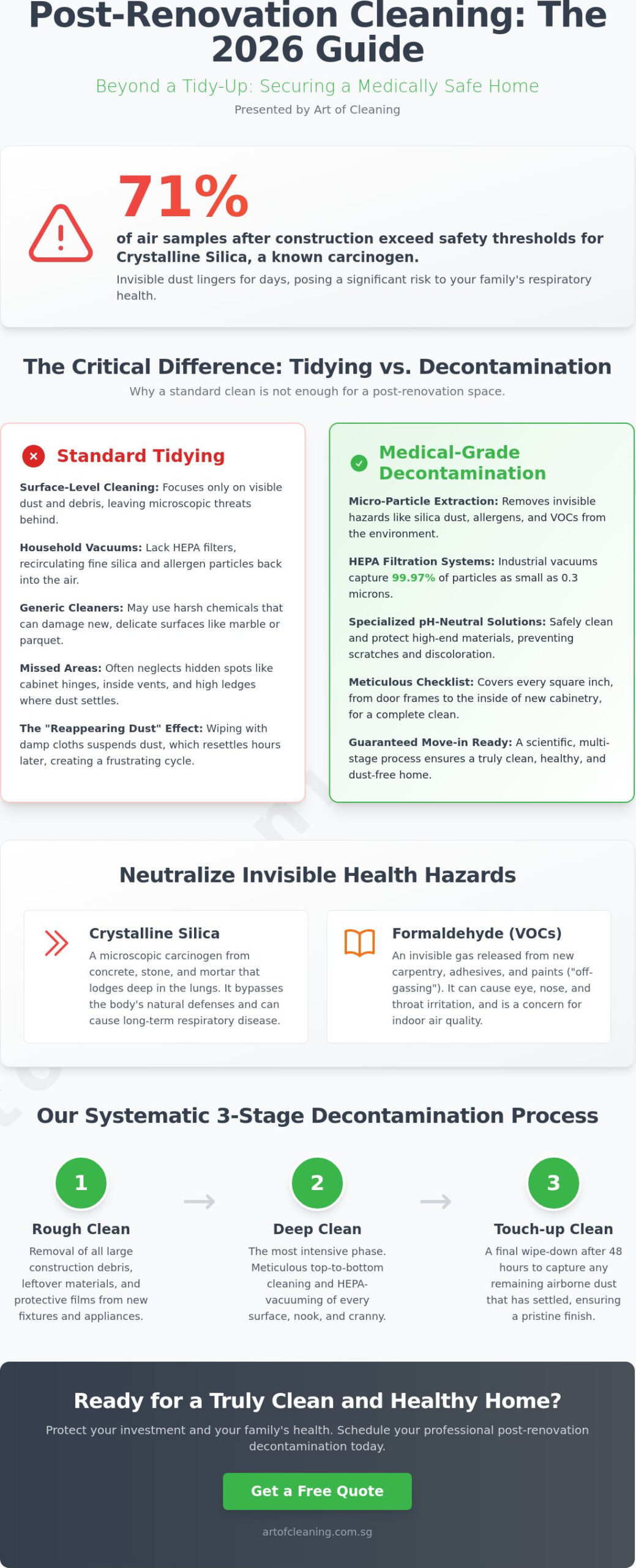
Did you know that 71% of air samples collected after construction tasks exceed the recommended safety thresholds for crystalline silica? This microscopic carcinogen is often invisible to the naked eye, yet it can linger in your home’s air for days after the contractors leave. While your new space looks finished, professional post renovation cleaning is a technical decontamination process that’s essential for your family’s respiratory health.
You’ve likely noticed that fine white dust keeps reappearing no matter how much you wipe, or perhaps you’re worried about the strong chemical smells from new cabinetry. It’s frustrating to feel like your expensive new marble or parquet floors are at risk of being scratched by construction grit. We understand that you want a home that’s medically safe for your children and pets, not just one that looks tidy on the surface.
This 2026 guide will show you how to eliminate invisible risks like silica and formaldehyde using medical-grade HEPA filtration and botanical-grade disinfectants. You’ll learn the difference between standard tidying and deep decontamination. We’ll provide the exact steps to protect your renovation investment and give you total peace of mind for an immediate move-in.
Key Takeaways
- Distinguish between a standard tidy-up and a medical-grade decontamination process to ensure your new space is truly safe for occupancy.
- Identify the specific protocols needed to neutralize invisible health hazards like formaldehyde and fine construction particulate that standard vacuums miss.
- Learn how to protect your investment by using pH-neutral, specialized methods for cleaning high-end materials like marble, parquet, and vinyl.
- Utilize our 2026 room-by-room checklist to find hidden dust pockets in areas often neglected by budget services, such as door frames and cabinet hinges.
- Discover why a scientific approach to post renovation cleaning is the only way to prevent the “reappearing dust” phenomenon and secure your home’s long-term hygiene.
What is Post Renovation Cleaning? The Difference Between Tidying and Decontamination
Many homeowners mistake a post renovation cleaning for a standard domestic tidy-up. It’s not. This process is actually a multi-stage technical removal of hazardous residues left behind by common building materials like drywall, concrete, and engineered stone. While a regular maid service focuses on surface-level dust and organic grime, construction-grade decontamination targets respirable toxins and abrasive grit that can damage both your health and your new finishes.
Visual cleanliness is a deceptive metric in a newly renovated space. A room might appear “sparkling” under the light, but invisible threats like micro-dust and chemical off-gassing from adhesives often linger. These contaminants are too small to see, yet they are large enough to cause significant respiratory irritation. True decontamination ensures that these particles are physically extracted from the environment rather than just moved around with a damp cloth.
The Three Stages of Post-Construction Cleaning
Precision cleaning requires a systematic approach that respects the settling time of airborne particulates. We break this down into three distinct phases:
- Rough Clean: This initial stage involves the removal of large debris, leftover materials, and the peeling of protective films or stickers from new appliances and windows.
- Deep Clean: The most labor-intensive phase. This is where we perform the meticulous removal of fine dust from every square inch of the property, including high ledges, inside cabinetry, and behind fixtures.
- Touch-up Clean: Dust often stays airborne for several days. A final wipe-down is performed about 48 hours after the deep clean to catch any particles that have finally settled, ensuring the space is truly move-in ready.
Why Specialized Equipment is Non-Negotiable
Standard household vacuums are designed for pet hair and crumbs, not construction byproduct. Using a domestic vacuum for a post renovation cleaning is actually counterproductive. Most home filters are too porous to trap fine silica dust; instead, the machine sucks the dust in and exhausts it back into the room through the rear vent, effectively “misting” your air with toxins. This is why 71% of air samples in construction zones fail safety tests when proper extraction isn’t used.
Our artisanal approach relies on industrial-grade extraction systems equipped with HEPA filtration. These specialized vacuums capture 99.97% of microscopic particles as small as 0.3 microns. Beyond air safety, professional tools protect your investment. We use specific attachments designed to lift abrasive grit away from delicate surfaces like new marble or parquet without dragging the particles across the finish, preventing the permanent micro-scratches that often occur during amateur cleanups.
The Health Risks of Construction Residue: Silica, Dust, and Formaldehyde
Construction doesn’t just leave a mess; it leaves a legacy of microscopic pollutants. The most hazardous of these is crystalline silica, a known human carcinogen found in engineered stone, concrete, and mortar. According to the American Lung Association, silica dust is so fine that it bypasses the body’s natural defenses, lodging deep within lung tissue. Research from DEOHS in 2026 revealed that 71% of air samples taken after common construction tasks exceeded recommended safety thresholds. This dust doesn’t simply disappear. It lingers in the air and settles into porous surfaces, creating a long-term respiratory risk if not addressed through professional post renovation cleaning.
You’ve likely experienced the “white film” phenomenon. This is when surfaces look clean immediately after a wipe-down, only for a chalky residue to reappear 24 hours later. This happens because standard cleaning methods often lack the suction power to capture PM2.5 particulates. Instead of removing the dust, a damp cloth often just suspends it in a thin layer of moisture. Once the water evaporates, the dust remains. Only industrial-grade extraction can break this cycle by physically removing the particles from your home’s ecosystem.
Formaldehyde: The Invisible Threat in New Carpentry
Modern Singaporean renovations rely heavily on custom “built-in” carpentry. These fixtures often use composite wood products held together by resins that contain formaldehyde. This chemical is a volatile organic compound (VOC) that “off-gasses” into your living space for months or even years. The Health Effects of Formaldehyde can range from simple eye and throat irritation to more severe chronic respiratory issues. Simply “airing out” a room is rarely sufficient for the high concentrations found in new cabinets. Our specialized formaldehyde removal singapore service uses advanced neutralizing agents to accelerate the breakdown of these toxins, making your home verifiably safe for immediate move-in.
Silica Dust and Fine Particulates
The danger of silica lies in its size. These particles are often smaller than 2.5 microns, making them invisible to the naked eye but highly invasive to the human body. When contractors cut tiles or sand drywall, they release millions of these “sharp” particulates. Standard domestic vacuums actually redistribute these toxins by blowing them through the exhaust and back into the room. Effective decontamination requires air scrubbing and high-efficiency extraction. If you’re concerned about the air quality in your new space, our team can provide a comprehensive disinfection service to ensure every surface is medically clean and free from construction byproduct.
Protecting Your Investment: Specialized Care for Premium Surfaces
Your renovation represents a significant financial commitment. It’s a common mistake to view the final cleanup as a simple chore when it is actually the first step in long-term asset preservation. Improper post renovation cleaning techniques can cause permanent damage to high-end finishes within hours. Using the wrong chemicals, such as acidic solutions intended to strip cement haze, can permanently etch natural stone or strip the protective sealants from new wood. We treat your home with an artisanal level of care, ensuring that every surface is decontaminated without compromising its integrity.
While organizations like OSHA focus on the health risks of construction residue, these same microscopic particulates pose a physical threat to your home’s finishes. Construction dust is essentially composed of crushed minerals and glass fibers. When moved across a surface with a standard cloth or mop, these particles act like high-grit sandpaper. This is why professional intervention is necessary to lift, rather than drag, contaminants away from your new investment.
Marble and Parquet: Avoiding Post-Renovation Scratches
Natural stone and hardwood are particularly vulnerable to construction grit. We follow a strict “dry-extraction first” rule. Mopping a floor covered in fine drywall dust creates a permanent slurry that can settle into the pores of marble or the grain of parquet, leading to a dull, cloudy appearance that’s difficult to reverse. If your stone surfaces have already lost their luster due to construction traffic, we often recommend a targeted marble polishing treatment. This process removes micro-scratches and restores the deep, mirror-like brilliance your renovation intended.
Upholstery and Fabric Decontamination
Newly installed curtains, sofas, and headboards act as massive “dust magnets” during the final stages of a renovation. Even if items were covered, fine particulates often find their way through gaps in plastic sheeting. This isn’t just a matter of appearance; it’s about hygiene. If your furniture was on-site during the works, a deep mattress cleaning singapore and upholstery extraction are essential to remove allergens trapped deep within the fibers.
We choose between steam and dry cleaning methods based on the specific fabric type. For delicate silks or synthetic blends common in modern Singaporean homes, high-temperature steam provides hospital-grade sanitization without the use of harsh chemicals. This ensures your soft furnishings are as fresh and safe as the rest of your newly decontaminated space.
The 2026 Comprehensive Post-Renovation Cleaning Checklist
A successful post renovation cleaning follows a strict logical sequence: top-to-bottom and inside-to-out. This isn’t just about efficiency; it’s about physics. As we agitate and extract fine construction particulates from high ledges, gravity ensures any remaining dust settles on lower surfaces that haven’t been treated yet. Budget cleaning services often miss these nuances, resulting in that frustrating “reappearing dust” mentioned earlier. Our meticulous checklist covers every architectural detail, from the tops of door frames to the internal mechanisms of cabinet hinges where microscopic grit likes to hide.
Kitchen and Cabinetry Checklist
The kitchen is the heart of the home but also the primary collector of fine dust. We don’t just wipe the shelves. Our artisanal approach ensures every corner is decontaminated:
- Internal Cavities: Vacuuming and wiping the interior of every drawer, paying special attention to the runners and hinges where sawdust accumulates.
- Adhesive Removal: Degreasing newly installed surfaces to remove adhesive residues, stickers, and fingerprints left by contractors.
- Food-Prep Sanitization: Thoroughly sanitizing countertops and the interior of appliances so they’re medically safe for immediate use.
Bathroom and Wet Area Sanitation
New bathrooms often suffer from “grout haze,” a milky film left on tiles after installation. We use acid-free removal techniques to clear this haze without damaging the integrity of the new stone or grout. We also polish chrome fixtures using non-abrasive methods to prevent micro-scratches. A critical, often overlooked task is deep cleaning the floor traps. Construction sludge, composed of cement and tile fragments, often settles in these traps, leading to slow drainage or future clogs if not extracted immediately.
Air Quality and Ventilation Points
Your air conditioning system is the lungs of your home. During a renovation, fan coils and filters act as magnets for drywall dust. We meticulously clean AC filters and wipe down external fan coils to prevent these particles from recirculating. We also treat ceiling fans and light fixtures, as these are the first places dust settles after being kicked up. If your renovation was extensive, we recommend checking if professional air duct cleaning is required to ensure your indoor air quality is truly restored.
If you want to ensure your home meets these rigorous standards and is truly safe for your family, you can book our specialist post-renovation cleaning services today.
Transitioning to a Healthy Home: The Art of Cleaning Advantage
Opting for a “budget” clean often results in hidden expenses later. While a low-cost service might clear visible debris, it typically fails to address the microscopic particulates that trigger long-term respiratory issues. This leads to higher health costs and potential damage to expensive finishes that require professional restoration. We approach post renovation cleaning with a scientific mindset, prioritizing the total hygiene of your living environment over mere aesthetics. Our goal is to ensure your home is medically safe for your family from the very first day.
Our artisanal methodology centers on precise dust extraction. We don’t just move dust; we remove it using medical-grade HEPA systems that capture 99.97% of contaminants. This rigorous process ensures that the air you breathe is as clean as the surfaces you touch. By combining technical expertise with a deep concern for family safety, we transform a chaotic construction site into a verifiably healthy home. We take pride in the precision of our labor, treating every project as a craft rather than a simple chore. Once your post-renovation decontamination is complete, many homeowners find that scheduling regular spring cleaning services Singapore is the ideal way to maintain that verified level of hygiene and protect their assets long-term.
Why a Professional Cleaning Company Matters
There’s a significant gap between a standard cleaning company and a freelance maid. Professional organizations invest in specialized training and industrial equipment designed specifically for construction byproduct. We provide the security of full insurance and liability coverage, protecting your new assets against accidental damage. Our specialists develop a customized plan tailored to the specific materials in your home, whether you’ve installed delicate vinyl or high-end marble. This level of specialization is what ensures your renovation investment remains protected for years to come.
Ready for Move-In: Your Final Step
Preparing for our team is simple. Ensure all major construction work is complete and that contractors have removed their heavy tools. This allows our specialists to focus on deep decontamination without interference. During the final walkthrough, we encourage you to inspect the “hidden” spots we’ve treated, such as the tops of door frames and inside cabinet tracks. This transparency ensures you feel confident in the safety and freshness of your new space. A professional clean is the final, essential step in your renovation journey. Secure your post-renovation hygiene with Art of Cleaning today.
Secure Your Family’s Health in Your New Space
Moving into a newly renovated home represents a fresh start, yet the invisible legacy of construction can linger long after the contractors leave. We’ve established that technical decontamination is a medical necessity rather than an aesthetic choice. By addressing microscopic silica dust and volatile organic compounds through a specialized post renovation cleaning, you protect both your family’s respiratory health and your significant financial investment. Standard methods simply don’t match the precision of industrial-grade extraction.
Our commitment to hygiene and asset care has been recognized through features on MediaCorp and Channel 8. We combine artisanal skill with advanced HEPA-extraction technology to ensure 99.97% of particulates are physically removed from your environment. Whether you require expert restoration for your new marble floors or deep decontamination of your parquet, our team provides the authoritative care your home deserves. We act as the final guardian of your living space, ensuring it’s truly ready for your loved ones.
Don’t risk the reappearance of fine dust or the long-term effects of chemical off-gassing. Book Your Professional Post-Renovation Decontamination Today and step into a home that’s verifiably fresh and safe. Your new beginning deserves nothing less than professional precision.
Frequently Asked Questions
How soon after renovation can I start the deep cleaning process?
You should wait at least 24 to 48 hours after all construction work and paint touch-ups are finalized. This settling period is crucial because it allows microscopic airborne particulates to land on surfaces where they can be physically extracted. Cleaning too early often results in dust reappearing the next day as the remaining airborne particles finally descend.
Is it necessary to clean the aircon after renovation works?
Yes, cleaning your air conditioning system is vital because the fan coils and filters act as magnets for fine drywall and silica dust. Running your AC without a thorough cleaning recirculates these irritants throughout your home, which can trigger respiratory issues. A professional aircon cleaning prevents mechanical strain on your units and ensures the air you breathe is verifiably decontaminated.
Can post-renovation cleaning remove the ‘new house’ chemical smell?
While standard tidying only masks odors, a specialized post renovation cleaning targets the actual source of these smells, such as adhesive residues and VOCs. We use advanced neutralizing agents and high-efficiency extraction to accelerate the removal of chemical off-gassing. For homes with extensive custom carpentry, we often suggest targeted formaldehyde removal Singapore to secure long-term air safety for your family.
What is grout haze and why can’t I just mop it away?
Grout haze is a stubborn mineral film left behind after tile installation that requires specific pH-balanced solutions for safe removal. Simply mopping with water typically redistributes the mineral particulates, leading to cloudy streaks once the surface dries. Our specialists use non-acidic haze removers that lift the film without etching your new tiles or compromising the integrity of the grout lines.
Will professional cleaning remove paint splatters from my new flooring?
Yes, our technicians utilize specialized scrapers and gentle solvents to remove paint splatters from various floor types without causing surface damage. We customize our removal technique based on your specific material, whether it’s delicate vinyl, marble, or parquet. This precision ensures that your new flooring remains pristine while removing the unsightly evidence of construction mishaps.
How long does a full post-renovation cleaning usually take for an HDB or Condo?
A typical 3 to 4-bedroom HDB or condo usually requires 6 to 8 hours for a comprehensive decontamination. The exact time depends on the renovation’s scale and the volume of construction byproduct present in the space. We value meticulous precision over speed, ensuring that every hidden hinge and high ledge meets our high standards before we consider the job complete.
Can I stay in the house while the post-renovation cleaning is being done?
We recommend that residents stay elsewhere during the cleaning process to avoid inhaling any dust agitated during the initial extraction phase. Even though we use HEPA-filtration to capture 99.97% of microscopic particles, the environment is technically a working site until the final touch-up is finished. Vacating the space ensures your safety and allows our team to operate with maximum efficiency.
Does post-renovation cleaning include formaldehyde removal as standard?
Formaldehyde removal is generally a specialized add-on service rather than a standard part of a post renovation cleaning. While our deep clean removes surface-level chemical residues, neutralizing formaldehyde trapped within new cabinetry resins requires a specific, multi-stage treatment. We can provide a professional assessment to help you decide if your new carpentry necessitates this additional level of health-focused decontamination.
Pingback: Post Renovation Cleaning Singapore: The Ultimate 2026 Decontamination Guide – Art of Cleaning Pte Ltd
Pingback: Formaldehyde Removal Singapore: The 2026 Guide to Safe Indoor Air Quality – Art of Cleaning Pte Ltd