
What if your floor is actually a breeding ground for invisible irritants that regular vacuuming simply cannot reach? In Singapore’s relentless humidity, carpets often trap moisture and organic matter, creating a perfect environment for dust mites and fungal spores to thrive. You’ve likely noticed those persistent musty odors or felt the frustration of an allergy flare-up despite your best cleaning efforts. When standard home tools fail, professional carpet cleaning services provide the deep extraction necessary to sanitize your living space at a molecular level.
We know you value a home that is both beautiful and safe for your family. It’s common to feel overwhelmed by stubborn stains that reappear or the fear that your expensive rugs are deteriorating prematurely. This 2026 guide promises to help you master the science of carpet hygiene. You’ll learn how to effectively eliminate allergens and understand the technical standards, such as the latest IICRC guidelines, required for a truly sanitized environment. We will preview the essential differences between DIY maintenance and professional intervention, giving you total clarity on how to protect your home’s health with meticulous care and precision.
Key Takeaways
- Learn why professional carpet cleaning services are a medical necessity for removing the 70-80% of dry soil that standard vacuums can’t reach.
- Discover how oily resins from daily life lock allergens into your carpet and the specific science needed to break those bonds.
- Identify the critical differences between DIY machines and industrial extraction to prevent damage from over-shampooing and sticky residues.
- Master a five-step home maintenance routine, including a simple policy that prevents 80% of outdoor contaminants from entering your living space.
- Explore the “Art of Cleaning” methodology that uses medical-grade disinfectants to provide a scientifically clean and healthy environment for your family.
Beyond Aesthetics: Why Carpet Cleaning Services are a Health Priority
Many homeowners view vacuuming as the final step in floor maintenance. This is a dangerous misconception. Daily vacuuming only addresses surface debris; it doesn’t reach the biological contaminants embedded deep within the pile. Professional carpet cleaning services involve a rigorous sanitization process designed to neutralize threats at a molecular level. Think of your carpet as a giant, horizontal filter. It captures dust, pollen, and pollutants that circulate in your indoor air. Once this filter becomes saturated, it can no longer trap new particles, and every footstep releases a cloud of irritants back into your breathing zone.
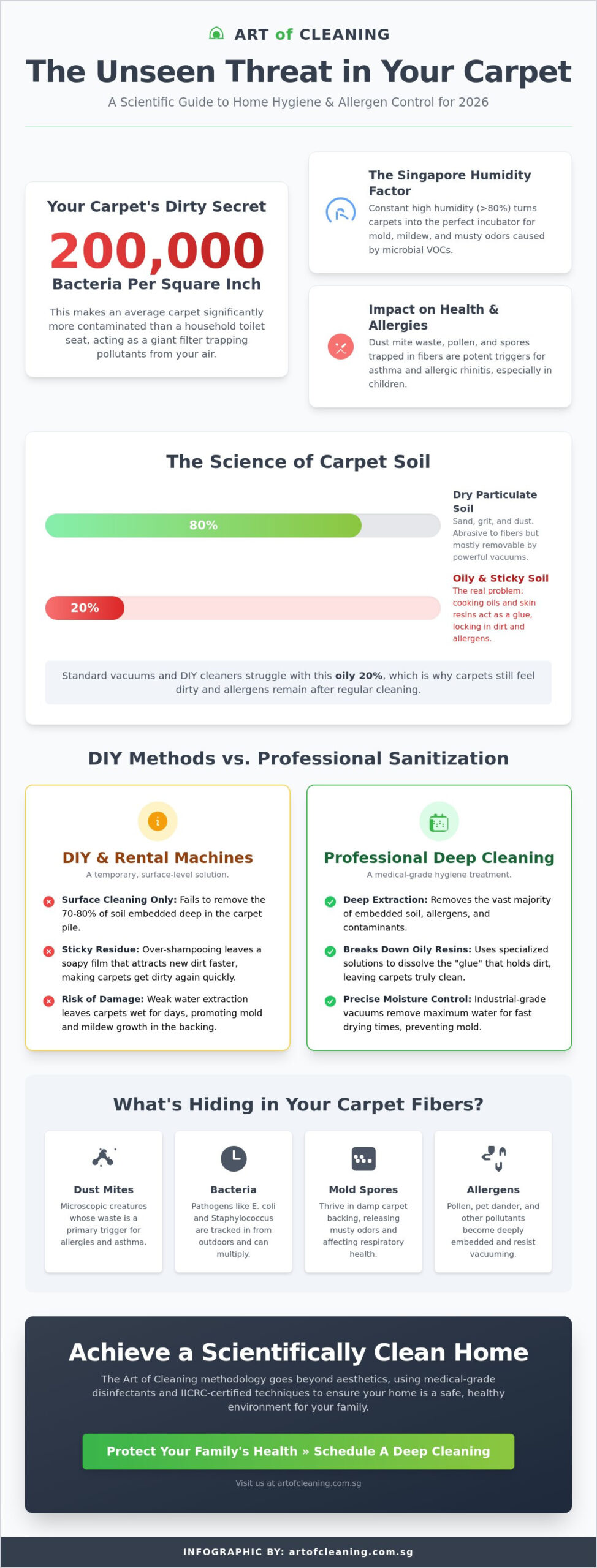
The scale of this invisible threat is staggering. Data suggests that a standard carpet can harbor up to 200,000 bacteria per square inch. This makes it significantly more contaminated than a typical toilet seat. These microorganisms thrive on a constant supply of skin flakes and hair shed by residents. While your carpet might look pristine to the naked eye, it likely contains millions of dust mites, fungal spores, and bacteria that compromise your home’s air quality. Relying on common carpet cleaning methods like simple steam or foam isn’t enough to achieve true hygiene. You need a systematic approach that addresses the unique environmental challenges of the region.
The Singapore Humidity Factor: A Breeding Ground for Microbes
Singapore’s climate presents a specific set of risks for textile floor coverings. With relative humidity levels frequently exceeding 80%, carpet fibers act as a sponge for atmospheric moisture. This creates an ideal incubator for mold and mildew growth deep within the backing. When these microbes metabolize, they release microbial volatile organic compounds (mVOCs). These gases are responsible for the heavy, musty odor that persists even after surface cleaning. Professional intervention focuses on precise moisture control. Without industrial-grade extraction, excess water from DIY attempts can remain trapped for days, actually accelerating the microbial bloom you’re trying to stop.
Impact on Respiratory Health and Allergies
For families dealing with asthma or allergic rhinitis, carpet hygiene is a medical priority. Dust mite excrement is one of the most potent triggers for respiratory distress in Singaporean households. These allergens are microscopic and easily become airborne during normal activity. Utilizing professional carpet cleaning Singapore specialists ensures that these triggers are physically extracted rather than just moved around. By removing the biological load from the fibers, you significantly reduce the concentration of VOCs and allergens, creating a safer environment for children, the elderly, and those with sensitive immune systems.
The Science of Carpet Contaminants: What’s Lurking in the Fibers?
To understand the necessity of professional carpet cleaning services, one must first look at what actually constitutes “dirt.” Scientific analysis reveals that 70% to 80% of carpet soil consists of dry particulate matter. This includes sand, grit, and microscopic silicate particles that act like tiny shards of glass. While these are abrasive and physically damage fibers, they aren’t the hardest to remove. The real challenge lies in the remaining 20%. This portion consists of oily resins derived from human skin contact and airborne cooking greases. These oils act as a biological glue, effectively locking dry soil into the pile so that standard vacuuming cannot dislodge it.
Neglected carpets also serve as a sanctuary for complex life cycles. Dust mites thrive in these textile environments, feeding on the constant supply of shed skin cells. A single gram of carpet dust can contain thousands of these microscopic arachnids. Their waste products, along with pathogens like E. coli or Staphylococcus aureus often tracked in from outdoors, create a significant health hazard. If you’re concerned about the hidden state of your floors, you can explore professional sanitization options designed to handle these microscopic interactions.
Bio-Contaminants and Allergen Accumulation
Beyond simple dirt, carpets accumulate a diverse range of biological matter. Pet dander, seasonal pollen, and even microscopic insect husks settle into the fibers over time. As people move through the space, high foot traffic acts as a mechanical force. It pushes these contaminants deeper into the carpet backing, where they become inaccessible to consumer-grade equipment. Research into the health effects of carpet contaminants shows that these repositories can trigger chronic inflammatory responses. We define ‘bio-load’ as the total microbial population per gram of fiber, a metric that highlights the invisible density of life within your flooring.
Chemical Residues and Indoor Air Quality
Carpets don’t just trap biological threats; they also capture environmental pollutants. Fine particulate matter (PM2.5) and nitrogen dioxide from urban traffic often drift indoors and settle into the carpet pile. The danger isn’t just that they stay there. A phenomenon known as ‘re-suspension’ occurs every time someone walks across the room. This mechanical disturbance kicks settled dust and chemicals back into the breathing zone, where they are easily inhaled. Deep extraction is the only effective way to remove these trapped chemical residues. By choosing professional carpet cleaning services, you ensure these pollutants are physically removed from the home environment rather than being recycled into the air you breathe.
DIY vs. Professional Carpet Cleaning: A Comparative How-To Analysis
Choosing between a rental machine and professional carpet cleaning services often comes down to a misunderstanding of physics. For those who prefer a hands-on approach, looking at the equipment standards of specialized providers like CleanRent Lublin highlights why industrial-grade Karcher tools are necessary for deep sanitization, as consumer-grade equipment typically lacks the required thermal capacity and suction power. While a home machine might reach 50 or 60 degrees Celsius, industrial extractors operate at significantly higher temperatures. This heat is vital for breaking down the oily resins that lock soil into fibers. Without sufficient heat, you’re merely moving dirt around rather than removing it. Industrial units also offer superior lift; they remove nearly all the moisture they inject. Home units often leave fibers damp for over 24 hours, which is a critical failure in a humid environment.
A common phenomenon in DIY attempts is the “Wick-Back” effect. This occurs when a stain is cleaned only at the surface. Because the deep-set soil in the backing wasn’t extracted, moisture travels down the fiber, dissolves the remaining dirt, and brings it back to the surface as the carpet dries. This is why stains often “magically” reappear a few days after a home cleaning. Adhering to professional carpet cleaning standards ensures that the extraction process reaches the very bottom of the carpet pile, eliminating the source of the stain entirely. In the long run, the cost of professional care is offset by the extended lifespan of your carpets; you’re protecting a major household investment from premature wear.
The Risks of Improper DIY Cleaning
Improper cleaning techniques can cause irreversible damage. The most frequent mistake is over-shampooing. When too much detergent is used, it’s nearly impossible to rinse out with a home machine. This leaves a sticky residue that actually attracts new dirt faster than before. Excess moisture is another major risk; if the carpet pad remains wet, it becomes a permanent site for mold growth. Even “natural” home remedies like vinegar can be problematic. Its acidic nature can strip the factory-applied stain protection or set certain types of stains permanently into the fiber. Using the wrong brush or too much friction can also lead to fiber distortion, making the carpet look fuzzy and worn.
When to Call the Professionals
Maintaining a healthy home requires a proactive schedule. For most Singapore households, a professional deep clean is recommended every 6 to 12 months. If you have pets, small children, or family members with respiratory issues, you should consider a 6-month interval. Watch for “Red Flag” signs that indicate your home’s “filter” is full. These include persistent musty odors, visible dark lanes in high-traffic areas, or an unexplained increase in sneezing when you’re in the room. You can check our pricelist to plan your maintenance budget and ensure your living environment remains scientifically clean and safe.
The 5-Step Essential Guide to Maintaining Carpet Hygiene at Home
Maintaining a healthy home requires a systematic approach to daily care. While the scientific contaminants we discussed previously require industrial extraction, your daily habits determine how quickly your carpet “filter” reaches its limit. Implementing a strict maintenance protocol can significantly extend the period between professional deep cleans and protect your family’s respiratory health. Consistent effort prevents the accumulation of the pollutants that eventually trigger allergies. When surface care is no longer enough, engaging professional carpet cleaning services ensures that your home environment remains a safe sanctuary.
Step 1 & 2: Preventative Measures and Vacuuming Technique
The foundation of carpet hygiene is the removal of dry particulate soil before it becomes embedded. You should implement a “No Shoes” policy immediately. Statistics show that up to 80% of indoor soil is tracked in from the outdoors on footwear. Using high-quality entrance mats serves as your first line of defense, trapping heavy grit before it reaches your main living areas. Your choice of equipment matters significantly. Use a vacuum cleaner equipped with a HEPA filter to ensure that microscopic allergens aren’t simply exhausted back into the air.
- The Slow Pass Method: Move the vacuum slowly to allow the brush roll and suction to agitate and recover deep-seated grit. One pass is never enough for high-traffic zones; three to four passes are often required for maximum recovery.
- Furniture Rotation: Move your sofas and tables every few months. This prevents permanent fiber crushing and eliminates “dust pockets” where microbes can breed undisturbed in the dark.
Step 3, 4 & 5: Spill Response and Climate Control
In Singapore, managing your micro-climate is just as important as physical cleaning. You should aim to keep indoor humidity levels below 60% using air conditioning or dehumidifiers. This specific threshold is critical; it inhibits the reproductive cycle of dust mites and prevents mold spores from germinating within the carpet pile. If a spill occurs, your response must be immediate and precise. Use the “Blot, Don’t Rub” protocol. Rubbing a stain pushes the liquid deeper into the backing and can permanently distort the fiber twist. Use a clean, white cloth and a pH-neutral spotting agent like a mixture of mild dish soap and water to gently lift the substance.
Finally, ensure there is adequate air circulation after any spot cleaning. Use fans to accelerate drying; moisture is the enemy of a healthy carpet. Even with perfect home habits, microscopic particles will eventually accumulate. If you notice your home environment feels less than fresh, it’s time to book professional carpet cleaning services to reset your home’s hygiene standards. Regular inspections by experts can catch early signs of fiber degradation before they become permanent eyesores.
The Art of Cleaning Standard: Professional Deep Extraction and Sanitization
At Art of Cleaning, we view every textile fiber as a critical component of your home’s environmental health. Our methodology isn’t a standard cleaning routine; it’s a specialized sanitization protocol rooted in scientific precision. We utilize medical-grade disinfectants and non-toxic solutions that are specifically formulated to be safe for infants and pets. Our equipment is calibrated for the unique challenges of the Singapore climate, ensuring high-pressure extraction while maintaining low-moisture drying times. This balance is vital to prevent the microbial bloom that occurs when fibers remain damp in high humidity. By prioritizing hygiene over surface-level aesthetics, we act as the guardians of your indoor air quality.
Our Specialized Deep Cleaning Process
Every assignment begins with a meticulous pre-inspection phase. Our technicians perform fiber identification to determine the exact material composition of your carpet. This step is crucial because it dictates the specific chemical pH and water temperature required to avoid fiber distortion or color bleeding. We utilize the Hot Water Extraction method, which remains the industry gold standard for deep sanitization. This process uses high-temperature water to dissolve the oily resins and biological glue holding contaminants in place, followed by powerful suction to physically remove them from your home. Our carpet cleaning services are available for both residential households and commercial office sectors, providing a deep, artisanal clean that restores the health of your space.
Why Trust Our Artisanal Approach?
Trust is built on transparency and verified results. Our commitment to excellence has been recognized through features on major national media platforms, serving as a hallmark of our reliability in the local community. We don’t just stop at dirt removal. Our specialized expertise extends to formaldehyde removal services and post-renovation hygiene, ensuring that your home is free from construction dust and chemical off-gassing. We take pride in the precision of our labor, treating every project as a craft rather than just a task. If you’re ready to experience a scientifically clean environment, we invite you to contact us for a personalized hygiene assessment. Our team is dedicated to providing the stability and health-based trust your family deserves.
Secure Your Home’s Environmental Health for the Future
Your carpet acts as your home’s most significant filter, capturing airborne pollutants that would otherwise settle in your family’s breathing zone. As we’ve discussed, managing Singapore’s unique humidity and the biological load within textile fibers requires more than just surface-level care. True hygiene is achieved when diligent daily protocols meet the technical precision of professional carpet cleaning services. By prioritizing deep sanitization over mere aesthetics, you’re investing in the long-term respiratory health of everyone in your household.
Art of Cleaning stands as a meticulous guardian of your living environment. Having been featured on major national platforms like Channel NewsAsia and MediaCorp, we bring a verified level of expertise to every home. We exclusively use specialized medical-grade disinfection and 100% non-toxic, family-safe solutions to ensure your space is both pristine and protected. Don’t let invisible allergens dictate your home’s comfort levels any longer.
Book Your Professional Carpet Hygiene Assessment Today and take the first step toward a scientifically cleaner, safer, and more vibrant living environment for your loved ones.
Frequently Asked Questions
How often should I engage carpet cleaning services in Singapore?
Most Singaporean households should schedule professional carpet cleaning services every 6 to 12 months to maintain a healthy living environment. If your home includes pets, young children, or individuals with respiratory sensitivities, a 6-month interval is highly recommended. Regular intervention prevents the biological load from reaching a saturation point that triggers allergy flare-ups or persistent musty odors.
Can professional cleaning remove deep-seated odors and mold?
Yes, industrial extraction effectively neutralizes the microbial volatile organic compounds responsible for heavy, musty smells. Unlike surface-level DIY attempts, professional sanitization targets the carpet backing where mold spores often germinate due to Singapore’s high humidity. By physically removing the organic matter that fuels microbial growth, we eliminate the source of the odor rather than simply masking it with fragrances.
Is carpet cleaning safe for babies and pets?
Carpet cleaning is entirely safe for your most vulnerable family members when conducted with the correct scientific protocols. We prioritize the use of 100% non-toxic and family-safe solutions that leave no harmful chemical residues behind. This health-first approach ensures that infants crawling on the floor and pets with sensitive respiratory systems remain protected from irritants and pathogens.
How long does it take for a carpet to dry after professional cleaning?
Most carpets will be touch-dry within 4 to 6 hours under standard indoor conditions. Our specialized equipment is calibrated for high-power extraction, which removes the vast majority of moisture during the cleaning process. Maintaining steady air circulation with fans or air conditioning after the service will further accelerate the drying time in our humid local environment.
What is the difference between steam cleaning and dry carpet cleaning?
Steam cleaning, technically known as Hot Water Extraction, uses high-temperature water to dissolve oily resins and is the gold standard for deep sanitization. Dry cleaning uses chemical compounds or minimal moisture for surface-level maintenance. While dry methods allow for faster foot traffic, they often lack the thermal energy required to kill deep-seated microorganisms or remove embedded grit.
Can you remove old, stubborn stains that I couldn’t get out myself?
Many stubborn stains that resist home remedies can be successfully removed using professional-grade spotting agents and heat. Success often depends on whether the spill has permanently dyed the carpet fiber or if previous DIY attempts caused permanent fiber distortion. Our technicians perform a precise fiber identification phase to apply the most effective and safe chemical pH for each specific stain.
Do I need to move all my furniture before the cleaners arrive?
You should clear small items, breakables, and floor-level clutter before the professional team arrives. While technicians can often clean around larger, heavy pieces like wardrobes or entertainment units, moving sofas or dining chairs allows for a more comprehensive sanitization of high-traffic zones. It’s best to discuss specific furniture requirements during your initial assessment to ensure a systematic and efficient workflow.
Are the chemicals used in carpet cleaning harmful to indoor air quality?
No, the specialized solutions used in professional carpet cleaning services are designed to improve your indoor air quality by removing trapped pollutants. We utilize medical-grade disinfectants that are formulated to neutralize pathogens without releasing harmful volatile organic compounds (VOCs). This process effectively resets your home environment, making the air significantly cleaner and safer for your family to breathe.
Pingback: Professional Office Cleaning Singapore: The 2026 Workplace Hygiene Buying Guide – Art of Cleaning Pte Ltd
Pingback: Best Carpet Cleaning Singapore: The 2026 Definitive Comparison & Buying Guide – Art of Cleaning Pte Ltd