
Labor costs now account for 50% to 60% of the total expense for professional cleaning, yet many Singapore facilities still face high employee absenteeism and carpets that wear out years too early. You likely recognize that a standard janitorial sweep isn’t enough to mitigate hidden allergens or protect your significant flooring investment. If your current service feels inconsistent, it’s because your office carpet cleaning contract lacks the scientific rigor and technical standards required for a modern, healthy workplace environment.
This strategic guide will show you how to structure a maintenance agreement that transforms floor care into a health-security asset. We’ll show you how to implement a ‘set-and-forget’ schedule designed to extend your carpet’s life by at least 50% while adhering to local safety standards and environmental guidelines. By moving toward dynamic, data-driven cleaning schedules, you’ll learn how to secure measurable improvements in indoor air quality and ensure your workplace remains a safe, productive space for every team member.
Key Takeaways
- Transition from reactive spot-cleaning to a proactive hygiene program that prioritizes employee health by targeting hidden contaminants deep within carpet fibers.
- Determine whether steam cleaning or dry encapsulation is best for your facility based on specific carpet materials like nylon, wool, or polypropylene.
- Optimize your maintenance budget by segmenting your office into high, medium, and low traffic zones for more efficient cleaning frequencies.
- Evaluate any office carpet cleaning contract using a specialized checklist that verifies industrial-grade HEPA filtration and technician certification.
- Move beyond surface-level tidiness by partnering with a specialist who combines scientific precision with artisanal care to protect your workplace assets.
The Strategic Importance of an Office Carpet Cleaning Contract in 2026
In 2026, a professional office carpet cleaning contract is no longer just a line item for building aesthetics; it’s a fundamental component of your facility’s health-security infrastructure. Many businesses mistakenly view carpet care as a reactive task triggered by visible stains or dull colors. However, a modern contract establishes a scheduled, multi-method hygiene program designed to manage the invisible environment where your team spends forty hours a week. By shifting from “spot-cleaning” to proactive maintenance, you’re investing in a system that actively purifies the air and protects your staff.
Climate-controlled offices often suffer from stagnant air, where carpets act as a giant horizontal filter. While these fibers trap dust and pollutants, they have a limited capacity. Once saturated, every footstep releases a cloud of microscopic particulates back into the breathing zone. This cycle directly correlates with increased respiratory complaints, allergies, and fatigue among staff. A structured maintenance plan ensures these contaminants are removed before they can compromise the wellness of your workforce, turning your flooring into a tool for health rather than a reservoir for germs.
Beyond Aesthetics: The Science of Invisible Contaminants
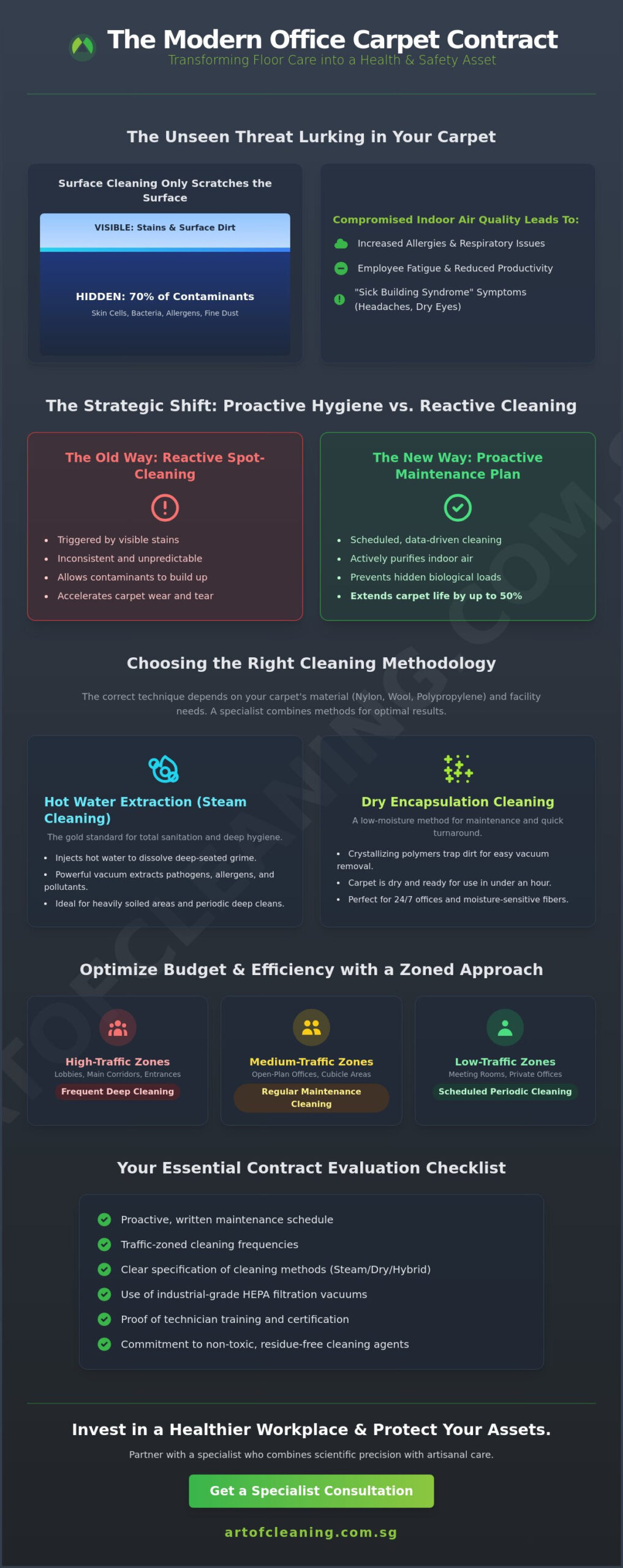
Daily vacuuming is a surface-level ritual that only addresses about 30% of debris. The remaining 70%, comprised of skin cells, bacteria, and fine atmospheric dust, settles deep within the base of the pile. These hidden contaminants are the primary triggers for “Sick Building Syndrome,” causing dry eyes, headaches, and throat irritation. Utilizing advanced carpet cleaning methodologies is the only way to neutralize these biological loads. Our approach focuses on the molecular level, ensuring that your office environment is as safe as it is visually clean.
Protecting the Bottom Line: ROI of Carpet Longevity
Every grain of sand or grit trapped in your carpet acts like a microscopic blade. As employees walk across the floor, this grit grinds against the fibers, eventually shearing them off at the base and destroying the carpet backing. This mechanical wear is what causes those permanent “traffic lanes” that no amount of cleaning can fix. Implementing a consistent office carpet cleaning contract can extend the life of your flooring by up to 50%, deferring the massive capital expenditure of a full replacement. For a deeper look at how hygiene impacts your facility’s value, explore our Professional Carpet Cleaning Singapore: The Ultimate Health & Hygiene Guide (2026). By managing your assets with scientific precision, you secure both the health of your team and the stability of your maintenance budget.
Specialized Cleaning Methodologies: Steam vs. Dry Encapsulation
Selecting the correct methodology is the most critical technical decision within an office carpet cleaning contract. It isn’t merely a matter of preference; it’s a scientific requirement based on the specific fibers in your workplace. While a general cleaner might apply a one-size-fits-all approach, a specialist understands that nylon, wool, and polypropylene each react differently to heat, moisture, and pH levels. Using the wrong method can lead to permanent fiber damage, rapid re-soiling, or even mold growth in our humid climate.
Large corporate spaces often benefit from a hybrid strategy. This involves utilizing intensive extraction for high-impact zones like lobbies and corridors while employing low-moisture techniques for expansive open-plan desk areas. This balanced approach ensures that every square foot receives the appropriate level of care without unnecessary downtime. Crucially, any professional program must prioritize non-toxic, residue-free chemicals. Sticky detergent residues left behind by inferior services act as a magnet for new dirt, which quickly negates the results of the cleaning and compromises the air quality your team breathes.
Hot Water Extraction: The Gold Standard for Deep Hygiene
Hot Water Extraction, frequently known as steam cleaning, remains the industry benchmark for total sanitation. This process involves injecting pressurized hot water and specialized cleaning agents deep into the pile to loosen embedded pathogens, allergens, and bacteria. The powerful vacuum system then flushes these contaminants out of the building entirely. In Singapore’s high-humidity environment, managing drying times is a technical challenge that requires industrial-grade air movers. This method is essential for high-traffic reception areas and corridors where soil load is heaviest. If you’re looking for a partner who understands these technical nuances, you can explore our specialized office cleaning services to see how we manage deep hygiene.
Encapsulation and Dry Cleaning: Minimal Downtime Solutions
Encapsulation technology is a sophisticated alternative designed for speed and efficiency. The process uses specialized polymers that seek out and surround soil particles, crystallizing them into microscopic beads that are easily removed during the next scheduled vacuuming. It’s an ideal solution for 24/7 environments like call centers or sensitive server rooms where moisture must be kept to an absolute minimum. Because this method uses significantly less water, the carpet is typically dry and ready for foot traffic within an hour. We prioritize encapsulation formulas with low Volatile Organic Compound (VOC) levels, ensuring that the transition back to work is safe for even the most sensitive employees. By integrating these low-moisture solutions into your maintenance plan, you maintain a high standard of appearance without disrupting the flow of your business.
Designing Your Maintenance Schedule: Traffic Zones and Frequency
Effective facility management requires a shift away from static, blanket cleaning dates. A modern office carpet cleaning contract should be built on a dynamic “zone map” that recognizes how your space is actually used. In 2026, with hybrid work models changing occupancy levels, a one-size-fits-all schedule is inefficient and costly. By categorizing your office into High, Medium, and Low traffic zones, you can allocate your budget where it has the greatest impact on both hygiene and appearance, ensuring that resources aren’t wasted on rarely used spaces while critical areas remain pristine.
High-traffic zones like entrances and main corridors might require deep cleaning on a quarterly basis, while low-traffic storage areas or secondary offices may only need attention once a year. Medium-traffic areas, such as shared workstations and internal department walkways, typically benefit from a bi-annual deep clean to keep bacterial loads low. It’s also vital to account for “Peak Seasons.” In Singapore, the post-monsoon period often brings increased moisture and soil tracking, necessitating an extra service cycle to prevent mold growth in the damp fibers. Additionally, your contract must include a dedicated spot-cleaning clause. Immediate response to spills prevents permanent fiber staining and maintains a consistent professional image between scheduled deep cleans. This prevents a single coffee spill from becoming a permanent eyesore.
High-Traffic Zone Management
Lift lobbies, pantries, and thoroughfares are the front lines of your office’s hygiene battle. These areas experience the highest soil load and mechanical wear. We recommend monthly interim cleaning for these zones to prevent “path-wearing,” where embedded grit begins to physically degrade the carpet pile. When grit isn’t removed, it acts like sandpaper, shredding the delicate fibers every time someone walks by. For more detailed insights on managing a comprehensive facility program, see our Office Cleaning Services Singapore: The 2026 Strategic Guide to Workplace Hygiene. This proactive approach ensures that contaminants don’t migrate from the entrance into more sensitive work areas like the main office floor.
Meeting Rooms and Executive Suites
Client-facing spaces require a different level of meticulous care. In these zones, the focus is on maintaining professional prestige and addressing specific “offenders” like coffee and tea stains. We suggest scheduling deep cleans to coincide with major board meetings or corporate visits. This ensures your executive suites are in peak condition when they matter most. Because these areas are often used for high-stakes discussions, we prioritize low-moisture methods to ensure the room is ready for use within an hour, maintaining the seamless flow of your business operations. A clean board room reflects a company that values precision and attention to detail, creating a reassuring environment for your most important guests.
Essential Checklist for Evaluating a Commercial Carpet Cleaning Contract
When you review an office carpet cleaning contract, the technical fine print is just as important as the bottom-line cost. A generic agreement often lacks the specific safeguards needed to protect your facility’s air quality and physical assets. You should look for a contract that explicitly details the use of industrial-grade HEPA filters. Standard vacuums often exhaust fine dust back into the office, but HEPA-certified equipment ensures that 99.97% of microscopic particles are captured. This technical distinction is what separates a surface-level sweep from a true hygiene intervention.
Transparency in pricing is another non-negotiable factor. Many providers offer a low entry rate only to add “per-stain” charges or equipment surcharges later. A professional agreement should provide a comprehensive, all-inclusive scope that covers every technical requirement. You must also verify that the contract includes robust insurance and liability coverage. This protects your office furniture, partitions, and electronic equipment from accidental damage during the cleaning process. Before signing, you can view our professional cleaning pricelist to understand how transparent, value-driven pricing should be structured.
Key Performance Indicators (KPIs) for Facility Managers
A successful maintenance program is measured by results you can verify. Visual inspection standards should go beyond “looking clean” to ensuring there is no “wicking,” which is when old stains reappear as the carpet dries. We also prioritize odor neutralization over masking. If a cleaner uses heavy perfumes, they’re likely hiding bacteria rather than removing it. Your contract should guarantee a fragrance-free finish that indicates a truly sanitized environment. Additionally, ensure there are clear response time guarantees for emergency stain removal, as immediate action is the only way to prevent permanent damage from accidental spills.
Health and Safety Compliance
Your cleaning partner must demonstrate a commitment to both employee safety and environmental responsibility. This begins with a thorough review of Safety Data Sheets (SDS) for every chemical brought onto your premises. In 2026, compliance with local environmental standards is mandatory, especially regarding the disposal of wastewater. Our specialized technicians are trained to handle these protocols with the precision your workplace deserves. If you’re ready to upgrade your facility’s hygiene standards, contact our expert team to discuss a tailored maintenance program that prioritizes the health of your team and the longevity of your assets.
Optimizing Workplace Hygiene with Art of Cleaning’s Specialized Contracts
Standard cleaning is a commodity, but workplace hygiene is a strategy. At Art of Cleaning, we position ourselves as your dedicated hygiene partner rather than a mere service provider. Our 2026 approach combines artisanal care with scientific precision, ensuring that your office carpet cleaning contract is built on data and meticulous labor. We understand that every corporate environment has unique demands, which is why we offer customizable contract tiers. These range from essential maintenance for smaller studios to premium health-grade care for high-occupancy headquarters, allowing you to scale your hygiene investment based on actual facility usage.
Choosing a single-source provider offers significant operational advantages. Beyond carpets, our expertise extends to sofa cleaning, mattress cleaning, and vinyl floor polishing. This integrated approach ensures that every textile and hard surface in your office is maintained to the same high standard of sanitation. By consolidating these services under one professional contract, you eliminate the friction of managing multiple vendors while ensuring a consistent, health-focused environment for your entire team.
The Art of Cleaning Difference
Our commitment to excellence is rooted in technical results. We utilize professional-grade extraction systems designed to achieve 99.9% allergen removal, significantly reducing the triggers for workplace respiratory issues. Our technicians undergo specialized training to handle complex commercial fibers, which virtually eliminates the risks of carpet shrinkage or browning often caused by untrained operators. In one recent engagement, our structured maintenance program successfully extended a commercial client’s carpet life by an additional 3 years, deferring a significant replacement cost. We treat your flooring as a high-value asset that requires precision, not just a surface that needs a wash.
Getting Started with Your Office Hygiene Strategy
The journey toward a healthier workplace begins with a comprehensive site audit. Our experts assess your specific office layout, identify traffic patterns, and evaluate fiber types to build a plan that works for your budget and your schedule. We then provide a tailored quotation that reflects the exact needs of your commercial space, ensuring full transparency without hidden fees. Secure the health of your workplace and the longevity of your assets by partnering with specialists who take pride in the craft of cleanliness. Contact Art of Cleaning for a Professional Site Audit to establish a new standard of hygiene for your office today.
Securing Your Workplace Health and Asset Value for 2026
A high-performance workplace relies on a foundation of hygiene that goes beyond visual appeal. By implementing a data-driven approach to traffic zones and selecting the correct scientific methodology for your specific fibers, you transform maintenance into a health-security asset. Establishing a robust office carpet cleaning contract is the most effective way to ensure consistent indoor air quality while extending the lifespan of your flooring by at least 50%. It’s a strategic move that protects both your employees and your capital investment.
Art of Cleaning provides the specialized upholstery and carpet deep cleaning expertise required to meet the rigorous standards of 2026. As a specialist featured on major national media platforms and trusted by corporate facilities across Singapore, we bring artisanal precision to every square foot. We invite you to secure your office hygiene with a specialized carpet maintenance contract from Art of Cleaning. Our meticulous site audits and technical rigor provide the peace of mind that your environment is truly sanitized. We’re ready to help you create a safer, more productive workplace for your entire team.
Frequently Asked Questions
How often should an office carpet cleaning contract be reviewed?
Annual reviews are the standard for most facilities, but you should re-evaluate your agreement whenever there are significant changes in office occupancy or hybrid work models. If your team has grown or you’ve shifted to higher in-office attendance, your cleaning frequency needs to reflect the increased soil load. Regular audits ensure that your service levels match the actual mechanical wear on your flooring assets and keep your maintenance budget efficient.
Can deep cleaning be done during office hours without disruption?
Low-moisture encapsulation methods allow for deep cleaning during business hours with minimal disruption to your staff. These techniques use specialized polymers to trap dirt, and the carpet is typically dry and ready for foot traffic within 60 minutes. While intensive steam extraction is best reserved for after-hours or weekends, encapsulation provides a quiet, fast-drying alternative for 24/7 environments like call centers or sensitive server rooms.
What is the difference between general office cleaning and specialized carpet contracts?
General office cleaning focuses on surface-level tasks like emptying bins and basic vacuuming, whereas a specialized office carpet cleaning contract involves deep-tissue hygiene using industrial-grade equipment. Specialized contracts target the 70% of contaminants that settle at the base of the pile, which standard vacuums cannot reach. This scientific approach uses high-pressure extraction and HEPA filtration to remove pathogens and allergens, actively purifying the air your team breathes.
How does professional carpet cleaning impact employee sick leave?
Professional cleaning reduces sick leave by removing the microscopic triggers that cause respiratory issues and headaches, which are common symptoms of “Sick Building Syndrome.” Carpets act as a horizontal filter for airborne pollutants, but once they become saturated, they release dust and bacteria back into the breathing zone. By neutralizing these biological loads through scheduled deep cleans, you create a healthier environment that can lead to fewer employee complaints related to allergies and fatigue.
Are the chemicals used in commercial carpet cleaning safe for people with allergies?
We prioritize the use of non-toxic, residue-free cleaning agents that are specifically formulated to be safe for sensitive individuals in shared workspaces. Our process avoids harsh fragrances or masking agents that can trigger allergic reactions; instead, we focus on total pathogen removal. We always maintain Safety Data Sheets (SDS) for all agents used, ensuring that our methods comply with the highest health and safety standards for every person in your office.
What should I do if a major spill occurs between scheduled contract cleanings?
You should ensure your office carpet cleaning contract includes a dedicated spot-cleaning clause for immediate emergency response. If a spill happens, blot the area with a clean, dry cloth immediately but avoid scrubbing, as this can permanently damage the carpet fibers. Having a professional responder on call ensures that the spill is neutralized using the correct pH-balanced agents before it becomes a permanent, unsightly stain that ruins your office’s professional image.
How long does it take for office carpets to dry after a professional deep clean?
Drying times vary by method, with encapsulation drying in about an hour and hot water extraction typically taking between 4 to 8 hours. In Singapore’s humid climate, we utilize industrial air movers to accelerate the evaporation process after steam cleaning. This ensures that your office is ready for full operation by the next business day, preventing any risk of mold or mildew growth in the damp fibers and ensuring a fresh, healthy start for your team.