
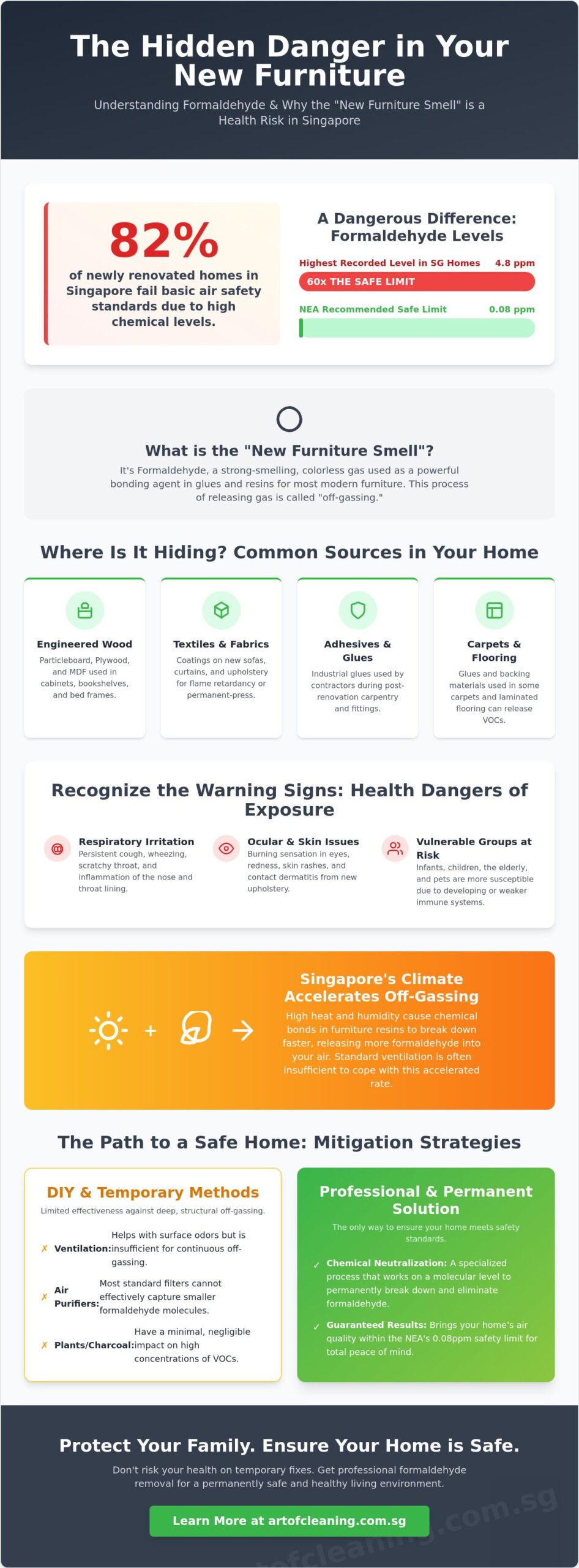
Did you know that 82% of newly renovated homes in Singapore fail basic air safety standards, with chemical levels often reaching double the safe limit? That sharp, sour smell clinging to your new cabinets isn’t just a sign of fresh decor; it’s a signal of invisible off-gassing. Understanding formaldehyde in new furniture dangers is vital for your family’s well-being, especially when local residential levels have been recorded as high as 4.8 ppm. This figure is 60 times the safety threshold established by the National Environment Agency (NEA).
It’s natural to feel anxious when a beautiful new nursery causes unexplained eye irritation or persistent respiratory discomfort. You deserve a home that feels like a sanctuary, not a source of physical distress. This guide provides the professional clarity you need to navigate these hidden health risks and reclaim your indoor environment. We’ll examine the latest 2026 safety regulations, identify common symptoms of exposure, and detail the most effective methods to bring your home back to the NEA 0.08ppm safety standard for total peace of mind.
Key Takeaways
- Learn why formaldehyde is a staple in modern furniture resins and how to identify its presence through its distinctive ‘sour’ odor.
- Discover the specific formaldehyde in new furniture dangers, including how these invisible toxins trigger persistent respiratory irritation and ocular discomfort.
- Understand why Singapore’s high humidity and heat accelerate chemical off-gassing, making standard ventilation insufficient for reaching safety standards.
- Evaluate the limitations of DIY solutions and learn why specialized activated carbon is essential for filtering volatile organic compounds effectively.
- Explore how professional chemical neutralization works on a molecular level to permanently bring your home within the NEA 0.08ppm safety limit.
What is Formaldehyde and Why is it in Your New Furniture?
Formaldehyde is a colorless, strong-smelling gas that acts as a foundational component in modern manufacturing and industrial chemistry. To truly understand What is Formaldehyde?, we must look at its role as a powerful bonding agent. It’s a Volatile Organic Compound (VOC) primarily used in industrial glues and resins to create the structural integrity we expect from household items. When you unbox a new wardrobe or walk into a freshly renovated room, that sharp, almost vinegary “new furniture smell” is actually a chemical warning. It’s the physical manifestation of gas being released into your breathing zone. Understanding the formaldehyde in new furniture dangers is the first step toward securing a healthy home environment for your family.
Manufacturers rely on these chemicals because they’re incredibly effective at bonding wood chips, sawdust, and fibers together to create affordable, sturdy composite materials. Without these resins, the mass production of modern flat-pack furniture wouldn’t be possible. However, the structural benefits of these glues come with a hidden cost to indoor air quality. These bonds aren’t permanent; they’re susceptible to breaking down, especially when exposed to heat. This chemical instability is why the formaldehyde in new furniture dangers persist long after the initial purchase, as the gas continues to leak from the core of the material into your living space.
Common Sources: From Built-in Cabinets to Sofa Fabrics
Most formaldehyde enters the home through engineered wood products. Materials like particleboard and Medium-Density Fibreboard (MDF) are saturated with urea-formaldehyde resins during production. These are the building blocks of most modern kitchen cabinets, bookshelves, and bed frames. Beyond the wood itself, industrial glues used by contractors during post-renovation carpentry often contain high concentrations of the gas. It’s also found in textiles; many new sofas and curtains are treated with flame retardants or permanent-press coatings that continue to release VOCs long after the installation is complete. Even the adhesives used in some carpets can contribute to the overall chemical load in a room.
The Process of Off-Gassing: A Long-Term Hazard
Off-gassing is the process where volatile chemicals transition from a solid state within furniture to a gaseous state in the air. This isn’t a quick event that finishes in a week. Because the formaldehyde is embedded deep within the resins of MDF or plywood, it leaks out slowly as the material reacts to temperature and humidity. In a climate like Singapore’s, this process accelerates significantly. It can take several years for a piece of furniture to fully “air out” on its own. There’s a vital difference between surface odors, which might dissipate with a few days of open windows, and structural chemical release, which requires specialized formaldehyde removal services to neutralize effectively. Relying solely on time is often a gamble with your respiratory health.
The Health Dangers of Formaldehyde Exposure in the Home
The formaldehyde in new furniture dangers aren’t just theoretical; they manifest as tangible physical distress for many homeowners. Exposure often begins with acute respiratory reactions. You might notice a persistent cough, wheezing, or a scratchy throat that seems to worsen when you’re in the living room or bedroom. These symptoms occur because formaldehyde is a powerful irritant that targets the mucous membranes of the respiratory tract. When the gas is inhaled, it dissolves into the lining of the nose and throat, causing immediate inflammation and discomfort.
Ocular and dermatological impacts are equally common and often distressing. Many residents report a distinct “burning” sensation in their eyes or unexplained redness after installing new built-in wardrobes. This chemical sensitivity can also trigger skin rashes or contact dermatitis if you spend prolonged periods on new upholstery. In newly renovated Singaporean apartments, these symptoms are frequently grouped under “Sick Building Syndrome.” This is a condition where occupants experience acute health effects that appear linked to time spent in a building, but no specific illness can be identified. The lack of proper ventilation in air-conditioned spaces only traps these toxins, intensifying the physical toll on your body.
Infants, the elderly, and pets are particularly vulnerable to these chemical hazards. Their smaller lung capacities and developing immune systems mean that even “moderate” levels of VOCs can cause significant harm. For parents, the anxiety of an infant sleeping in a newly renovated nursery is well-founded, as babies breathe more rapidly and absorb more toxins relative to their body weight. Protecting these sensitive family members requires a proactive approach to indoor hygiene.
Acute vs. Chronic Exposure: What the Science Says
While short-term reactions like watery eyes are alarming, the long-term Health Dangers of Formaldehyde Exposure are far more insidious. The World Health Organization and Singapore’s NEA have established a safety threshold of 0.08ppm (parts per million). Consistently exceeding this limit through chronic exposure is scientifically linked to serious conditions, including nasopharyngeal cancer and leukaemia. Daily inhalation of even low levels can lead to permanent changes in respiratory function and a weakened immune response over several years.
Identifying the Signs of Formaldehyde Poisoning
Recognizing the signs of chemical sensitivity is crucial for early intervention. If you experience morning headaches, persistent fatigue, or a sudden worsening of asthma and allergy symptoms after buying new furniture, your indoor air quality is likely compromised. These symptoms often dissipate when you leave the house, only to return once you’re back indoors. If these patterns persist, it’s a clear indicator that your living space needs a professional air quality assessment to identify and neutralize the underlying chemical source.
Evaluating Risk: Material Choice and the Singapore Climate Factor
Singapore’s tropical climate acts as a catalyst for chemical off-gassing, turning a slow release into an aggressive environmental hazard. Ambient humidity levels frequently exceeding 80% and consistent high temperatures create the perfect conditions for industrial resins to break down. For every 10°C increase in temperature, formaldehyde release can double. This means a piece of furniture that seems safe in a temperate, climate-controlled showroom can become significantly more hazardous once it’s installed in a non-ventilated Singaporean room during the afternoon heat. Understanding the formaldehyde in new furniture dangers in this specific context is vital for local homeowners who often find that standard ventilation isn’t enough.
The type of material you choose for your home directly dictates your long-term chemical exposure risk. Solid wood is the safest option as it contains no added resins, but its high cost often leads homeowners toward engineered alternatives. Medium-Density Fibreboard (MDF) and laminated plywood are common in Singaporean carpentry, yet they rely heavily on urea-formaldehyde glues. While many products carry a “Green Label,” it’s important to recognize the ‘Green Label’ myth; low-VOC doesn’t always mean zero-VOC. These certifications often mean the product meets a specific threshold, but the cumulative effect of filling a room with “low-emission” cabinets can still push indoor air quality far beyond safe limits. To better understand the dangers of formaldehyde exposure, one must look at how these materials behave over several years, not just the first few weeks.
High-Risk Furniture Materials to Watch For
Particleboard remains the highest-risk material due to its high concentration of urea-formaldehyde resins used to bond wood chips. Because it is porous, it allows gas to escape more easily than denser woods. Laminate flooring also presents a significant risk because of its large surface area; when an entire flat is floored with laminate, the total volume of off-gassing can be immense. Don’t overlook upholstered sofas either. While we focus on wood, the hidden foams and industrial adhesives used in upholstery often contribute to the formaldehyde in new furniture dangers lurking in your living room.
Why New Condos and HDBs Often Exceed Safety Limits
Modern high-rise architecture in Singapore often prioritizes aesthetics over cross-ventilation. In many new Condos and HDB units, windows are designed for safety and views rather than maximum airflow, which allows VOCs to stagnate. The density of built-in carpentry is another factor; Singaporeans love floor-to-ceiling wardrobes and extensive kitchen cabinets, which increases the “loading factor” of chemicals in a small square footage. When you turn on the air-conditioning, you seal the unit, effectively trapping these toxins inside the living space and recirculating them through your lungs.
When moving into these new units, it is standard practice to conduct a thorough walkthrough. While air quality is a hidden concern, identifying property defects is equally vital, and many residents rely on Prime Defectors to perform professional inspections before settling in.
Mitigation Strategies: DIY Solutions vs. Professional Removal
Managing the formaldehyde in new furniture dangers often starts with homeowners attempting various home remedies. One common approach is the “flushing” method, which involves opening all windows and using high-velocity fans to create a cross-breeze for several hours a day. While this helps reduce the immediate concentration of airborne gases, it doesn’t address the chemical source embedded deep within the furniture resins. Many also turn to air purifiers, but there’s a common misconception that any HEPA filter will suffice. HEPA filters are designed to capture particulate matter like dust and pollen; they’re entirely ineffective against gaseous VOCs. For real results, you need a purifier with a substantial bed of activated carbon and zeolite. In 2026 tests, specialized units like the Austin Air HealthMate Plus reduced formaldehyde levels from 180 ppb to 28 ppb in just 90 minutes.
Some homeowners attempt to “bake” their house by turning up the heat or leaving the air-conditioning off in the afternoon sun to accelerate off-gassing. This is a high-risk strategy. Without professional extraction, you’re simply saturating your indoor air with a higher concentration of toxins that settle back into your soft furnishings once the room cools. For a comprehensive approach, refer to our Professional Post Renovation Cleaning Singapore guide to understand how deep cleaning complements chemical removal.
Debunking Common Formaldehyde Myths
Social media often suggests that indoor plants like Sansevieria can purify the air. While plants do absorb minute amounts of VOCs, you’d need a literal jungle in every room to keep pace with the off-gassing rate of a single MDF wardrobe. Similarly, bamboo charcoal bags have a very low saturation point; once they’re full, they stop working entirely. Perhaps the most persistent myth is the “vinegar bowl” trick. Placing bowls of vinegar around a room might mask the “sour” chemical scent with a different odor, but it does absolutely nothing to neutralize the underlying formaldehyde in new furniture dangers.
When DIY Isn’t Enough: Identifying High-Concentration Scenarios
If that distinctive chemical smell persists after four weeks of constant ventilation, your furniture is likely off-gassing at a rate that DIY methods cannot handle. Immediate physical symptoms, like stinging eyes or a dry throat upon entering a room, are clear indicators of a high chemical concentration. You might be tempted to use a handheld DIY formaldehyde meter, but these consumer-grade sensors are often inaccurate and sensitive to other household chemicals, providing a false sense of security. When these signs appear, it’s time to stop experimenting and seek professional formaldehyde removal services to ensure your home meets the NEA safety standards.
Professional Formaldehyde Removal: The Only Permanent Solution
Professional chemical neutralization isn’t about covering up a smell; it’s about changing the molecular structure of the pollutant itself. Unlike DIY sprays that sit on the surface, medical-grade decomposers penetrate deep into the material to break the carbon-hydrogen-oxygen bonds of the formaldehyde molecule. This process effectively converts a hazardous gas into harmless water vapor and carbon dioxide. Addressing the formaldehyde in new furniture dangers through this scientific method is the only way to ensure the toxins are permanently eliminated. For those moving into a newly renovated space, this treatment is a non-negotiable step. It provides a healthy foundation before your family begins living and breathing in the new environment.
Our methodology at Art of Cleaning treats indoor air hygiene as a meticulous craft that requires both precision and specialized training. By integrating our targeted chemical removal with Professional Deep Cleaning Services Singapore, we address both visible post-construction dust and invisible chemical hazards simultaneously. This dual focus ensures that your home isn’t just visually stunning, but chemically safe for long-term habitation.
The Art of Cleaning Decontamination Process
The process begins with a systematic application of medical-grade formaldehyde decomposers across all high-risk surfaces. We use specialized equipment to ensure the solution reaches the interior of built-in wardrobes, the undersides of kitchen cabinets, and the back panels of shelving units. We pay particular attention to hidden crevices and unsealed edges of engineered wood, as these are the primary exit points for off-gassing. Once the treatment has stabilized, we conduct post-treatment air quality testing. This step is vital to verify that the indoor environment has been successfully brought below the NEA 0.08ppm safety threshold.
Comprehensive Hygiene: Beyond Just Furniture
Chemicals don’t just stay trapped in the wood; they settle into fabrics and fibers throughout the home. To truly eliminate the formaldehyde in new furniture dangers, a holistic approach is required. This means integrating removal services with professional Sofa Cleaning to extract any VOCs that have permeated your upholstery. Curtains and carpets should also undergo high-temperature steam cleaning to ensure total decontamination. This comprehensive strategy creates a living space that meets the highest standards of hygiene and family safety.
If you’re ready to secure your home’s air quality and protect your family’s health, Contact Art of Cleaning for a Formaldehyde Removal Quote today. Our specialists are ready to help you reclaim your home from invisible toxins.
Reclaim Your Home Air Quality Today
Your new home should be a sanctuary of health, not a source of persistent respiratory distress. We’ve detailed how Singapore’s unique climate accelerates off-gassing and why common household “hacks” like vinegar bowls or indoor plants fail to address the root cause of chemical saturation. Effectively managing the formaldehyde in new furniture dangers requires moving beyond surface-level aesthetics to prioritize deep, molecular-level hygiene. It’s about ensuring that the air your family breathes meets the highest safety standards every single day.
Art of Cleaning provides NEA-compliant decontamination through our specialized chemical decomposition technology. Our meticulous approach to home safety has been featured on major local broadcasting networks, confirming our status as a reliable specialist in the region. Don’t let invisible toxins compromise your peace of mind or your family’s well-being. Protect your family with professional Formaldehyde Removal Services today and transform your living space into the healthy environment you deserve. You’ll finally be able to enjoy your beautiful new interior with total confidence.
Frequently Asked Questions
How long does formaldehyde stay in new furniture?
Formaldehyde off-gassing typically persists for several years, often ranging from two to five years depending on the material’s core density. While the most intense release occurs in the first six months, the formaldehyde in new furniture dangers remain a long-term concern as the resins deep within MDF or particleboard break down slowly. This process is further accelerated by Singapore’s high ambient humidity and heat, which keeps the chemical release active for longer.
What does formaldehyde smell like in a home?
Formaldehyde has a distinctive sharp, pungent, and “sour” odor that many describe as similar to vinegar or pickles. This scent is often strongest inside freshly installed cabinets or drawers where the gas has had time to accumulate in a confined space. While the smell might dissipate after a few weeks of ventilation, its absence doesn’t necessarily mean the air is safe, as human noses often become desensitized to low-level chemical presence.
Can an air purifier remove formaldehyde from new furniture?
Standard HEPA filters cannot remove formaldehyde because they’re designed to trap solid particles like dust and pollen, not gaseous chemicals. To effectively address indoor VOCs, you must use an air purifier equipped with a heavy bed of activated carbon or zeolite. These materials adsorb the gas molecules through a chemical reaction. However, even high-quality purifiers act as a secondary measure and don’t eliminate the chemical source embedded in the furniture itself.
Is the 0.08ppm formaldehyde limit mandatory in Singapore?
The 0.08ppm limit is the established safety threshold under the SS 554:2016 Code of Practice for indoor air quality in air-conditioned buildings in Singapore. While it serves as a critical benchmark for health, the National Environment Agency (NEA) has implemented stricter regulations recently. As of January 1, 2026, the sale and use of interior paints containing formaldehyde at concentrations of 0.01% w/w or higher is officially banned to further protect residents.
Are IKEA or other mass-market furniture brands high in formaldehyde?
Most global mass-market brands, including IKEA, adhere to strict international emission standards like the California Air Resources Board (CARB) Phase 2 or European E1 standards. While these products emit significantly less gas than uncertified alternatives, they aren’t always “formaldehyde-free.” The cumulative effect of multiple new pieces in a small, unventilated HDB or condo unit can still push the room’s total chemical concentration above safe levels despite individual certifications.
Can I sleep in a room with a strong ‘new furniture’ smell?
It’s not advisable to sleep in a room where the “new furniture smell” is overwhelming, especially for children, the elderly, or individuals with respiratory conditions. Sleeping in a concentrated chemical environment increases your exposure time to formaldehyde in new furniture dangers, potentially leading to morning headaches, eye irritation, and throat dryness. If you can’t move to another room, ensure the space is heavily ventilated with open windows and fans throughout the night.
How much does professional formaldehyde removal cost in Singapore?
Professional removal costs in Singapore vary based on the size of your property and the density of built-in carpentry. Factors such as the number of bedrooms, the total volume of MDF or particleboard used in renovations, and the current air quality readings will influence the total investment required. For an accurate assessment tailored to your specific home layout and chemical levels, it’s best to request a professional consultation and site inspection.
Will formaldehyde removal treatment damage my new furniture’s finish?
High-quality chemical neutralization treatments are designed to be safe for a wide variety of furniture finishes, including laminates, veneers, and delicate fabrics. The medical-grade decomposers used by specialists are non-corrosive and don’t leave visible residues or alter the appearance of your new decor. These solutions focus on reacting with the formaldehyde molecules at a molecular level rather than affecting the structural materials or the aesthetic coatings of your wardrobes or cabinets.