
Could your usual jog, open windows or quick errand expose you to more haze than you realise? Knowing the things to avoid during haze Singapore can feel confusing when advice about masks, air-conditioning and indoor precautions seems to conflict. It’s worth checking current guidance, especially if children, older adults or people with existing health conditions are part of your household.
This guide explains which everyday habits may increase exposure and how to make decisions using Singapore’s official advisories. You’ll learn how to use the 1-hour PM2.5 reading for immediate activity decisions and the 24-hour PSI for planning, along with practical steps for making your home more comfortable during haze. We’ll also cover when to seek medical advice if symptoms are concerning. These measures support informed decisions, but cleaning is not a substitute for official health guidance.
Key Takeaways
- Learn which everyday habits are among the things to avoid during haze Singapore, and why clear skies alone don’t confirm that outdoor air is safe.
- Use NEA’s 1-hour PM2.5 readings for immediate activity decisions and the 24-hour PSI to plan ahead.
- Consider how open windows may let haze particles indoors, and don’t assume air-conditioning alone filters them out.
- Check the date and source of haze claims, then verify advice with Singapore’s Ministry of Health or NEA.
- Manage settled dust after haze as home maintenance, not as a substitute for steps to reduce exposure.
What Singapore haze means, and why some everyday habits matter
When haze reaches Singapore, ordinary routines such as exercising outdoors, opening the windows or deciding whether to head out can raise practical questions. Haze is air containing fine particles and other pollutants, often carried across the region by smoke from fires. The Southeast Asian Haze overview explains the wider regional context, including fire-related causes. But visibility is only one clue: it can change without showing exactly what pollutants are in the air or which precautions are appropriate.
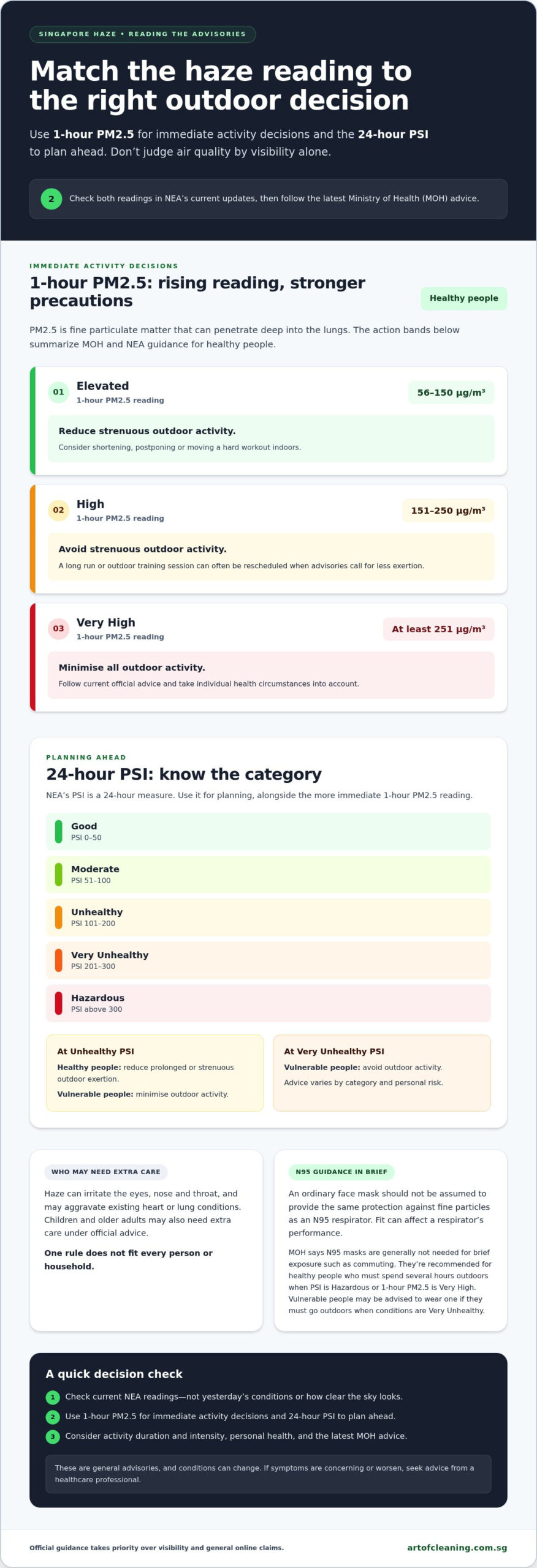
That’s why decisions about the useful things to avoid during haze Singapore should rely on current readings, not just the appearance of the sky. The National Environment Agency (NEA) reports the 24-hour Pollutant Standards Index (PSI), which supports planning, and the 1-hour PM2.5 concentration, which helps guide immediate activity decisions. PM2.5 refers to fine particles that can penetrate deep into the lungs.
How to use Singapore’s PSI and official advisories
Check NEA’s current updates at haze.gov.sg, then refer to Ministry of Health (MOH) guidance for health precautions. The PSI is a 24-hour measure: readings of 0-50 are Good, 51-100 Moderate, 101-200 Unhealthy, 201-300 Very Unhealthy, and above 300 Hazardous. Advice varies by category and personal risk. At Unhealthy levels, for example, healthy people should reduce prolonged or strenuous outdoor exertion, while vulnerable people should minimise outdoor activity. At Very Unhealthy levels, vulnerable people should avoid outdoor activity.
For immediate decisions, check the 1-hour PM2.5 band as well. MOH and NEA advise healthy people to reduce strenuous outdoor activity when the reading is Elevated (56-150 µg/m³), and to avoid it when High (151-250 µg/m³). A Very High reading (at least 251 µg/m³) calls for healthy people to minimise all outdoor activity. These are general advisories, so check the latest official guidance as conditions change.
Who may need extra care during haze
Haze can irritate the eyes, nose and throat, and may aggravate existing heart or lung conditions. MOH guidance treats people with such conditions as vulnerable; children and older adults may also need extra care under the official advice. The appropriate precautions depend on the current reading and individual circumstances, so don’t assume one rule fits every person in a household.
- Use the relevant PSI and PM2.5 advisory rather than judging air quality by visibility alone.
- Plan outdoor activity around current conditions, and adjust it when official guidance recommends reducing or avoiding exertion.
- People with existing health conditions should follow their clinician’s advice alongside MOH guidance.
This section offers general information, not individual medical advice. If symptoms are concerning or worsen, seek advice from a healthcare professional.
Outdoor activities to avoid when haze affects Singapore
Don’t base outdoor plans on how clear the sky looks. Fine particles can affect air quality even when visibility seems improved, so a bright morning isn’t an all-clear for a run, a long walk or work that keeps you outdoors. Check current NEA readings and health advisories before deciding how much time to spend outside. The right choice depends on current conditions and your health, not on one fixed rule for every person or day.
Do not ignore readings before exercising or commuting
For immediate decisions, check NEA’s 1-hour PM2.5 reading at haze.gov.sg and follow current MOH advice. Use the 24-hour PSI to plan ahead, including for outdoor work or activities the next day. If guidance recommends reducing strenuous exertion, postpone a hard workout or choose an indoor option if that suits you. A short commute and a prolonged outdoor session are different kinds of exposure, so consider the duration and intensity of the activity.
Before heading out, consider what the activity involves. A short trip to the shops may be necessary, while a long run, brisk walk or outdoor training session can often be rescheduled when advisories call for less exertion. People whose work takes them outdoors can refer to current guidance and workplace arrangements for managing exposure. If you have a heart or lung condition, take your clinician’s advice into account as well.
- Check current readings before planned outdoor exercise instead of relying on yesterday’s conditions.
- Consider shortening, postponing or moving strenuous activity indoors when official guidance advises reducing exertion.
- For essential journeys, follow the latest advice and take your personal health circumstances into account.
These are choices to consider, not a blanket instruction to avoid every outdoor activity. Among the things to avoid during haze Singapore are treating visibility as a safety measure and continuing strenuous exercise when the advisory recommends scaling back.
Do not assume any face mask blocks haze particles
Mask type matters. Don’t assume an ordinary face mask provides the same protection against fine particles as an N95 respirator. Fit can also affect a respirator’s performance. Follow current MOH guidance rather than relying on a general online claim or choosing a mask based only on appearance.
MOH guidance says N95 masks are generally not needed for brief exposure, such as commuting. They’re recommended for healthy people who must spend several hours outdoors when the 24-hour PSI is Hazardous or 1-hour PM2.5 is Very High. Vulnerable people may be advised to wear one if they must go outdoors when conditions are Very Unhealthy. Check MOH’s latest advice for specifics, including how it applies to you.
When haze has left settled dirt on household furnishings, professional cleaning services can help with routine home maintenance. Cleaning isn’t a substitute for checking readings or following health guidance.
Indoor haze mistakes: what not to do at home
Spending more time indoors can reduce outdoor exposure, but it doesn’t make a home automatically free of haze particles. Fine particles can enter buildings, and choices such as opening windows or assuming an air-conditioner filters everything can affect indoor air. Follow current NEA and MOH advice, consider household needs, and don’t treat any single measure as a complete solution.
Do not leave windows open without considering outdoor conditions
Before airing a room, check current haze readings and official advice. When outdoor pollution is elevated, open windows may allow more haze particles inside. Keeping them closed during such conditions can limit that pathway, but ventilation choices also depend on the home and its occupants. There’s no single window-opening schedule that suits every household or haze day, so reassess as outdoor conditions change.
For example, don’t open windows simply because the sky looks clearer or because you want to refresh a room. Visibility doesn’t tell you the current particle concentration. Check NEA updates and follow its latest recommendations, while considering household needs and any advice from a healthcare professional. Don’t assume one reading will apply throughout the day.
Do not mistake cooling for particle filtration
An air-conditioner can cool a room, but cooling alone doesn’t establish that fine particles are being removed. Filtration depends on the system and its filter, so don’t assume every unit captures haze particles. Check the manufacturer’s instructions for your equipment and rely on current public-health guidance for advice about indoor air and filtration.
An air purifier with a HEPA filter can reduce fine particles indoors, according to research guidance for haze precautions. It’s a measure to consider, not a promise of a haze-proof room. Follow the device and filter instructions, and continue checking official advisories. Don’t treat an air purifier as permission to ignore other steps to reduce exposure.
Also avoid adding unnecessary smoke or particles indoors during haze. Smoking, burning incense or candles, and other activities that create smoke can add pollutants to indoor air. Cooking is a normal household need, so use appropriate ventilation and follow official advice rather than relying on a blanket rule that fits every home. The aim is to limit avoidable sources without making daily life impractical.
- Check NEA guidance before opening windows, and reassess as conditions shift.
- Don’t equate a cool room with filtered air; check what your equipment is designed to do.
- Consider a HEPA-filter air purifier to reduce fine particles, while following its instructions and official advice.
- Limit avoidable indoor smoke, but don’t mistake cleaning for protection from airborne haze.
These are practical things to avoid during haze Singapore, but no household measure can guarantee that outdoor particles won’t enter. Cleaning surfaces or furnishings may address settled dirt; it doesn’t remove the need to follow air-quality advisories and take appropriate steps to reduce exposure.
Haze shortcuts and misinformation to avoid
A forwarded message can sound convincing, especially if it includes a PSI number or a confident claim about masks. But haze conditions change, and advice that was accurate for one reading or day may no longer apply. Verify a post before acting on it. The things to avoid during haze Singapore include making health or activity decisions based on old screenshots, anonymous claims or a single precaution presented as a complete solution.
Do not rely on old screenshots or unsourced PSI claims
A screenshot may omit its date, location or original source. Check when it was published, then look for the information in NEA haze updates or current MOH health guidance. PSI and PM2.5 readings can change, so a number shared earlier may not describe conditions now. Don’t repeat a viral statistic or health recommendation unless you can trace it to a credible, current source.
Use this quick check before sharing or following a claim:
- Identify the claim. Is it about today’s air quality, mask use, symptoms or a recommended activity?
- Check its date and origin. Look for the original agency notice, not just a cropped image or repost.
- Verify with MOH or NEA. Use the latest official reading or health advice that applies to the claim.
Be cautious if a post says one step makes every other precaution unnecessary. A mask, staying indoors or using an air purifier may each have a role under relevant conditions, but none is a reason to ignore current advisories or personal health needs.
Do not dismiss symptoms or change treatment based on a post
Haze exposure can irritate the eyes, nose or throat and may aggravate existing heart or lung conditions, but symptoms vary and can have other causes. A social media post can’t diagnose what’s happening or determine what treatment you need. If you have an existing condition, follow your clinician’s advice and don’t stop, start or change prescribed treatment based on an online claim.
Seek medical advice if symptoms are concerning, persist or worsen. If you’re unsure what to do, contact a healthcare professional rather than waiting for a post to confirm your concerns. A mask or home cleaning can’t replace medical care, and cleaning settled dust is maintenance, not treatment for haze-related symptoms.
Once immediate health precautions are addressed, settled dirt on household furnishings can be handled as routine home maintenance. For that separate task, consider professional home cleaning and choose methods that suit the item and its care instructions. Keep health decisions anchored to official advice and a medical professional’s guidance.
After haze: reduce settled dust without treating cleaning as protection
Once haze conditions ease, you may notice dust or residue on window sills, floors and furnishings. Cleaning can address visible, settled dirt as part of ordinary home maintenance. It doesn’t prevent exposure to airborne haze, undo past exposure or replace current NEA and MOH advice. Keep the distinction clear: a clean-looking room doesn’t prove the air is safe.
A simple, cautious approach to settled household dust
Clean as needed for your household. The amount of settled dust, surface type, occupants and personal preferences all affect what feels appropriate. Avoid claiming that a particular cleaning method prevents haze-related health effects. For more detailed surface-care guidance, see the professional carpet cleaning guide and the curtain cleaning guide.
A measured approach is enough. You don’t need to deep-clean every item simply because haze has passed. Focus on visible dirt and normal upkeep, and continue following official health guidance if haze conditions are ongoing or symptoms are a concern.
When professional home cleaning may help with routine maintenance
Some furnishings can be harder to maintain with routine household cleaning. Art of Cleaning provides Carpet Cleaning, Curtain Steam Cleaning and Curtain Dry Cleaning using professional-grade equipment and eco-friendly, family- and pet-safe solutions. These services support home maintenance by addressing dirt on carpets and curtains; they are not treatments for haze exposure or substitutes for official precautions.
Choose a service suited to the item and its care needs. Carpets and curtains may call for different approaches, and steam cleaning and dry cleaning are distinct methods. Art of Cleaning offers both curtain cleaning options alongside Carpet Cleaning. The suitable maintenance choice depends on the surface, its condition and your preferences.
If carpet or curtain care is on your list, request a free quote from Art of Cleaning. There’s no need to rush into deep cleaning as a haze precaution. Keep exposure-reduction decisions separate, guided by current official advisories, and treat cleaning as one practical part of maintaining your home.
Make your next step a calm, practical one
Haze season can make everyday choices feel uncertain, but you don’t need to react to every rumour or rush into an intensive clean. Keep your household routine flexible, use current official guidance when conditions change, and treat home maintenance as its own task. A comfortable space is worth caring for, without expecting cleaning to prevent exposure or replace health advice.
For routine upkeep, Art of Cleaning provides professional cleaning using professional-grade equipment and eco-friendly, family- and pet-safe solutions. The company has also been featured on Mediacorp Channel 8. If you’re considering help maintaining carpets or curtains, explore Art of Cleaning’s professional cleaning services.
Make health decisions using trusted, current advice, and choose home maintenance that suits your needs. To discuss carpet or curtain cleaning and request a free quote, contact Art of Cleaning.
Frequently Asked Questions
Is it safe to exercise outdoors during haze in Singapore?
It depends on current air quality and your health. Check NEA updates and MOH advice before planning a run, outdoor class or long walk. If guidance recommends reducing outdoor exertion, postpone strenuous exercise or consider an indoor alternative. Someone with an existing heart or lung condition may need more cautious advice from their clinician. Don’t use a lack of visible haze as your signal to exercise. Seek medical advice if symptoms concern you.
Can I use a normal face mask to protect myself from haze?
Don’t assume an ordinary face mask offers the same protection as a respirator recommended for haze conditions. MOH guidance varies according to air quality and personal circumstances, so consult its current advice rather than relying on a general online claim. A mask’s type and fit matter, but this FAQ can’t provide individual fitting or medical instructions. If you have a health condition, follow your clinician’s advice when deciding what precautions are suitable.
Should I close my windows when there is haze in Singapore?
Consider current outdoor conditions before opening windows rather than following a fixed routine. If outdoor air quality is poor, opening windows to air a room may bring particles inside; when conditions improve, ventilation needs may differ. Air-conditioning can cool a room, but cooling alone doesn’t show that fine particles are filtered. Check your equipment’s instructions for its filtration details, and use current public-health guidance to inform household decisions.
What happens if I keep exercising outdoors during haze?
Haze exposure may irritate your eyes, nose or throat, and can aggravate existing heart or lung conditions. Effects can differ between people and depend on individual circumstances, so symptoms alone can’t confirm a cause. Follow current NEA and MOH activity advice, especially if you have an existing condition. If symptoms are concerning or getting worse, seek medical advice instead of trying to manage them with a mask or household cleaning.
How do I check whether haze advice online is current?
First check the post’s date and whether it identifies an original source. Then compare its claim with current NEA air-quality updates or MOH health guidance. For example, don’t plan tomorrow’s outdoor activity using a PSI screenshot with no date, or share a mask recommendation that doesn’t link to official advice. Conditions can change, so the things to avoid during haze Singapore include acting on stale information as if it were current.
Can cleaning my home protect me from haze exposure?
No. Cleaning can remove settled dust from surfaces, carpets or curtains, but it doesn’t prevent exposure to airborne haze or treat health effects. Follow public-health advice during hazy conditions, and choose household cleaning methods that suit the material and its care instructions. Art of Cleaning provides carpet and curtain cleaning as home-maintenance services, using professional-grade equipment and eco-friendly, family- and pet-safe solutions. Treat cleaning as upkeep, not a replacement for exposure-reduction steps or medical care when needed.