
For haze dust removal in Singapore, close windows and external doors when outdoor air quality is poor, and use a portable air purifier with a fine-particle filter suited to the room. Damp-wipe surfaces and wet-mop floors to collect settled dust without stirring it into the air. Together, these steps address airborne particles and dust already settled at home.
It’s understandable to focus on visible dust, but haze particles can remain airborne or settle on furnishings even when residue isn’t obvious. This guide explains how haze enters the home, how to reduce household exposure, and why damp cleaning is preferable to dry dusting. It also covers how to use local air-quality readings and indoor filtration as part of a practical routine, without treating every soft furnishing as if it needs professional cleaning.
Key Takeaways
- Reduce haze entry by keeping windows and external doors closed when outdoor air quality is poor, and use room-appropriate air filtration for airborne particles.
- Use damp cloths and wet mops to collect settled dust; dry sweeping and feather dusting can stir it back into the air.
- Haze can enter through open windows and doors, so consider how ventilation and daily movement in and out of the home affect indoor air.
- Use Singapore’s air-quality readings to guide outdoor activity and household precautions during changing haze conditions.
- Focus cleaning on surfaces and furnishings that have accumulated dust, and follow care instructions for delicate fabrics.
1. What are some Practical Tips For Households to Reduce Exposure to Haze Particles at Home?
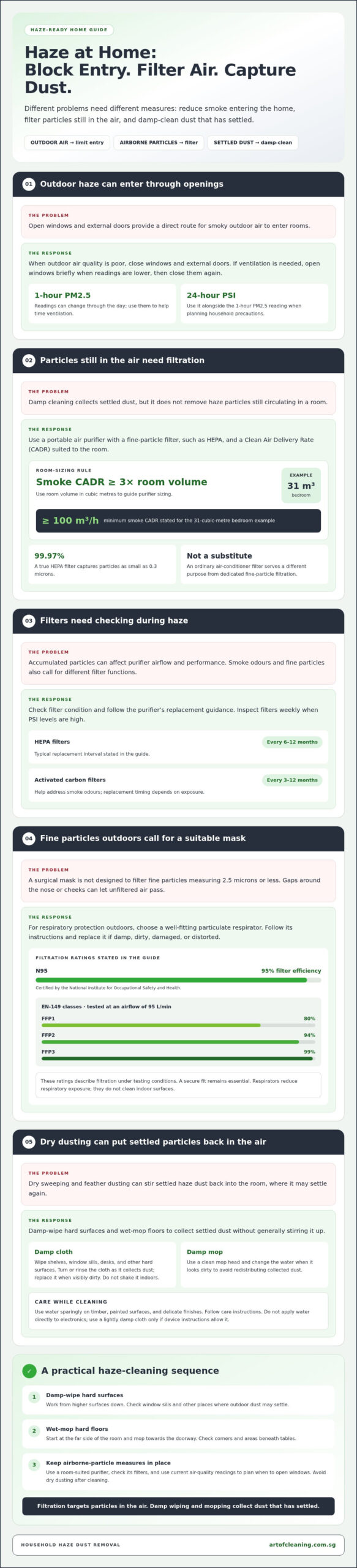
Start with the home’s openings. When outdoor air quality is poor, close windows and external doors to limit smoke entering rooms. If ventilation is needed, open windows briefly when readings are lower, then seal the home again. Singapore’s 1-hour PM2.5 readings can change through the day, so use them alongside the 24-hour PSI when planning ventilation.
A surgical mask isn’t designed to filter fine particles measuring 2.5 microns or less. For respiratory protection outdoors, choose a well-fitting particulate respirator. N95 masks are certified by the National Institute for Occupational Safety and Health to have 95% filter efficiency. Fit matters: gaps around the nose or cheeks can let unfiltered air pass. Follow the mask’s instructions and replace it if it becomes damp, dirty, damaged, or distorted.
EN-149 masks offer other filtration classes. At an airflow of 95L/min, an FFP1 separates 80% of airborne particles, an FFP2 separates 94%, and an FFP3 separates 99%. These ratings describe filtration under testing conditions; a secure fit is still essential during wear. N95 and EN-149 masks are designed to reduce respiratory exposure to airborne contaminants, not to clean indoor surfaces.
For indoor air, use a portable air purifier with a fine-particle filter, such as HEPA, and a Clean Air Delivery Rate suited to the room. A practical sizing rule is smoke CADR at least three times the room’s volume in cubic metres. For a 31-cubic-metre bedroom, that means at least 100 cubic metres per hour. A true HEPA filter captures 99.97% of particles as small as 0.3 microns.
Check the purifier’s filter condition and replacement guidance. HEPA filters typically need replacement every six to 12 months. Activated carbon filters, which help address smoke odours, often need replacement every three to 12 months, depending on exposure. During haze, inspect filters weekly when PSI levels are high, since accumulated particles can affect airflow and performance.
Don’t rely on an ordinary air-conditioner filter as a substitute for dedicated fine-particle filtration. It serves a different purpose. During smoky conditions, dry laundry indoors to reduce contact with smoke odours and airborne particles. Pair these steps with damp cleaning: filtration targets particles still in the air, while wiping and mopping collect dust settled on household surfaces.
- Close windows and external doors when outdoor air quality is poor.
- Use a room-sized purifier and check its filters during high PSI readings.
- Choose a properly fitted particulate respirator instead of relying on a surgical mask for fine particles.
2. Damp-wiping and wet-mopping settled dust
Haze particles settled on a table or floor need a different approach from those still airborne. For haze dust removal in Singapore, damp-wiping and wet-mopping collect settled dust without generally stirring it up. Dry sweeping and feather dusting can lift particles back into the room, where they may settle again. A slightly damp cloth traps residue more effectively than a dry duster, while a damp mop gathers it from hard floors.
Work from higher surfaces down so loosened dust falls onto areas you haven’t cleaned yet. Wipe shelves, window sills, desks, and other hard surfaces with a clean, damp cloth. Turn or rinse the cloth as it collects dust, and replace it when visibly dirty. Don’t shake it indoors. For a small surface, use separate cloth sections for cleaner and dustier areas to avoid spreading residue.
For floors, start at the far side of the room and mop towards the doorway. Use a clean mop head and change the water when it looks dirty to avoid redistributing collected dust. Check corners, areas beneath tables, and floors beside windows, where particles entering from outdoors may settle. Let cleaned surfaces dry before replacing rugs or other items.
Use water sparingly on timber, painted surfaces, and delicate finishes. Follow the manufacturer’s care instructions before wiping materials that moisture could damage. Don’t apply water directly to electronics. Use a lightly dampened cloth only if the device instructions allow it. Keep cleaning tools away from air intakes, and avoid sweeping dust towards a purifier’s filter.
Cleaning collects settled particles, but it doesn’t remove haze still circulating in a room. A suitable purifier can reduce airborne particles, while activated carbon filters help address smoke odours. These filters serve different purposes. Follow the purifier’s instructions during haze season and use current air-quality readings to plan when to open windows. Damp-wiping remains useful even when readings change, because settled dust may still be present.
Build a simple routine: damp-wipe hard surfaces, then mop floors, and rinse reusable cloths after use. Avoid dry dusting afterwards, which can disturb residue you’ve just collected. Effective haze dust removal in Singapore homes combines careful surface cleaning with measures for airborne particles. It doesn’t mean every furnishing needs professional treatment. Follow care instructions for delicate materials and focus on areas where dust has accumulated.
Wet cleaning is generally preferable to dry sweeping or feather dusting for removing settled dust during haze, helping keep collected particles from becoming airborne again.
3. How haze enters homes
Haze begins outdoors, where smoke from regional vegetation and forest fires can travel towards Singapore. Winds carry fine particles, while rainfall and changing weather influence where smoke moves and how long it lingers. PM2.5 particles measure less than 2.5 micrometers across, small enough to remain suspended before settling on indoor surfaces. A closed room reduces direct entry, but it isn’t sealed from every outdoor-air pathway.
Open windows and doors provide a direct route into the home. Even a brief opening can let outdoor pollutants mix with indoor air, especially when haze levels are elevated. Particles can also enter through gaps around window frames, door edges, and other openings. In enclosed rooms, incoming smoke may linger when ventilation is limited. Closing windows and external doors when air quality is poor helps reduce this direct exchange.
People moving between outdoors and indoors can bring particles inside on clothing, bags, shoes, or hair. Dust may then transfer to a sofa, floor, or mattress through contact. Remove shoes at the entrance and change out of smoky outdoor clothing. Keep bags away from beds and frequently used soft furnishings. These habits limit the surfaces that collect particles carried in from outside.
Indoors, haze particles can remain airborne or settle on floors, shelves, and fabrics. Movement through a room can disturb settled dust and send some particles circulating again. A portable air purifier with effective particulate filtration can help reduce airborne particles in an enclosed room. Choose a unit with a Clean Air Delivery Rate suited to the room and a filter capable of capturing fine particles, such as HEPA. Activated carbon filters address odours, while particle filters perform a different task.
Without an air filter, indoor air quality can be 1.8 to 2 times worse than outdoor air. That comparison underlines why indoor exposure depends on both entry and removal: closing openings limits new particles, while filtration treats airborne matter already inside. Cleaning handles dust that has settled, but it doesn’t replace filtration for particles still in the air. Use both approaches for different parts of the problem.
Singapore’s 1-hour PM2.5 readings can fluctuate during the day as weather conditions change. Check current readings before deciding whether to open windows for ventilation. If outdoor air quality is poor, keep openings closed and run suitable indoor filtration. After haze has entered, damp-wipe hard surfaces and wet-mop floors rather than dry-sweeping. This sequence reduces further entry, captures settled dust, and helps limit its return to the air.
5. During haze
Use Singapore’s air-quality readings to guide the day, because haze conditions can shift. The NEA myENV app provides updated haze readings. Check both the 24-hour PSI forecast and 1-hour PM2.5 reading, which reflects recent fine-particle levels. The PSI helps with planning ahead; PM2.5 readings can fluctuate over the day as weather changes, so they offer a more immediate snapshot.
Match outdoor activity to the reading and your health needs. For healthy people, Singapore’s guidance says to reduce prolonged or strenuous outdoor physical exertion when the 24-hour PSI is 101–200. People with chronic lung or heart disease should avoid prolonged or strenuous outdoor exertion in this range. At 201–300 PSI, healthy people should avoid prolonged or strenuous outdoor exertion, while those with chronic lung or heart disease should avoid outdoor activity.
For children, minimise prolonged or strenuous outdoor exertion when the forecast PSI is above 100, and avoid outdoor activity when it is above 300. At a 24-hour PSI of 300, healthy people should minimise outdoor activity. Elderly people, pregnant women, children, and people with chronic lung or heart disease should avoid outdoor activity. Follow Ministry of Health guidance for precautions relevant to particular health vulnerabilities.
The 1-hour PM2.5 reading gives another way to plan immediate activities. At 56–150 µg/m³, healthy people should reduce strenuous outdoor activity for the next hour, while vulnerable people should avoid it. At 151–250 µg/m³, healthy people should avoid strenuous outdoor activities for the next hour. Vulnerable people should avoid all outdoor activities for that hour and may wear a mask to reduce exposure.
At 251 µg/m³ or above, healthy people should minimise all outdoor activities for the next hour. Vulnerable people should avoid all outdoor activities during that hour. Both groups may wear a mask to reduce exposure. A properly fitted N95 or EN-149 mask can reduce respiratory exposure to airborne contaminants; a normal surgical mask isn’t designed to filter fine particles effectively.
At home, keep windows and external doors closed when outdoor air quality is poor. Run a portable purifier with suitable particle filtration, and check its filters weekly when PSI levels are high. Damp-wipe surfaces and wet-mop floors to collect settled dust. Avoid dry sweeping, which can put particles back into the air. During smoky conditions, dry laundry indoors to reduce contact with smoke odours and airborne particles. These steps address different exposure routes: outdoor activity, air entering the home, and dust already settled indoors.
5. Haze season
Singapore’s haze season often coincides with the Southwest Monsoon, from June to September. Regional vegetation and forest fires can produce smoke that travels here, while winds and rainfall influence its movement. Haze has no fixed duration because fire activity and weather conditions change. Prepare for variable conditions rather than assuming it will last a set number of days.
Use Singapore’s PSI categories to understand the broader air-quality picture. According to the National Environment Agency Singapore, the PSI category is Unhealthy at 101–200 PSI. According to the National Environment Agency Singapore, the PSI category is Very Unhealthy at 201–300 PSI. Read the category alongside the current forecast, not as a measure of dust settled on household furnishings.
The 24-hour PSI forecast helps residents plan activities for the following day. Singapore’s National Environment Agency publishes a forecast range during the Southwest Monsoon months, a practice in place since 2013. The 1-hour PM2.5 reading provides a more immediate indicator of fine-particle concentration. Check both measures because short-term particle levels can fluctuate with weather, while the forecast supports planning ahead.
Singapore’s 24-hour PSI combines average concentrations of six component pollutants. It therefore represents a broader measure than the 1-hour PM2.5 reading, which focuses on fine particles. Singapore publishes the PM2.5 readings alongside PSI, with readings reported for five regions. Compare the regional information relevant to your location, then adapt outdoor plans and indoor precautions as conditions change.
Build a seasonal routine before readings worsen. Save the NEA myENV app for updated haze readings, keep windows closed when outdoor air quality is poor, and run a suitable air purifier indoors. Check its filter when PSI levels are high. Keep cleaning cloths and a mop ready for settled dust. Damp cleaning collects surface particles without generally stirring them up, unlike dry sweeping.
After a haze episode, assess your home by checking for visible dust and odours, and consult furnishing care instructions. Haze exposure alone doesn’t mean every sofa, mattress, rug, or carpet needs professional cleaning. Start by damp-wiping hard surfaces and wet-mopping floors. Follow the manufacturer’s instructions for delicate fabrics. If soft furnishings have accumulated dust or need deeper care, choose a cleaning method suited to their material.
NEA’s 1-hour PM2.5 bands are intended to help the public plan immediate activities during haze periods and are based on analysis of readings during haze and non-haze periods in Singapore. Singapore’s PSI descriptor for readings from 0 – 100 is Good to Moderate, and its PSI category is Moderate at 51-100 PSI. At the upper end, Singapore’s PSI descriptor for readings of 301 and above is Hazardous.
Recent conditions show why checking updates matters. Singapore’s haze task force announced its readiness to roll out plans on Aug 9 after the 24-hour PSI entered the moderate range in central Singapore. Singapore’s 24-hour PSI entered the unhealthy range on 4 September 2026, for the first time since 2023. These markers complement the current regional readings and forecast, helping residents judge conditions as they change.
Art of Cleaning: Carpet Cleaning
Art of Cleaning provides Carpet Cleaning when dust has settled into carpet fibres and routine surface cleaning isn’t enough. For rugs and upholstered furnishings, Rug Cleaning, Sofa Cleaning, and Mattress Cleaning offer focused care for those items. These services complement household steps such as damp-wiping and filtration. They don’t replace measures that reduce airborne particles or prevent haze from entering the home.
Consider professional cleaning when a carpet, rug, sofa, or mattress has visible dust buildup, or when its care instructions call for a suitable specialist method. Haze exposure alone doesn’t mean every furnishing needs treatment. The right next step depends on the item’s condition and material.
To discuss cleaning for your furnishings, contact Art of Cleaning.
Choose the Right Next Step for Your Furnishings
A haze-ready home depends on steady decisions, not a single clean. For haze dust removal in Singapore, focus on routines your household can maintain: care for surfaces regularly, and assess soft furnishings based on their condition and care instructions. Visible dust or lingering concerns on a carpet, rug, or sofa may call for focused cleaning, while furnishings without signs of buildup may not need professional attention.
Art of Cleaning provides Carpet Cleaning, Rug Cleaning, and Sofa Cleaning for furnishings that need specialist care. Identify the item that needs attention and consider its material and condition when planning the next step. This measured approach helps you care for your home without assuming every furnishing needs treatment.
For help with carpet, rug, or sofa cleaning, contact Art of Cleaning. Take the next step at a pace that suits your home.
Frequently Asked Questions
What are some Practical Tips For Households to Reduce Exposure to Haze Particles at Home?
Reduce exposure by limiting outdoor air entry and planning household routines around current conditions. Keep outdoor shoes near the entrance, change out of smoky clothing after coming indoors, and keep bags away from beds and sofas. During poor air quality, dry laundry indoors and avoid leaving windows open for extended periods. If someone in your household is more vulnerable to haze, plan errands and outdoor activities carefully using Singapore’s current air-quality guidance.
What are the best ways to remove haze particles from indoor air in Singapore?
Use a portable air purifier with a fine-particle filter, such as HEPA, and a Clean Air Delivery Rate suited to the room. To choose a suitable setup, measure the room and compare its volume with the purifier’s stated smoke CADR. Run the unit as directed in the enclosed space where household members spend time. Activated carbon can help with smoke odours, but serves a different purpose from particle filtration.
How can I reduce haze and dust indoors without an air purifier?
Limit new particles entering the home, then carefully remove settled dust. Keep windows and external doors closed when outdoor air quality is poor, and damp-wipe hard surfaces instead of dry dusting. Wet-mop hard floors, rinse or change cleaning cloths as they collect residue, and dry laundry indoors during smoky conditions. These measures limit entry and collect settled dust, but don’t filter particles that remain airborne.