
A part-time cleaner may be the more practical choice if you mainly need help with selected household tasks. Choosing between a part-time maid and a part-time cleaner in Singapore comes down to the support you need: part-time cleaning is generally non-residential, booked for agreed hours and focused on specific jobs. If you want a regular cleaning session rather than broader household assistance, a cleaner may suit your routine better.
It’s understandable to focus on the job title, but the more useful comparison is what gets done during each visit and how often you need it. This guide compares typical duties, session lengths, scheduled and ad hoc arrangements, and ways to think about session-based and monthly budgeting. You’ll also find a simple decision guide to help match the arrangement to your household’s cleaning needs and schedule.
Key Takeaways
- Choose based on the support you need: broader household help differs from a non-residential cleaner focused on selected tasks.
- Match the arrangement to your routine by weighing agreed service hours against the flexibility of an ad hoc clean.
- Clarify which household tasks matter most so you can assess whether a cleaning session fits your priorities.
- For targeted home cleaning or a hygiene-focused service, consider whether Art of Cleaning’s part-time home cleaning or Disinfection Service suits your needs.
Availability and scheduled service hours
A live-in foreign domestic worker suits households needing help with daily routines, while part-time cleaning covers selected tasks during agreed hours. In Singapore, a full-time domestic helper is a live-in Migrant Domestic Worker supporting the employer’s household. This arrangement can offer continuity for families coordinating housework around children, meals and work schedules.
Part-time help is generally non-residential, arranged in advance for agreed hours and focused on selected tasks. A recurring appointment can fit a predictable routine, such as cleaning while children are at school. An ad hoc booking is better suited to a specific, one-off need than to continuous household support.
Hiring a foreign domestic worker also brings employer responsibilities beyond scheduling. According to the Ministry of Manpower Singapore, the standard Foreign Worker Levy for a foreign domestic worker in Singapore is S$300 per month. The Ministry of Manpower Singapore also states that employers must arrange personal accident insurance with minimum coverage of S$60,000. These obligations matter when comparing a resident helper with task-based cleaning appointments.
| Option | Availability | Best fit |
|---|---|---|
| Live-in Migrant Domestic Worker | Household support in a live-in arrangement | Ongoing daily assistance |
| Scheduled part-time cleaner | Agreed hours arranged in advance | Recurring cleaning tasks |
| Ad hoc cleaner | Booked for a particular cleaning need | One-off support |
| Directly hired help | Timing arranged between household and worker | Households managing arrangements themselves |
| Company-supplied cleaner | Service arranged through a cleaning company | Households preferring a service booking |
Choose a live-in arrangement if your household needs regular support beyond cleaning sessions. Choose scheduled part-time help when defined tasks and agreed hours fit your routine; consider an ad hoc service for an occasional, specific need.
Part-time and ad hoc cleaning arrangements
Part-time cleaning suits households that need help with selected tasks, not continuous household support. In Singapore, this help is generally non-residential and arranged in advance for agreed hours. A regular booking can create a predictable routine without the longer commitment of a live-in helper. The Household Services Scheme can provide part-time home cleaning and basic caregiving, as well as services such as grocery shopping, car-washing and pet-sitting.
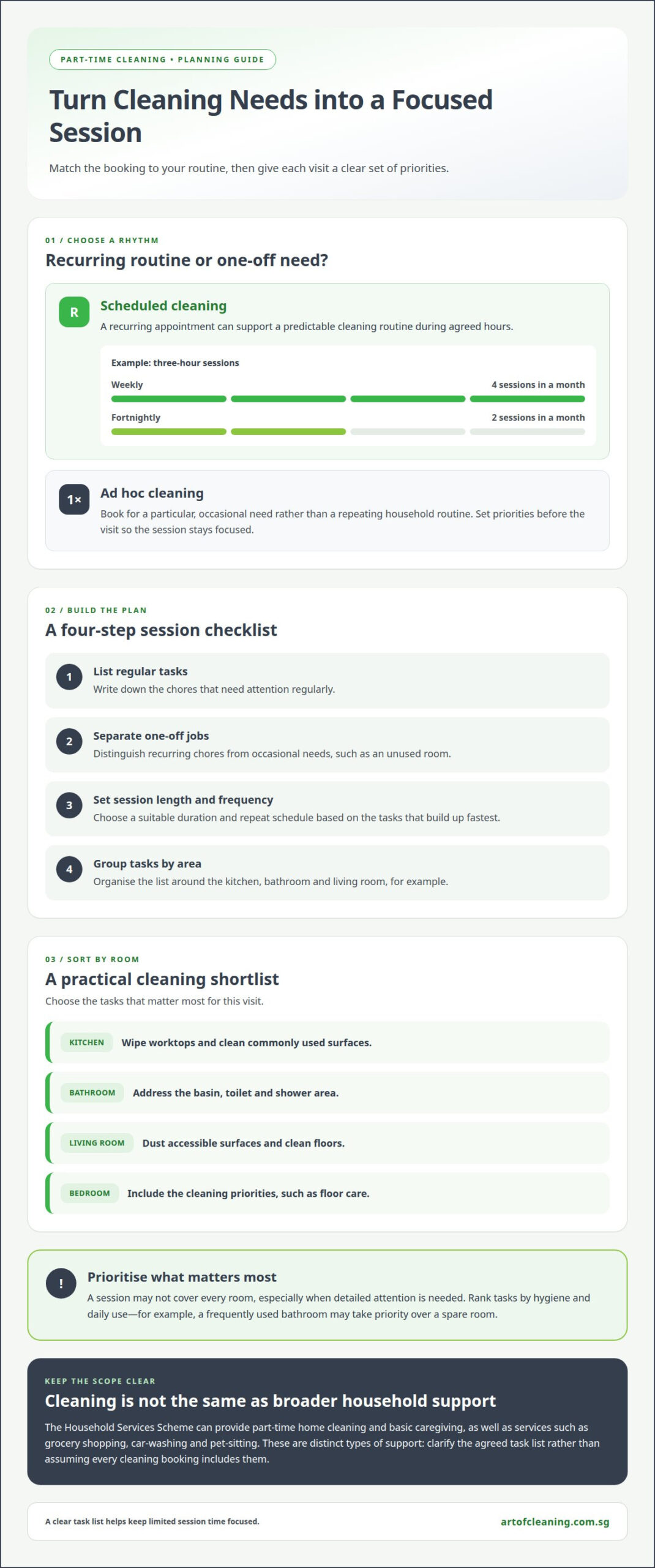
Frequency and session length shape how much can be covered. For example, a three-hour weekly arrangement has four sessions in a month, while a three-hour fortnightly arrangement has two. Once- or twice-weekly support may suit households that want a recurring clean. Choose a frequency based on the tasks that build up fastest, such as floor care, bathroom cleaning or kitchen surfaces.
An ad hoc arrangement is better for a specific, occasional need than a fixed household routine. Before booking, identify priority areas and describe any surfaces or rooms needing attention. If visitors are coming, for example, focus the session on shared spaces. If a room has been unused, direct attention there instead. Clear priorities help keep a limited session focused.
Use this simple planning sequence:
- List the tasks that need regular attention.
- Separate recurring chores from one-off needs.
- Choose a suitable session length and repeat frequency.
- Group tasks by area, such as kitchen, bathroom, and living room.
That approach makes the distinction practical: a scheduled cleaner supports a repeating cleaning plan, while ad hoc help addresses a defined need. Neither arrangement replaces broader daily household assistance. If you want help with a particular clean, consider scheduled home-cleaning support as part of your household routine.
Common Tasks for Part-Time Maid Services in Singapore
In Singapore, “part-time maid” often describes scheduled household help, but the actual task list matters more than the label. A cleaning session usually centres on household cleaning rather than continuous care. For example, a household might prioritise floors, kitchen surfaces and bathroom upkeep during a visit.
The Household Services Scheme can provide part-time home cleaning and basic caregiving. It can also cover services such as grocery shopping, car-washing and pet-sitting. These are distinct types of household support, so don’t assume every cleaning booking includes them. The agreed task list determines what the worker focuses on during a session.
For a cleaning-focused visit, group tasks by room and purpose. A useful shortlist might include:
- Kitchen: wipe worktops and clean commonly used surfaces.
- Bathroom: address basin, toilet, and shower-area cleaning.
- Living room: dust accessible surfaces and clean floors.
- Bedroom: tidy the cleaning priorities, such as floor care.
These examples help define priorities; they don’t guarantee that every task will fit into one visit. A session may not cover every room, especially when the home needs detailed attention. Rank tasks by hygiene and daily use. For example, a frequently used bathroom may take priority over a spare room.
Basic caregiving is separate from cleaning. If support involves someone’s daily routine, clarify that requirement rather than treating it as another cleaning chore. Likewise, grocery shopping or pet-sitting requires a specific arrangement, not an assumption based on the phrase “part-time maid.”
To clarify which service you need, write down the rooms, surfaces and tasks requiring attention. Then separate regular cleaning from occasional jobs, such as cleaning a rarely used room. This task-based list helps you decide whether you need household cleaning, another type of support, or a combination of distinct tasks. It also gives each visit a clear focus.
Are part-time cleaners in Singapore employed directly or supplied by cleaning companies?
You can arrange cleaning directly with an individual or book through a cleaning company. The difference is who coordinates the service. With direct hiring, the household and cleaner discuss the schedule, priorities and visit details themselves. With a company booking, the company is the service contact for those arrangements.
Neither option automatically determines what gets cleaned. A direct arrangement could focus on bathrooms and floors, while a company booking could cover those same priorities. The useful comparison is how each arrangement handles practical details, such as schedule changes, the agreed task list and communication about the visit.
Before choosing, set out the arrangement in concrete terms:
- Tasks: identify rooms and priorities, such as kitchen surfaces or bathroom cleaning.
- Timing: agree on the visit schedule and how changes are communicated.
- Scope: distinguish routine cleaning from a one-off request, such as attention to a spare room.
- Contact: establish whether messages about the booking go to the cleaner or the company.
For example, specify whether the priority is floors throughout the home or selected rooms only. That prevents a broad request such as “clean the flat” from obscuring what matters most during the visit. Once the arrangement and task scope are clear, compare them with your household’s preferred schedule and level of involvement.
To explore cleaning service options for your home, consider the tasks and arrangement that best fit your routine.
Art of Cleaning: Disinfection Service
Art of Cleaning provides a Disinfection Service for households seeking hygiene-focused cleaning beyond routine tidying. It may suit a home after illness, a move or a period of heavier use, when frequently touched areas need attention. For recurring household cleaning, part-time home cleaning offers a separate option focused on routine upkeep.
Some cleaning needs call for attention to specific furnishings rather than the whole home. Carpet Cleaning and Rug Cleaning address those items as distinct tasks. Choose the right service by identifying the need: routine household upkeep, disinfection, or care for carpets and rugs.
For a straightforward next step, contact Art of Cleaning to discuss the service that fits your home.
Choose the next step for a cleaner, more comfortable home
Choosing between a part-time maid and a part-time cleaner in Singapore is easier when you focus on the result you want at home, not the service label. Consider which spaces need attention and whether your priority is routine cleaning, hygiene or soft furnishing care. That gives your next decision a practical focus.
For targeted furnishing care, Art of Cleaning offers Carpet Cleaning, Rug Cleaning and Sofa Cleaning. These services may suit a specific cleaning need rather than general household upkeep. A clear description of the item or area helps define the service you need.
Keep your next step simple: note the rooms or furnishings you’re concerned about and the outcome you want. Then choose support that addresses that priority without adding services you don’t need. Thoughtful care can help make your home feel fresh and ready for everyday life.
Discuss your cleaning needs with Art of Cleaning and take the next step toward a fresher home.
Frequently Asked Questions
Which Option Is Right for Your Household?
Choose a cleaner for a defined cleaning list; choose a live-in helper if your household needs broader daily support. For example, a household that mainly needs help keeping floors and bathrooms clean has different needs from one requiring assistance across daily routines. Start by identifying what support is missing, then decide whether it’s limited to cleaning or extends beyond it.
What is the difference between a part-time maid and a part-time cleaner in Singapore?
The terms can overlap, so focus on the actual duties and arrangement rather than the title. A part-time cleaner is generally engaged for cleaning tasks, while “part-time maid” may be used broadly for household help. For example, cleaning a living room is a cleaning task; grocery shopping or pet-sitting is a separate household service that should be clearly included in the arrangement.
How much does a part-time maid or cleaner cost per hour or visit in Singapore?
Costs depend on the task list, home size, session length and visit frequency, so an hourly rate alone may not reflect the full service. For Art of Cleaning’s part-time home cleaning, the price depends on your requirements and is provided after you request a quote. Describe the rooms and priorities to receive pricing suited to the work requested.
What is the minimum booking duration and frequency for part-time cleaning services in Singapore?
A three-hour session is a useful planning reference, while weekly and fortnightly schedules are common examples. The right session length depends on the number of rooms and priority tasks. For a smaller scope, focus the visit on one area; for broader upkeep, divide priorities across recurring visits so essential tasks receive attention.
Which service is better for routine housekeeping, deep cleaning, or one-off cleaning in Singapore?
Scheduled part-time cleaning is a practical fit for routine upkeep, while a one-off booking suits a specific occasion or area. Deep cleaning calls for a clearly defined scope, such as detailed attention to a kitchen or bathroom rather than a general tidy. Choose based on the result you need: recurring maintenance, focused intensive cleaning or help with a particular task.