
Could regular cleaning make home upkeep easier without turning every visit into a full deep clean? If you’re searching for “Recurring Cleaning Service Singapore | Part-Time Maid”, you’re likely weighing ongoing cleaning support against a one-off service or a domestic helper arrangement. The right choice depends on what your household needs done regularly and what calls for specialist attention.
It helps to know what cleaning support can cover, especially when your priorities shift between visits. Part-time home cleaning supports routine upkeep, while deep cleaning and services such as sofa, carpet or mattress cleaning address different needs. Start with the areas that matter most to your household instead of assuming every home needs the same fixed checklist.
In this guide, you’ll learn how recurring cleaning differs from one-off deep cleaning and domestic maid arrangements, how to set priorities for repeat visits, and how to prepare for cleaning support. You’ll also find practical ways to shape a routine around your household’s needs.
Key Takeaways
- Recurring part-time home cleaning supports routine household upkeep, while deep cleaning and specialist services address different needs.
- Build a useful cleaning scope by identifying your main pain points, prioritising rooms and describing the results you want.
- Compare weekly, fortnightly or monthly routines against household size, daily use, pets and how needs change over time.
- Prepare for a visit by arranging access, noting priority areas and sharing relevant household instructions.
- Use this guide to understand Recurring Cleaning Service Singapore | Part-Time Maid options and shape a practical routine around your home.
What Does a Recurring Cleaning Service in Singapore Include?
Recurring cleaning is home-cleaning support arranged around a regular household routine, rather than a single appointment to clean the home once. Its purpose is to help maintain the home over time. The areas to prioritise should reflect how your household uses its space, not an assumed package that suits every home.
For households searching for a Recurring Cleaning Service Singapore | Part-Time Maid, the phrase can describe part-time home-cleaning support arranged as an ongoing routine. It doesn’t, by itself, specify the task list, visit length or frequency. Those details form part of the arrangement. Art of Cleaning provides part-time home cleaning support for household upkeep.
Recurring home cleaning versus one-off or deep cleaning
Repeat visits support ongoing upkeep, with priorities shaped around your household’s routine. A one-off appointment is a single service, while deep cleaning is a separate, more intensive need, often considered when a home needs a thorough reset. Move-in cleaning is another distinct service. These terms aren’t interchangeable, and recurring upkeep shouldn’t be assumed to include deep-cleaning work.
Some needs call for specialist attention rather than routine maintenance. Carpet, sofa, mattress and curtain cleaning, for example, focus on particular furnishings or surfaces. If you’re deciding between routine support and a more intensive reset, use a dedicated deep-cleaning comparison guide to understand which type of service better fits your situation.
What does the term part-time maid mean in Singapore?
In Singapore, people commonly use “part-time maid” when searching for home cleaning help on a part-time basis. The phrase is informal and can refer to different service arrangements, so it doesn’t automatically describe a particular task list or schedule. For background on the broader role, see the general explanation of a domestic worker.
Part-time home-cleaning support is different from hiring a live-in domestic worker. A cleaning service focuses on cleaning support for the home, while a live-in worker is employed by a household in a different capacity. Keeping the distinction in mind helps clarify what you’re looking for without assuming every provider uses “part-time maid” in the same way.
Before comparing options, separate your needs into two questions: are you looking for ongoing household upkeep or a one-time, intensive clean? Then identify any furnishings or surfaces that may need specialist treatment. This makes it easier to explain what matters to your household and shape a practical cleaning routine.
How to Set a Recurring Cleaning Scope That Fits Your Home
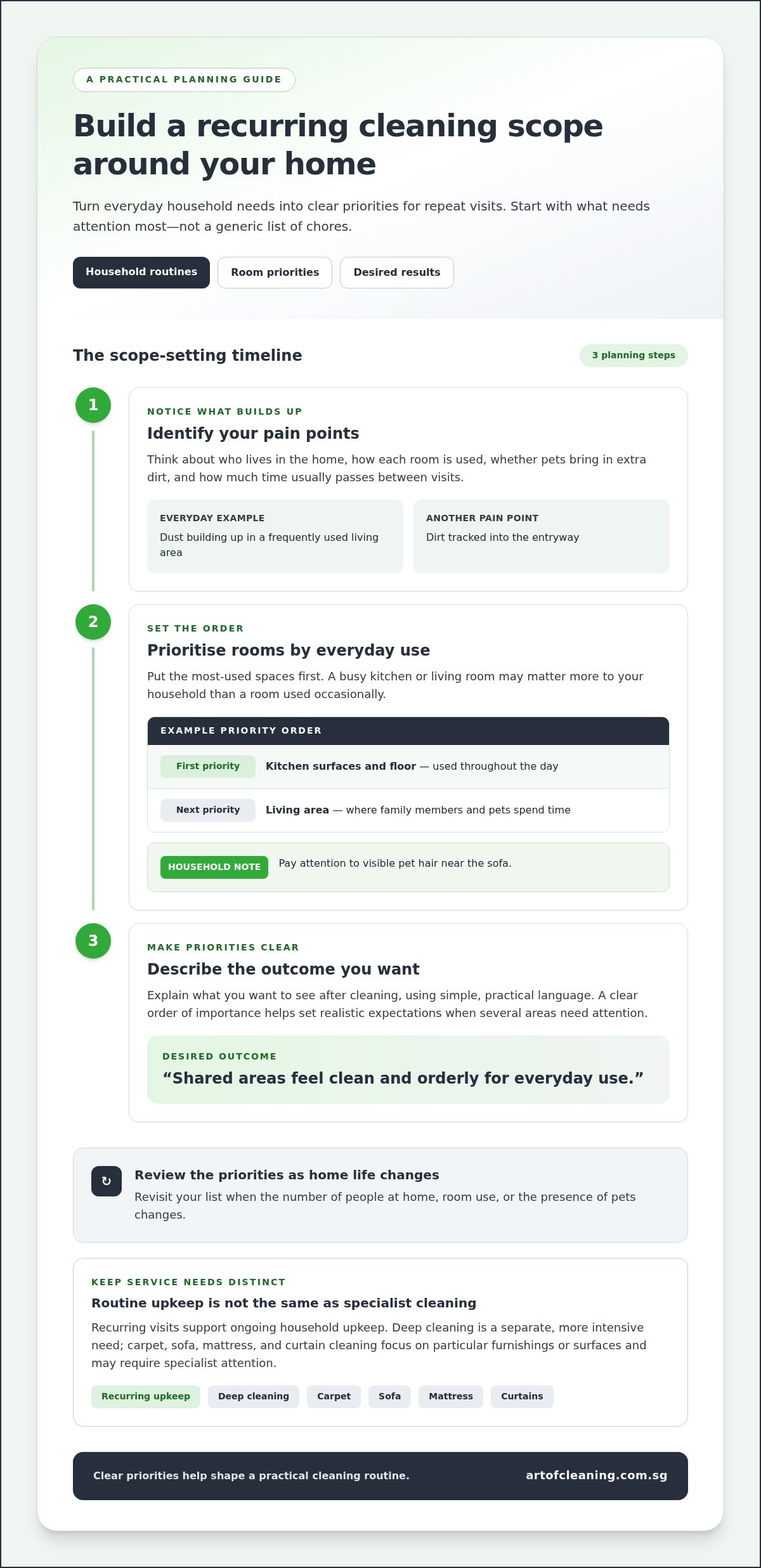
A useful cleaning scope starts with the parts of your home that need attention most, not a generic list of chores. Before arranging recurring support, consider who lives in the household, how each room is used, whether pets bring in extra dirt, and how much time typically passes between visits. These details help you explain your priorities and make clear which tasks matter most.
Choose priorities based on how your household uses each room
Use this simple planning process to turn everyday frustrations into practical instructions:
- Identify your pain points. Note what tends to build up, such as dust in a frequently used living area or dirt tracked into the entryway.
- Prioritise rooms. Put the most-used spaces first. A busy kitchen or living room may matter more to your household than a room used occasionally.
- Describe the outcome. Explain what you want to see after cleaning, such as a tidier shared space or clean floors.
Keep the priority list focused. Household routines change, so review it when the number of people at home, room use or presence of pets changes. A clear order of importance helps set realistic expectations for a visit, especially when several areas need attention.
Example priority worksheet
- First priority: Kitchen surfaces and floor, because the room is used throughout the day.
- Next priority: Living area, where family members and pets spend time.
- Household note: Pay attention to visible pet hair near the sofa.
- Desired outcome: Shared areas feel clean and orderly for everyday use.
This example is a planning and communication aid, not a guaranteed service checklist. Use it to identify the areas and outcomes that matter to your household when shaping a practical Recurring Cleaning Service Singapore | Part-Time Maid arrangement.
Separate routine tasks from specialist cleaning needs
Some surfaces need a different approach from ongoing household upkeep. Upholstery, carpets, mattresses and curtains may require specialist attention, rather than being assumed part of a recurring visit. Art of Cleaning provides these specialist services separately. Explore the home cleaning services to learn about them. If you’re considering hiring a domestic worker instead of engaging home-cleaning support, consult the Ministry of Manpower employment rules for official guidance.
Share your main priorities and any areas needing extra attention in clear, simple language. This gives your cleaning arrangement a practical starting point while keeping routine upkeep distinct from specialist treatments.
Weekly, Fortnightly, or Monthly Cleaning: How to Compare Your Needs
There isn’t one ideal interval for every household. Ask how much upkeep you want help with and what you’re comfortable managing between visits. Recurring cleaning can support selected priorities without covering every household task, so a clear scope helps you decide what matters most each time.
Use the intervals below as planning comparisons. They can help you think through your household’s routine and decide how often cleaning support would be useful.
| Routine to consider | May suit your planning if… | Consider between visits |
|---|---|---|
| Weekly | Rooms see heavy daily use, visible mess builds quickly, or you have limited time for regular upkeep. | Which recurring priorities would make the biggest difference, and what will household members continue to manage? |
| Fortnightly | You want repeat support while also handling some everyday tidying and cleaning yourself. | How much visible dirt or clutter tends to accumulate before the next planned visit? |
| Monthly or occasional | Your household maintains many tasks independently, or you’re considering less frequent support for selected upkeep. | Will the gap leave too many priorities competing for attention during one visit? |
When might more frequent cleaning feel useful?
A busy household, heavily used shared rooms, pets or limited time for routine upkeep can make more frequent support worth considering. These are factors, not rules. A household with children may have different priorities from another household of the same size. Notice how quickly high-use areas become messy and how much effort it takes to keep them in order between visits. That pattern is more useful than choosing an interval based on household type alone.
When could a less frequent routine be enough?
If household members regularly manage everyday tidying and surfaces don’t need attention as often, a less frequent routine may fit better. Reassess when occupancy, work patterns, pets or room use change. A longer interval doesn’t replace a deep clean when the home needs a more intensive reset, and specialist needs may call for a separate service.
For a search such as Recurring Cleaning Service Singapore | Part-Time Maid, remember that frequency and scope are separate decisions. First choose how often support might help, then agree on a focused set of priorities. Not every chore will fit into each visit, so rank essential areas above lower-priority tasks and adjust that list as your routine changes.
How to Prepare for a Part-Time Home Cleaning Visit
A little preparation makes your priorities easier to understand and gives the visit a clear starting point. You don’t need to clean before the cleaner arrives. Instead, identify the areas that matter most, make access straightforward and share household considerations that could affect the work.
A simple checklist before a cleaning appointment
Before each appointment, consider what has changed since the last visit. A short, focused note is usually more useful than a long list of every possible chore.
- Choose priority rooms: Name the spaces you’d most like addressed, such as a frequently used living area or kitchen.
- Note specific concerns: Point out a surface or area that needs extra attention, and explain the outcome you’re hoping for.
- Clear access: Put away personal belongings that could obstruct floors or surfaces you want cleaned. This is about access, not making the home spotless in advance.
- Share household considerations: Mention relevant preferences, sensitivities, pets or access instructions through the booking process.
Keep instructions practical and specific. For example, “Please prioritise the living room floor and kitchen surfaces” is clearer than “Please clean everything.” If an area is off-limits or requires particular care, say so plainly.
Keep expectations clear between visits
Recurring priorities give each appointment a useful baseline, while a brief update can highlight what’s different this time. Keep a short note of the main areas to address, then add a change, such as a spill that needs attention or a room that’s been used more often. Review the list as household routines, occupancy or needs shift.
Clear, realistic instructions help keep the arrangement straightforward. They also make it easier to distinguish regular upkeep from a larger or specialist cleaning need. A cleaning visit shouldn’t be assumed to cover every household task, so focus your instructions on the priorities that matter most.
For general service information, review the cleaning service price list. If you’re ready to explore part-time home cleaning support, learn about Art of Cleaning’s home cleaning services and use your priority notes to describe what matters to your household. This is a practical first step when considering a Recurring Cleaning Service Singapore | Part-Time Maid arrangement.
Explore Recurring Home Cleaning with Art of Cleaning
A practical cleaning routine starts with your household’s priorities, not a one-size-fits-all checklist. Art of Cleaning provides part-time home cleaning support for households looking to manage regular upkeep. The company serves customers nationally across Singapore.
Use the notes you’ve gathered to describe the areas that matter most, how your household uses them and what you’d like routine cleaning support to address. This gives you a clear basis for discussing an arrangement while keeping expectations grounded in your home’s needs. Recurring cleaning can be one part of household upkeep; it doesn’t need to cover every chore or specialist cleaning requirement.
How Art of Cleaning supports household cleaning needs
Part-time home cleaning supports household upkeep. Discuss your priorities, visit frequency and scope as part of the arrangement rather than assuming a fixed checklist. A focused list can help you explain what you value, whether that means attention to shared areas or another part of your home that needs regular care.
Some cleaning needs call for a separate specialist service rather than routine maintenance. Art of Cleaning also provides carpet, sofa, mattress and curtain cleaning. These services address specific furnishings or surfaces and shouldn’t be presumed to form part of a recurring home-cleaning visit. Explore the cleaning services overview to learn about the available services and decide which needs are routine and which may call for specialist attention.
Take the next step with a clear idea of your priorities
Before making an enquiry, note the rooms you want to prioritise, household considerations worth sharing and questions you have about arranging part-time home cleaning. You don’t need a perfect checklist. A few clear points can help explain what practical support looks like for your household.
If you’re exploring a Recurring Cleaning Service Singapore | Part-Time Maid option, Art of Cleaning’s home page is a straightforward place to continue. Explore part-time home cleaning with Art of Cleaning and take your priority list with you as you consider a routine that fits your home.
Build a Cleaning Routine That Works for Your Household
A recurring cleaning routine works best when it reflects the way your household uses its space. Identify the rooms and tasks that matter most, then consider how often you’d like support based on how much upkeep you handle between visits. Keep expectations practical: recurring home cleaning supports regular maintenance, while deep cleaning or specialist treatments address separate needs.
If you’re comparing a Recurring Cleaning Service Singapore | Part-Time Maid option, remember that the phrase can refer to part-time home-cleaning support, not a live-in domestic maid arrangement. A clear priority list helps you explain what you’re looking for and shape a routine around your home.
Art of Cleaning provides part-time home cleaning support for households across Singapore. Explore the service and consider how it could fit your household’s upkeep needs.
Explore Art of Cleaning’s home cleaning services and take the next step with a clearer idea of your priorities. A practical routine can make regular home care feel more manageable.
Frequently Asked Questions
What is a recurring cleaning service?
A recurring cleaning service is planned home-cleaning support arranged to repeat according to a household’s routine. Unlike a one-off appointment, it focuses on ongoing upkeep, with priorities shaped around how the home is used. If you’re searching for “Recurring Cleaning Service Singapore | Part-Time Maid,” look beyond the label and consider the arrangement’s scope, frequency and fit for your household’s needs.
Is a part-time maid the same as a live-in domestic worker?
No. “Part-time maid” is a common search phrase for part-time home-cleaning support, while a live-in domestic worker is employed by a household in a different arrangement. A cleaning service focuses on home-cleaning support rather than a live-in role. Describe whether you need routine cleaning visits or a live-in household worker to make your needs clear.
How often should I book a recurring cleaning service?
Choose an interval based on how your household uses its rooms and how much upkeep you handle between visits. More frequent support may feel useful if mess builds quickly or you have limited time for cleaning; a longer gap may suit a home where residents manage more routine tasks themselves. Treat weekly, fortnightly or monthly intervals as planning options, then reassess when household routines or occupancy change.
What does a part-time home cleaner usually do?
A part-time home cleaner provides support for household upkeep, with priorities shaped by the agreed arrangement. You may want attention focused on high-use spaces or particular surfaces, but don’t assume every possible task is included in each visit. Share the areas that matter most and describe household-specific considerations. Specialist needs, such as carpet, sofa, mattress or curtain care, may require separate cleaning services.
Can I use recurring cleaning for an HDB flat, condominium, or landed home?
Recurring home cleaning can be considered for different types of homes, including HDB flats, condominiums and landed homes. The most useful plan depends less on the property label than on its layout, household size, room use and cleaning priorities. Art of Cleaning provides part-time home cleaning support to customers nationally across Singapore. Describe your home’s needs clearly to shape an arrangement around your household’s upkeep priorities.
What is the difference between recurring cleaning and deep cleaning?
Recurring cleaning is planned repeat support for ongoing household upkeep. Deep cleaning is a distinct, more intensive service need, often considered when a home requires a thorough reset. One shouldn’t be assumed to include the other. Specialist treatments for furnishings or surfaces, such as sofa or carpet cleaning, are also separate needs. Consider recurring support for routine priorities and a dedicated service when the home needs more intensive attention.
How should I prepare for a recurring cleaning visit?
Before the visit, decide which rooms and priorities matter most, put away personal items that obstruct access to surfaces or floors, and share relevant access instructions or household preferences through the booking process. Note any area needing extra attention and keep instructions concise. Between visits, update your priorities if routines, occupancy or room use change. Clear expectations help keep the arrangement practical and focused.